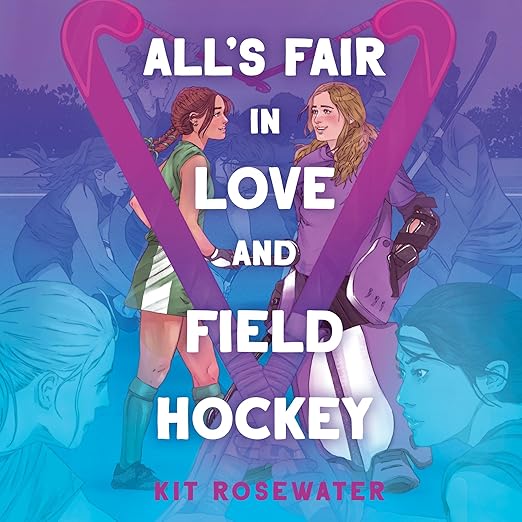
In Brief
- Performance: Dominique Salvacion is well-cast for Evelyn's interiority; she carries the rivals-to-romance transition without telegraphing beats ahead of the prose.
- What it covers: Grief and inherited identity, queer YA romance, sports as family legacy
- Feel: Emotionally layered and warm, with competitive tension underneath
- Our call: A queer YA sports romance that earns its Albertalli blurb by investing in identity and grief rather than just romantic mechanics, with strong narration from Dominique Salvacion.
Field hockey is not a sport that gets much narrative attention in YA fiction, and Kit Rosewater leans into that specificity from the first chapter. This audiobook pulled me in during what I expected to be a low-commitment afternoon listen and ended up claiming most of a weekend. The rivals-to-romance structure is familiar territory, but Rosewater is doing more than the genre usually asks, and Dominique Salvacion's narration makes the difference between a competent genre exercise and something genuinely affecting.
Evelyn was raised inside field hockey the way some people are raised inside religion: the ritual, the lineage, the specific weight of expectation that comes with belonging to a family that excelled before you arrived. Her mother's legacy at their target university is not a source of inspiration so much as a set of coordinates she has been given instead of a personality. When Rosa Alvarez arrives as a new recruit on a rival team and disrupts that trajectory through a series of escalating pranks and counter-moves, the novel's central conflict is not really about field hockey at all. The sport is the language; the argument is about what Evelyn actually wants from her own life.
A Closer Look at All's Fair in Love and Field Hockey
Rosewater handles the enemies-to-lovers structure with enough self-awareness to avoid the usual pitfalls. The truce between Evelyn and Rosa, where they agree to help each other improve their respective weaknesses on the field, is believably motivated rather than contrived. Their early sessions together are written with the specific awkwardness of two people who have invested significant energy in disliking each other and now have to figure out what to do with all that attention. Salvacion voices this transition precisely. She does not rush it toward warmth, and she does not oversell the antagonism during the rivalry phase. The performance finds the authentic beat of each scene without editorializing.
The novel's secondary current, Evelyn's grief over her mother's death and her complicated relationship to the legacy her mother left behind, is handled with more care than the genre typically allocates to emotional backstory. One reviewer notes that the book is 'largely about Evelyn's grief and her trying to work through the tension between what she thought her future should be and what she might want it to be.' That is accurate, and it is also what separates this from a purely sports-romance-flavored experience. Rosewater is writing about inheritance and identity as much as she is writing about field hockey and attraction.
What Makes All's Fair in Love and Field Hockey Worth Hearing
The queer YA romance genre has expanded significantly in recent years, and Rosewater's novel benefits from the comparative context. Becky Albertalli, who offers a blurb calling it 'a masterclass in romantic tension,' is a useful benchmark author. Where Albertalli typically centers the coming-out moment as the narrative engine, Rosewater treats Evelyn's queerness as a given and focuses instead on the specific emotional work of letting someone see you after you have spent years performing a version of yourself designed for someone else's expectations. That is a more interior project, and the audiobook format suits it particularly well because Salvacion can carry that interior register without making it feel like voice-over narration.
The team dynamics receive real attention, which is rarer than it should be in sports YA. The characters around Evelyn and Rosa are distinct and serve the story rather than existing purely as audience surrogates for the central romance. Rosewater brings own-voice experience to the queer representation, which the positive reviews consistently acknowledge. The dynamics feel earned rather than performed, and the sport-specific details give the competition sequences genuine weight rather than generic tournament backdrop.
Things to Know Before Starting All's Fair in Love and Field Hockey
The novel's pacing in the middle section, once the enemies phase ends and the truce is established, slows deliberately to build the emotional intimacy between Evelyn and Rosa. Some listeners will find this immersive; others will find it soft on plot momentum. The sports sequences are specific enough to serve as genuine stakes, but the novel is not primarily a sports story. Listeners who come for field hockey tournament drama and stay for identity crisis will have the right expectations. Listeners who need the plot to be primarily about the sport may want to adjust their approach before starting.
The novel's resolution is tidy in ways that real self-discovery rarely is, and that tidiness is more noticeable in audio, where the final chapters land without the visual closure of a physical book ending. One reviewer flagged some concerns about the authenticity of certain conversational moments around identity. The own-voice element is present and genuine, but the arc toward resolution does compress complexity in the final stretch. Salvacion's narration holds the emotional logic together better than the prose alone might manage at that point.
Who Kit Rosewater Is Writing For
Queer YA readers who want rivals-to-romance with emotional substance rather than just genre mechanics will find this audiobook rewarding. Fans of Albertalli and Jennifer Dugan will recognize the emotional register and find the sports backdrop a welcome piece of specificity. Listeners who loved the team-level writing in Cleat Cute will find comparable attention to ensemble dynamics here, with field hockey as the sport. Listeners who need fast-moving external plot throughout a YA romance may find the middle section slower than they prefer. At just over eight hours, the audiobook is a single-weekend commitment that earns its length through character work rather than event density, with Salvacion's narration providing consistent emotional grounding throughout.