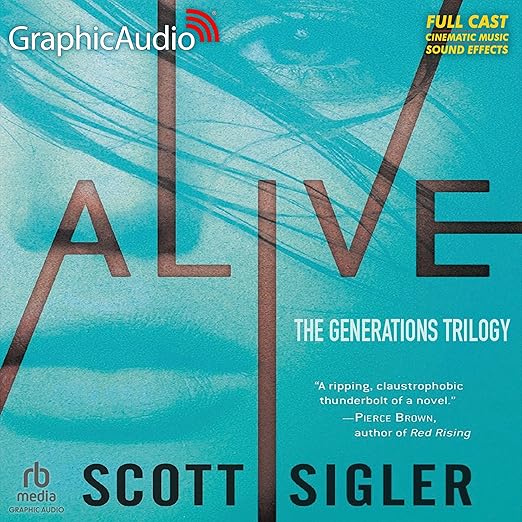
Two things about this audiobook are stated in two different places and do not quite agree. The narrator field says full cast, a format label and not a person. The description, further down, names sixteen: Colleen Delany, Bradley Smith, Elizabeth Jernigan, Michael John Casey, KenYatta Rogers, Alejandro Ruiz, Carolyn Kashner, Michael Glenn, Zeke Alton, Kimberly Gilbert, Lise Bruneau, Dawn Ursula, Terence Aselford, Yasmin Tuazon, Ken Jackson and Nathanial Perry. Sixteen credited performers across six hours and ten minutes is a dramatization, not a reading, and the bracket in the title says so outright. Which of those two credits a buyer sees first is a matter of where the page happens to render them.
For a premise this simple, Scott Sigler wastes almost nothing. A teenage girl wakes in a coffin with no memory of who she is, fights her way out, and finds a room lined with more caskets and a handful of equally confused survivors. Past the room is a corridor of bones and dust and no people. The only fact she owns about herself is a name engraved on the foot of the coffin, M. Savage, and within pages the others have decided she is in charge without anybody explaining why. The description quotes the novel's opening directly, and it is a good advertisement: total darkness, the sound of her own breathing, a head knocking against something solid that turns out to be a lid.
Once the leadership question lands, the book becomes interesting. She is not the biggest or the boldest, and the job in front of her is not survival so much as persuasion: getting a group of strangers to trust one another when none of them can remember a reason to. One reader on this page praises exactly that, calling her believable as somebody who both wants to lead and does not, who makes real mistakes and is not likable at every turn. That is a harder character to write than the genre usually bothers with, and that is what separates this from the chosen-one template the comparison titles on the blurb tend to run on. Leadership here is a burden somebody accepts badly, not a destiny.
Why It Works in Audio
This is the rare case where the format choice is doing structural work. A story about a roomful of amnesiac teenagers, all of them strangers to each other and to themselves, is a nightmare for a single narrator: everyone starts as a voice with no history, and telling them apart is the reader's whole job. Handing each to a different performer solves that in the first ten minutes. GraphicAudio put sixteen names on it, which is enough for the corridor scenes to sound like a crowd instead of one person doing accents. Panic in a group is a sound, and a single reader has to describe it while a cast can simply make it.
If six hours and ten minutes looks short for a novel with this much reputation attached, that is the trade a dramatized adaptation makes. Interior monologue gets cut, description gets carried by performance, and what remains is dialogue and event. For a book built on claustrophobia and immediate physical panic, the compression suits the material. You lose the narrator's reflective passages and you gain pace, which is the correct direction for this particular story. Six hours also puts it inside a single long journey or two evenings, which is an easier ask than most novels of comparable ambition manage.
Weak Spots in Alive [Dramatized Adaptation]
Where the page falls apart is the review column, and it falls apart completely. The adaptation is dated October 2020. Every last one of them was written before it existed: three on the same day in July 2015, one from Germany in June 2017, one from Canada in January 2018. Five years early, then three, then two. None of them can be about this production, and their vocabulary confirms it. One describes finishing in about two days as a fast reader.
The consequence is that a listener gets no information at all about the thing being sold. Sixteen performers, a condensed script, whatever the production does with pacing and atmosphere: unassessed, all of it. What the column does tell you is that the novel worked for people, which is worth something but answers a different question than the one a buyer is asking. Watch the dates before you weigh the stars, because the average is being assembled out of opinions about a different object entirely, one that people were already reviewing five years before this recording existed.
A second oddity sits in the same column. One entry arrives with its formatting tags intact, so the words that were meant to be italic and underlined appear wrapped in raw markup instead. It is cosmetic, but it is the kind of thing that suggests nobody has looked at this page in a while. The star count carries the same signature: one recorded vote, five visible texts, and a displayed 4.2 that a single whole-star rating has no way to produce.
Recommended For
That leaves a recommendation resting on the format and the premise. Listeners who enjoy audio drama, and specifically the multi-voice kind where a script has been staged instead of narrated, will find this an efficient and well-populated example. Anyone who liked the survival-puzzle shape of the books the blurb invokes, the Hunger Games and Divergent and Red Rising, will recognize the machinery immediately, and the cast makes the corridor sequences considerably more alarming than one voice could.
What should give you pause is the same thing that makes it appealing. A dramatized adaptation is an edit, and nothing on this listing tells you how much of the novel survived the cut. Readers who want Sigler's prose will be underserved by a version that necessarily replaces most of it with performance. The trilogy is also unfinished from here, since the listing marks this as the first of three, with no signal on the listing about whether the other two exist in the same staged format.
Listeners buying for a younger audience should note the opening: a girl waking in a coffin, biting a snake to get free, and a corridor full of human remains. The listing shelves this as teen and young adult; the content matches, but the first twenty minutes are genuinely frightening. Six hours buys a fast, loud, claustrophobic ride with no critical record behind it.
Before You Listen
Why do the reviews on this audiobook predate its release?
The production is dated October 2020, and all five visible responses were posted earlier: three in July 2015, one in June 2017 and one in January 2018. They are grading the printed novel. One even mentions finishing in two days as a fast reader, which settles the question.
Is the full cast credit reliable, and who is actually in it?
The narrator field carries only the label, but the description lists sixteen performers by name, including Colleen Delany, KenYatta Rogers, Lise Bruneau and Terence Aselford. That is a cast, not a narrator, and it matters for a story where a roomful of amnesiac strangers all speak in the same opening scene.
Can younger listeners handle this audiobook?
Broadly yes, with the caveat that the opening is harsh: waking trapped in a coffin, biting through a snake to get loose, and a corridor of bones beyond the room. Nothing here is gratuitous, but the first stretch is deliberately terrifying.