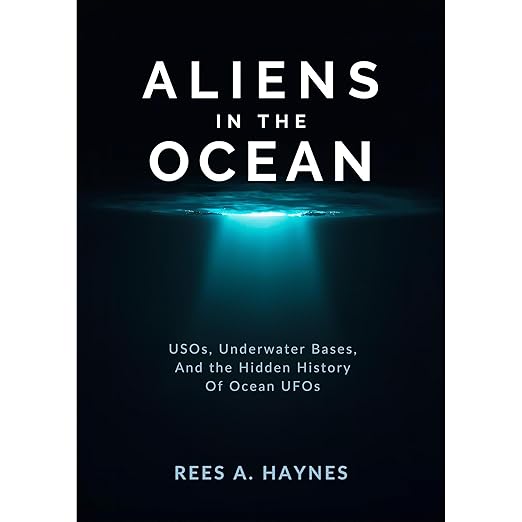
Rees Haynes builds the case downward, and that one decision is what separates this audiobook from the enormous stack of titles about unidentified craft. The argument is that the ocean rather than the sky is where the phenomenon actually lives, and the evidence gathered for it runs from a Navy commander chasing a wingless white object off San Diego in November 2004 to declassified Soviet sonar contacts moving at 230 knots beneath the surface. Two hours and thirty-one minutes is a short span for that much territory, and the compression is both the appeal and the limit. What you get is the shape of an argument rather than the weight of one.
How Aliens In The Ocean Holds Up
Fravor's encounter is the anchor, and the book is right to use it that way. A smooth white object with no wings, no exhaust and no visible means of propulsion; a pilot closing the distance; the thing gone and back on radar sixty miles away seconds later; then thirteen years of Pentagon classification before the footage surfaced. Haynes runs the sequence through the radar operator who first detected it, the pilots who gave chase and the crew members who watched their evidence get confiscated, which is a genuinely good structural choice. The same event from three positions produces a texture that a single narrative pass would flatten, and the Nimitz material is where the writing is at its most controlled.
Octopuses turn up as the most persuasive move in the book. The pitch is that an animal with thirty-three thousand genes, intelligence distributed across eight semi-autonomous arms and the ability to rewrite its own RNA is the nearest working model we have for what an ocean-dwelling intelligence might be. That argument stands whether or not anyone believes a word about craft. It sits beside NASA's Europa Clipper mission, the organic compounds erupting from Saturn's moon Enceladus, and the growing scientific view that ocean worlds may be the most common habitable environments in the universe. The marine biology and the planetary science hold up on their own terms, which is more than this category usually manages.
Where the short runtime earns itself is in the reframing. The closing argument holds that sixty years of listening for radio signals may have been a search in the wrong medium entirely, and it lands because the preceding chapters have done the groundwork: roughly five hundred and fifty times more money goes into exploring space than into exploring our own ocean, and ninety-five percent of the seafloor has never been seen by human eyes. Set against an official acknowledgment that unidentified objects exhibit an ability to submerge into the water, the question stops being whether you believe in visitors and becomes why the search was pointed upward by default. Two and a half hours is well spent on that reversal alone.
Sumer is where the book takes its largest swing. The claim is that myths from ten cultures on six continents describe the same five-element pattern: intelligent aquatic beings who came out of the water, taught humanity the arts of civilization, and went back down. Read generously, that is comparative mythology doing what it does. Read strictly, it is the weakest link in the chain, since a shared pattern across ten traditions is also what you would expect from the fact that most human settlements sat beside water and most of them told stories about it. The parallel arrives with more confidence than the method supports, and a listener who came for the Navy documentation should treat the ancient chapters as a different order of claim.
Weak Spots in Aliens In The Ocean
Synthetic is the answer to the obvious question about the reading. The reader slot on this listing holds a machine credit rather than a person's name, so this recording has no performer behind it. That matters more here than it would in fiction, because the material is thick with figures, place names and acronyms: 230 knots, thirty-three thousand genes, the Nimitz, Enceladus, Europa Clipper, the Fermi Paradox. The description also promises a timeline of major events, a glossary of key terms and a curated further reading list, none of which an audio file can hand you, and the listing carries no note about a companion file of any kind. Whatever apparatus was built for the book, you will be reconstructing it by ear.
Series fields on this listing sit empty while the description signs off by calling this Book 1 in the Aliens in the Ocean series. Both of those cannot be true in any useful sense. A listener who finishes and wants the next installment has nothing on the page to follow: no series name, no number, no companion titles. For a release dated March 2026 that is a discovery failure rather than a cosmetic slip. The shelving compounds it. The listing files the title under religion and spirituality with an Occult tag, while the content is Navy incident reports, declassified sonar records, cephalopod neurology and NASA mission planning. The fields and the copy describe two different books.
The Right Listener for Aliens In The Ocean
Curiosity about the ocean is a better reason to press play than curiosity about aliens. The marine and planetary chapters are the strongest, and they reward a listener with no position at all on unidentified craft: the octopus material, the Europa and Enceladus material, and the spending comparison between space exploration and ocean exploration would all sit comfortably in a straight science title. Anyone following the disclosure story from 2017 through 2026, the whistleblowers, the reporting and the congressional side of it, will find the summary competent and current as of a March 2026 release. Skeptics get a fair hearing on the documented incidents and none at all on the mythology.
Anyone who wants depth should look elsewhere, and the runtime admits it before the content does. Two hours and thirty-one minutes cannot carry ancient Sumer, Soviet submarine records, the Nimitz encounter, cephalopod cognition, two moons of the outer solar system and nine years of disclosure politics at anything other than a gallop. Every section is an introduction to a subject with whole books of its own, which makes this a map rather than a destination, and the promised reading list is where the actual next step lives. Judge it as an orientation to a phenomenon nobody has explained, not as the comprehensive guide the copy claims it to be.
Before You Listen
How long does the Aliens In The Ocean audiobook run?
Two hours and thirty-one minutes, which is brisk for the ground it covers. Slow Burn Pub is the publisher and it went out on March 15, 2026. The reading credit belongs to a synthetic voice, which means no narrator is named anywhere for this title.
Does this audiobook explain what a USO is?
The description bills this as the first comprehensive guide to the USO phenomenon, meaning unidentified submerged objects rather than the aerial kind, It rests the case on an official U.S. government position that such objects can travel underwater, which is the one sentence the rest of the book exists to explain.
Is Aliens In The Ocean suitable for someone with no background in the subject?
Yes, and the short runtime nearly forces it. Every strand arrives as an introduction: Soviet sonar records, the 1982 Lake Baikal case in which military divers reported humanoid beings at depth, cephalopod neurology, and the icy oceans of Europa and Enceladus. No prior reading is assumed anywhere.
Will this audiobook satisfy a listener who wants documented evidence only?
Partly. The documented half is solid, drawing on declassified Soviet Navy records, the classified Nimitz footage and an official government position on objects entering water. The comparative mythology half asks for a different kind of assent, and the copy presents both strands with equal confidence, so you will be sorting them yourself.