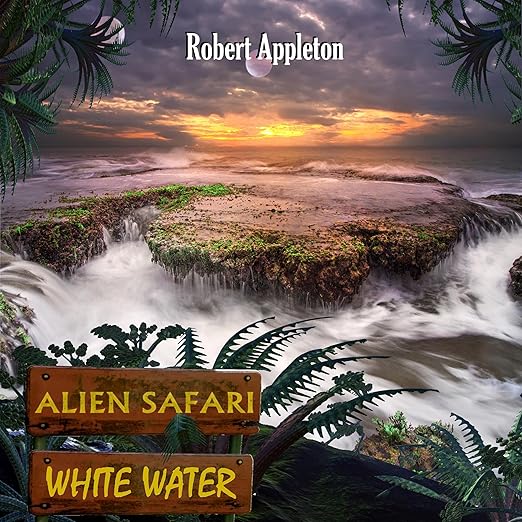
I started White Water on a Saturday afternoon with low expectations, not because I had been disappointed by the first Alien Safari book, but because sequels in fast-paced adventure science fiction have a tendency to repeat their predecessors' pleasures rather than expand them. Robert Appleton surprised me. This is a book that understands what it established in volume one and then deliberately complicates it. The result is eight-plus hours that move at a pace I rarely associate with plotlines this structurally ambitious.
The setup is efficient and quickly charged. Ranger Jan Corbija is running tourist cruises around the aquatic wonders of Hesperidia's islands to fund her scientific research, a quietly resonant detail that tells you something about who she is before the plot begins. Her final White Water tour of the season goes badly when passengers steal her equipment for an unauthorized dive into uncharted depths. What follows triggers a cascade of events that escalates from a bad day at work to something with civilizational stakes. When Jan's dog Stopper jumps overboard to rescue a child swept away in a storm, the story locates its emotional center immediately and does not let go for the next eight hours.
A Closer Look at Alien Safari: White Water
I want to be specific about why the dog works as a narrative device, because it could easily have been sentimental and instead it is structurally essential. Jan's determination to recover Stopper and the child drives every decision she makes, including decisions that put others at risk and raise genuinely uncomfortable questions about proportionality and command authority. Appleton is not interested in easy heroism. Jan's choices have costs.
A reviewer who read the book in one sitting noted not liking where things were going, afraid it would damage the story for the following volumes, and then finding that Appleton resolved it satisfyingly. That is a precise description of what good adventure plotting feels like from inside a story that has earned your investment. The creative tension between going to dark places and finding a way out that does not feel like a cheat is one of the harder things to accomplish in adventure fiction, and Appleton manages it here with evident craft.
While Jan is running her search-and-rescue operation on the water, her detective boyfriend Ferrix Vaughn, who has left a crucial bombing investigation to come to her aid, discovers that something unprecedented has been lost on Hesperidia. A secret from long ago. Something that could change the course of human history. The synopsis is deliberately vague about the specifics, and I will maintain that vagueness here. What I will say is that Appleton connects the two plotlines with more craft than the standard action thriller typically bothers with.
The bombing investigation Vaughn abandons and the ancient secret he discovers share structural DNA in ways that become clear only in retrospect, which is the hallmark of plotting that has been thought through in advance rather than improvised toward a conclusion. That structural thoughtfulness is one of the things that distinguishes this series from the genre's more disposable entries. Reviewers consistently describe Appleton as offering something distinct and original in the science fiction adventure space, and this installment supports that assessment.
Things to Know Before Starting Alien Safari: White Water
Appleton's books are built for audio. They are dialogue-rich, kinetically plotted, and structured around clear escalating sequences that suit the audiobook format's need for sustained momentum. Alex Bhat is well-matched to this material. He handles Jan's urgency in the water sequences with the right acceleration, there is a difference between reading fast and reading urgently, and he knows it. The Vaughn chapters carry a different register of tension (procedural and investigative versus visceral and immediate) and are differentiated in tone without feeling like a different book entirely.
Who Robert Appleton Is Writing For
Listeners who appreciate science fiction that treats its alien world-building with the seriousness of hard SF while keeping the pacing of adventure fiction will find a rare combination here. Hesperidia is not a backdrop; it is a planet with ecology, history, and secrets that matter to the plot in ways that reward attention. The creatures encountered in the deep-sea salvage operation are not generic alien fauna, they are specific to this world's biology and history in ways that Appleton has clearly thought through. Whether or not you are coming to this book from book one, the sense that the world extends beyond what any single story shows you is one of the series' most distinctive qualities, and White Water delivers it with more ambition than the first installment had to accommodate.
White Water functions as a sequel and draws on established character relationships and world-building from book one. New listeners will follow the plot, Appleton provides enough context, but the emotional investment in Jan, Stopper, and Vaughn is considerably deeper with the first book as foundation. For listeners who have finished book one and are wondering whether book two delivers: it does, and then some. The series is clearly planned as an extended sequence with accumulated stakes, and each volume rewards the investment of the previous ones. The eight-hour runtime goes quickly, which is the surest sign that a propulsive adventure audiobook has done its job.
Reviewers who describe Appleton as different enough from the genre's standard output to feel genuinely original are responding to this quality: the sense that the story could have gone in directions it chose not to go, which makes the directions it does take feel like real choices rather than formula. That authorial integrity, present from book one and amplified in book two, is the foundation for whatever this series becomes across its planned subsequent volumes. White Water earns confidence in that future.
Is White Water accessible to listeners who have not read the first Alien Safari book?
It functions as a sequel and draws on established character relationships and world-building. The setting and characters are introduced with enough context to follow the plot, but the emotional investment in Jan, Stopper, and Vaughn is considerably deeper with the first book as foundation. New listeners will follow the story but may feel the relational weight less acutely.
How does Robert Appleton handle the science fiction worldbuilding, is Hesperidia's alien ecosystem developed in detail, or does it remain background?
The alien environment of Hesperidia is integral rather than decorative. The aquatic creatures, the uncharted depths, and the history of the planet are plot-critical in this installment in ways that deepen what was established in book one. Readers who enjoy science fiction with substantive environmental world-building will find this satisfying.
Is there a significant romantic subplot, or is this primarily action and adventure?
The relationship between Jan and Vaughn is present and emotionally important to the story, but this is not romance fiction. The central emotional stakes are Jan's desperate search for Stopper and the child, and Vaughn's role in the parallel investigation. The relationship provides character context rather than driving the plot.
Does White Water end on a cliffhanger, and how many books are planned for the Alien Safari series?
Multiple reviewers reference at least three additional volumes beyond this installment, suggesting the series is planned as an extended sequence. White Water resolves its central crisis while clearly positioning the next volume. Whether that constitutes a cliffhanger depends on your tolerance for open threads; the immediate stakes of this book are addressed satisfyingly.