Quick Take
- Read by: Adam Aleksic narrates his own material with the enthusiasm of someone who genuinely loves the subject.
- At its heart: internet linguistics, algorithmic culture, generational slang
- Vibe: Energetic and current
- Short version: A smart, fast-moving audiobook for anyone curious about why the internet talks the way it does.
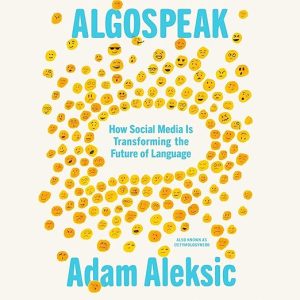
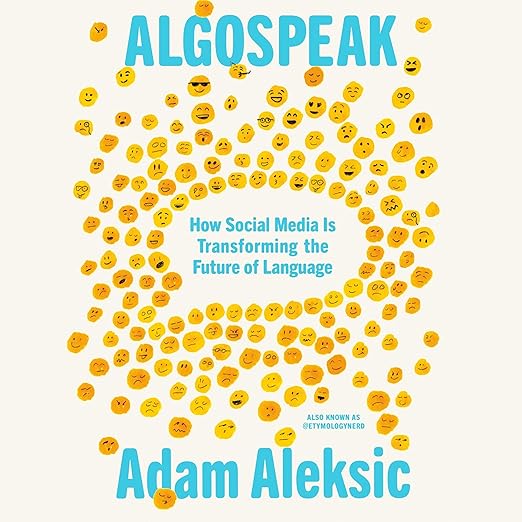
Unalive. My nephew dropped that word into a sentence last spring and I had no idea what he meant, which turns out to be exactly the confusion Adam Aleksic built this audiobook to address. Aleksic, a Harvard-trained linguist better known online as @etymologynerd, spends Algospeak tracing how social media algorithms are actively reshaping the words we use, from brainrot memes and incel slang to the habit of tacking '-core' onto every aesthetic imaginable. He narrates his own material across a brisk five hours and forty-six minutes, moving from emoji etymology to the way TikTok and YouTube shape or erase regional accents, treating the internet less as a place language happens to occur and more as a force actively rewriting it in real time, one trending sound at a time.
Mechanism Over Trivia Is Aleksic's Real Argument
Aleksic's central argument is that we've entered a genuinely new era of etymology, one 'heralded by the invisible forces driving social media algorithms,' and he backs that claim with original surveys, internet archival research, and a working linguist's actual methodology rather than just collecting internet trivia. The specific examples do a lot of the persuading: how 'unalive' emerged as a moderation workaround for discussing death and suicide, how the Spanish 'desvivirse' does similar work, how Taylor Swift fan communities develop their own dialects nearly overnight. Amanda Montell, author of Cultish and The Age of Magical Overthinking, calls Aleksic 'the wise, yet accessible internet linguistics oracle we need,' and that dual identity, credentialed linguist plus fluent internet native, is genuinely what separates this book from a lot of surface-level coverage of online slang.
What keeps the book from feeling like a list of viral vocabulary is Aleksic's insistence on mechanism over trivia: he's less interested in cataloging slang than in explaining why algorithms specifically reward certain linguistic patterns over others, and what that pressure does to language at scale over time. The chapters on grammatical loopholes and sentence structure changes get into genuinely technical linguistic territory without losing the conversational energy that makes the pop-culture examples land. It's a book that respects both halves of its own premise, that language is ancient and structural, and that the internet is actively, measurably changing it, without collapsing into either pure academic distance or pure content-creator hot takes, which is a harder needle to thread than either extreme on its own.
The book also sits usefully alongside a small but growing shelf of internet-linguistics trade nonfiction, and it earns its place there by leaning harder into original data collection, surveys and archival research rather than anecdote alone, than most comparable titles attempt. Where a lot of pop-linguistics writing treats slang as a fun curiosity to be catalogued, Aleksic treats it as a phenomenon with a traceable mechanism behind it, which gives the book a sturdier argumentative spine than its breezy, meme-heavy chapter titles might initially suggest to a browsing listener.
Aleksic Narrates From Inside Internet Culture
Self-narration is close to essential here, since Aleksic's own online persona as @etymologynerd is part of the book's argument, not just its marketing. Andy Kittross's review makes this point directly, noting that Aleksic 'is positioned to understand the landscape like few others' precisely because he occupies both the academic and creator worlds simultaneously, and that his 'engaging style makes the book super interesting.' A hired narrator, however skilled, would be explaining internet culture from the outside; Aleksic is narrating from inside it, and you can hear that difference in how naturally he moves between formal linguistic terminology and the exact slang he's analyzing in the same breath.
Yvonne Divita's review captures the book's real strength honestly: going in expecting straightforward slang trivia and finding 'so much more,' specifically extensive background on how phrases become 'everyday language' through documented mechanisms rather than just vibes. Aleksic's narration carries genuine enthusiasm without ever tipping into performative excitement, which matters for a book that wants to be taken seriously as linguistics even while covering inherently funny, ephemeral internet material. The energy in his voice reads as someone explaining something he finds genuinely fascinating, not someone selling you on why you should find it fascinating too, and that distinction carries the whole runtime.
A genuine audio-specific advantage sits buried in the format choice too: slang is fundamentally a spoken phenomenon before it's a written one, and hearing Aleksic actually pronounce and use the terms he's analyzing, rather than just reading them silently off a page, gives listeners a more accurate sense of how these words actually function in real conversation. For older or less terminally-online listeners specifically, hearing the pronunciation and cadence modeled aloud does real, practical work that text alone can't replicate.
Charts and Emoji Diagrams Won't Reach Audio
Alton's review mentions the book's illustrations directly, noting some 'felt a little low' in quality, particularly the smaller black-and-white images, and it's worth flagging clearly that whatever illustrations and charts exist in the print or ebook edition simply won't carry over to the audiobook at all. Listeners who specifically want the visual reference material, charts tracking slang evolution or emoji etymology diagrams, should consider pairing this listen with the print edition rather than expecting audio alone to cover everything the physical book offers on the page.
The other honest caveat is built into the subject matter itself: a book about fast-moving internet slang risks aging out of date almost as quickly as the trends it describes, and some of the specific examples, however well explained today, will inevitably read as dated within a few years the same way any snapshot of internet culture does. This is also, by design, a relatively short, focused argument rather than a comprehensive linguistic survey, which is a feature for a targeted listen but means it won't function as an exhaustive reference on internet language the way a longer academic text might.
Parents Decoding What Their Kids Actually Say
This audiobook is a strong fit for language nerds, social media culture watchers, and anyone who's ever wondered why their own vocabulary started shifting after too much time on TikTok or Instagram. Parents and older listeners trying to actually understand what their kids are saying, rather than just tolerating it, will find real explanatory value here too, since Aleksic treats the generational language gap as a genuine phenomenon worth explaining rather than something to mock from either side. Students of linguistics or media studies will also appreciate the original research methodology underpinning what could easily have been a lighter, listicle-style treatment of the same material.
Skip this one if you want a comprehensive academic linguistics textbook rather than a focused, creator-savvy trade book, or if internet self-reference and platform-specific examples aren't things you find inherently interesting regardless of the linguistic analysis wrapped around them. Listeners who already follow Aleksic's @etymologynerd content closely should also know that some material here will feel familiar if you've kept up with his social videos, though the book's structure and depth go well beyond what a short-form video can cover on its own.