Quick Take
- Voice: Lyle Blaker delivers the material with the measured authority the subject requires, keeping the policy-dense chapters accessible without undercutting their gravity.
- Big ideas: Military AI arms race, national security policy, the laws of war in the age of autonomous weapons
- Atmosphere: Urgent and sobering, analytically clear
- Worth it?: A rigorous and timely examination of AI's military applications that succeeds because the authors are actual subject-matter experts, not commentators borrowing credibility.
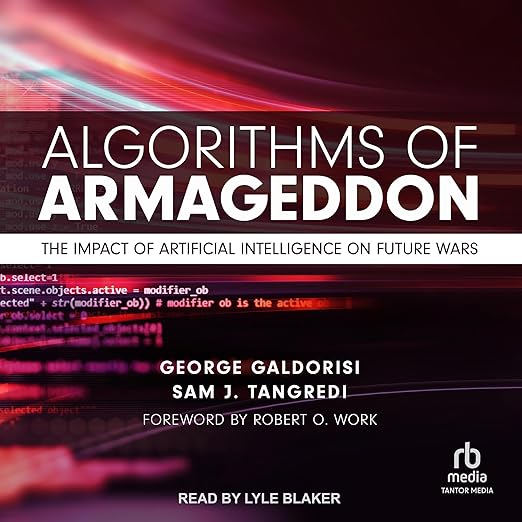
Algorithms of Armageddon enters the conversation about artificial intelligence and national security from a position that distinguishes it from most books in this space: its authors, George Galdorisi and Sam Tangredi, write from deep expertise in military systems and defense policy rather than from the technology journalism or speculative fiction adjacent perspective that dominates popular AI discourse. The result, at seven hours and thirty-eight minutes, is an audiobook that takes the AI arms race seriously as a geopolitical reality rather than a thought experiment, and holds your attention through the kind of specific, documented analysis that vague prognostication cannot match.
The scene that opens the book's argument is not a dramatic one in the cinematic sense; it is a strategic one. Galdorisi and Tangredi begin from the observable fact that China and Russia have made explicit, documented commitments to integrating artificial intelligence into their military systems, sensors, and weapons. They are not describing a future threat but one already in motion. The United States' response to this reality, and the policy failures and bureaucratic delays that have marked it, form the analytical spine of what follows. This is not a book about whether AI will change warfare. It is a book about the consequences of assuming that question is still hypothetical.
The Genie Out of the Bottle Frames Military AI
Reviewer Tom Hanson notes that the book "explains AI by drawing on concepts from history, art and philosophy" in a way that makes it both a primer for those new to understanding AI and engaging for practitioners. That observation captures something important about the book's methodology. Galdorisi and Tangredi do not treat technological literacy as a prerequisite for engagement with the policy arguments. The history of previous arms races, the philosophical debates around autonomous weapons and moral responsibility, and the practical mechanics of how AI is being inserted into weapons systems are handled with the same clarity and without condescension toward the general reader.
The "genie out of the bottle" framing is one of several conceptual anchors the authors use to navigate the debate between those who see military AI as inevitable and those who believe meaningful international governance is still possible. The book does not pretend this is a debate with an easy resolution. The later chapters on the possibility of humans failing to control military AI applications are among the most valuable, because they do not rely on science fiction scenarios but on documented patterns of complex system behavior, decision speed, and the fog of war. The conclusion that the dangers for the United States are real is argued from evidence rather than asserted for effect.
Blaker's Measured Delivery Marks Clear Transitions
Lyle Blaker's narration serves this material well. Policy-dense nonfiction can become an endurance test when the narration is flat or rushed, but Blaker brings a measured, authoritative delivery that fits the gravity of the subject without tipping into the theatrical. The structure of the book, which moves from AI fundamentals through arms race dynamics to the specific implications for U.S. national security, benefits from a narrator who can mark those transitions clearly without artificial urgency.
At just under eight hours, this is a listen calibrated for serious engagement. Bill Putnam's review describing the book as doing "a superb job explaining a complex topic in everyday terms" reflects the genuine pedagogical achievement of making this material accessible without simplifying it. Reviewer Matt S., who describes it as a "revelation" at the intersection of technology and geopolitics, represents the target audience accurately: this is a book for people who want to understand the actual strategic landscape rather than consume alarming headlines about it.
Underappreciated Implications of State AI Weaponization
The book is neither a protest against AI nor a straightforwardly optimistic account of technological progress. Its argument is more specific: that state weaponization of AI is a present reality with underappreciated implications for global stability and U.S. security specifically. Listeners expecting a balanced "both sides" account of whether AI is good or bad will find the framing too focused for that purpose. This is a book with a thesis, and the thesis is that the United States is behind in a race it has not fully acknowledged is underway.
The book's publication date matters for rapidly evolving subject matter. Galdorisi and Tangredi's core arguments about the structural dynamics of AI arms races and the policy failures in U.S. response have proved durable, but specific claims about capabilities, timelines, and geopolitical positioning should be cross-referenced against current reporting. The framework for understanding why authoritarian states move faster on military AI integration than democratic ones, which the book establishes clearly, is a more lasting contribution than any specific capability assessment.
Policymakers Get a Substantial Upgrade From Journalism
This audiobook belongs in the rotation of anyone who wants to understand AI's actual geopolitical stakes rather than its consumer applications. Policymakers, military professionals, defense analysts, and engaged citizens who feel they are getting incomplete information from technology journalism will find this a substantial upgrade. The 4.9 rating across thirty-one reviews reflects genuine enthusiasm from readers who came to the book with background in the subject and found it exceeded their expectations.
Casual technology readers who want a general AI overview or a broader survey of AI ethics will find the focus here too narrow and the policy detail too dense. This is a book about military AI and national security, not about artificial intelligence as a general phenomenon. The authors are direct about this scope, and within it they deliver a level of analytical rigor that is rare in the genre. The "time-critical understanding" the synopsis claims is not marketing language; it reflects the genuine urgency the authors bring to a subject they know from the inside.