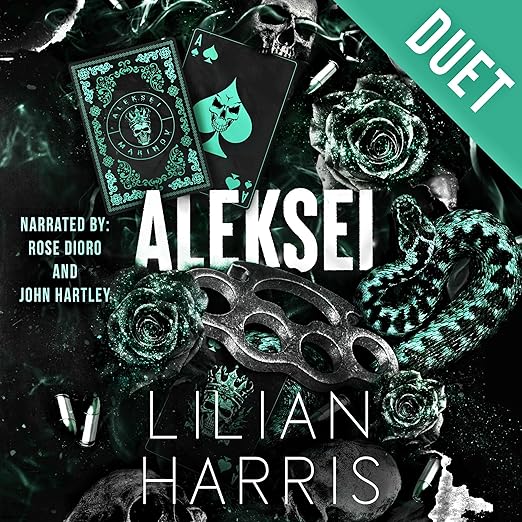
Aleksei Marinov hits the page as the Bratva's most feared killer, cold-blooded, possessed of a brutality that is both his armor and his identity. Lilian Harris's Aleksei is the second book in the Marinov Bratva series and an Amazon Top 40 bestseller, running thirteen hours and ten minutes with Rose Dioro narrating this audiobook. It positions itself as a standalone while drawing on the interconnected Russian mafia world Harris has been building across her Russian romance catalog. The forced marriage premise here operates with more psychological weight than the shorthand of the synopsis suggests, and Harris uses the full length of the story to earn the emotional reversals she is building toward.
Fiona is a lawyer who tried to put Aleksei behind bars. When that effort fails, the consequences fall on her family, and the only path forward is the one she would never have chosen: marriage to the man she has been working to destroy. The dynamic is established cleanly and early. This is not love, Fiona reminds herself repeatedly. It is revenge on his part and survival on hers. Harris uses that hostile intimacy as the foundation for a slow-burn that pulls both characters toward each other against their stated intentions. The moment when Aleksei, who has declared that Fiona means nothing to him, tears the world apart to save her after she is taken, that reversal is where the book stakes its emotional claim.
Harris writes Bratva romance with a consistency that her returning readers specifically praise. One reviewer noted that her stories follow similar themes but feel different enough to stay interesting, which is the defining challenge of writing within a tight genre framework. The interconnected Russian standalone structure means readers arrive with existing investment in the world, but Harris is careful enough with characterization that new readers can orient themselves without prior exposure to the series. Aleksei and Fiona's dynamic is self-contained even as it draws on the broader family context.
Aleksei himself is the central achievement here. A man raised by a cold father who withheld love entirely, he has built himself into an instrument of violence, and Harris tracks how that origin shapes his relationship with Fiona in ways that go beyond the surface-level menace of his reputation. His possessiveness and his brutality are presented not as virtues but as the distorted expressions of a man who has never been shown another way to hold something precious. When Fiona uncovers the truth that threatens to end whatever is forming between them, the book's emotional architecture depends on the reader having genuinely understood both characters rather than simply rooting for them to end up together.
One reviewer described the dynamic as fire and ice, oil and water, noting that when these two finally combine and ignite, it burns the whole world down. That kind of reading response, the physical, visceral investment, is what Harris consistently produces in her Russian standalones, and it is what elevates this above routine category romance.
Dioro Holds Fiona's Contradiction for Thirteen Hours
Rose Dioro's narration is well-cast for this material. Forced marriage dark romance requires a narrator who can hold the contradiction of Fiona's emotional state, the revulsion and the unwilling pull, without collapsing it into simple attraction or simple resistance. Dioro's performance conveys that ambivalence with enough nuance to make the slow-burn credible across thirteen hours. At that length, the audiobook has room to let the relationship develop at a pace that feels earned rather than rushed, and Dioro sustains the tension across the entire duration without the energy flagging in the middle sections.
The heat level is explicit. Harris notes in her author note that content warnings are available on her website, and readers who know the Bratva romance subgenre will have a clear sense of what to expect. The possession and obsession tropes are present and central. What makes the audiobook worth the time for fans of the genre is that Harris uses those tropes as starting points rather than endpoints, the possessive dynamic is complicated by Fiona's discovery and by Aleksei's response to it, which pushes the story beyond the expected arc into something that requires genuine character evolution.
Two Reviews Cannot Yet Support This Rating
The rating of 4.5 comes from only two reviews at the time of this writing, which means it is not statistically meaningful in the way a rating from 200 or 500 readers would be. Listeners should treat it as a preliminary signal. The book's placement as number two in the Marinov Bratva world means some character context from book one is assumed rather than restated, the broader family dynamics and the world's power structure are referenced without full explanation. New-to-series listeners will follow the central romance without difficulty, but some world-building references may feel opaque without prior context.
The synopsis deliberately withholds the truth that Fiona uncovers and the nature of the external threat in order to preserve the story's third-act reversals. Harris is working toward specific emotional beats that land better if you come to them without foreknowledge. Experienced readers of the genre will anticipate the general shape of the resolution, but the texture of the execution is what the book's reputation will ultimately rest on, and that texture is something only the listening itself reveals.
Dioro Guides You Through Genuine Emotional Intensity
Readers already invested in the Marinov Bratva series will want this entry immediately. For readers new to Lilian Harris, Aleksei works as a reasonable entry point if forced marriage and enemies-to-lovers Bratva romance is a genre you actively enjoy. The audiobook is appropriate only for adults, the content is explicit and the violence is genuine, not decorative. Skip it if you find possessive alpha heroes more irritating than compelling, or if you prefer romance subgenres with lower heat levels and faster emotional resolution. Rose Dioro's narration is a reliable guide through thirteen hours of genuine emotional intensity.