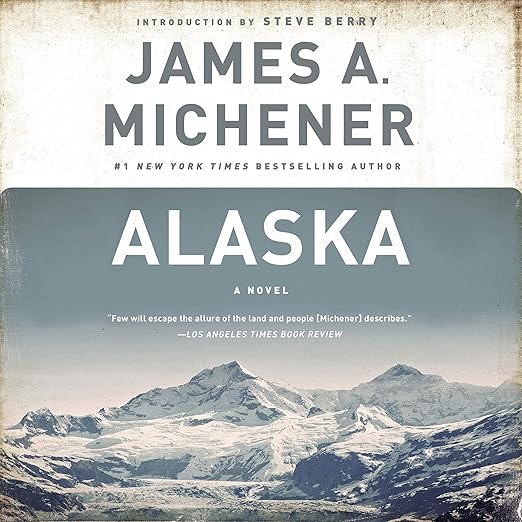
Alaska's story, in James Michener's telling, begins before there were people to tell it, prehistory first, statehood only arriving in the final stretch, and more than a hundred named characters, real and invented, carrying the fifty-seven-hour distance between those two points. This audiobook, narrated by Larry McKeever, is historical fiction in Michener's signature style, the same structural approach he used for Hawaii and Centennial: open with the land itself, then populate it across centuries.
Reviewer SAS describes it exactly this way, 'a vast, time-spanning narrative that compresses millennia into a single sweeping story,' noting Michener 'takes creative liberties to imagine the land's earliest inhabitants' before steadily accelerating toward the present. Fifty-seven hours is an enormous commitment by any standard, and this review treats that scale honestly rather than downplaying it.
What We Made of It
McKeever's job across this runtime is less about any single dramatic scene and more about sustaining a huge, shifting cast without letting a listener lose the thread between eras. Indigenous prehistory, Russian fur traders, gold rush prospectors, and twentieth-century statehood politics each demand a different register, and the novel's more than one hundred characters mean McKeever can't lean on just a handful of voices to anchor the whole listen; consistency across that scale is the real test.
Klapaucjusz's review captures the payoff for sticking with something this long: the book 'left a permanent imprint,' helping the reviewer understand 'Alaska's complicated history and demographics a little better' while still being, in their words, 'a surprisingly fun read all along.' That combination, genuine education plus genuine entertainment, is Michener's whole career case in miniature.
Michener was famous for spending years researching each of his regional epics on location before writing a word, and Alaska carries that same density of accumulated, specific detail, real geography, real historical figures woven alongside invented families, real statehood politics leading up to Alaska joining the union in 1959. That research depth is part of what stretches the runtime to fifty-seven hours; very little of it reads as padding.
The novel's characters, however fictional, are built from real composite research into Alaska's actual settler, indigenous, and immigrant populations across different eras, Russian colonial administrators, Tlingit and Inuit communities, Gold Rush prospectors, oil-boom workers, giving the book's more than one hundred characters a grounded specificity rather than reading as interchangeable historical-fiction archetypes.
Klapaucjusz's specific phrase, that the book left a 'permanent imprint,' is a meaningful claim for a work of historical fiction to earn; it suggests Michener's research-heavy approach succeeds at actually teaching real history alongside the fictional throughline, rather than using history as mere scenic backdrop for an unrelated plot.
Why Alaska Works as an Audiobook
Fra7299's review calls the book 'well researched, impressive historical fiction' and specifically recommends wintertime as the season to tackle it, treating the listen itself as a kind of expedition to match the subject matter. Real logic backs that framing; a fifty-seven-hour commitment benefits from a season with fewer competing demands on a listener's attention.
For listeners who've read other Michener epics, Alaska delivers the expected structural pleasures, geological deep time collapsing into human drama, fictional families intersecting with real historical events, without feeling like a retread of Hawaii or Centennial's specific beats. The setting itself does enough of the differentiating work.
The three attached reviews span a genuinely useful range of listener perspectives, a casual reader, someone with a personal connection to the region, and a self-described marathon-format completist, and all three land firmly positive despite very different starting expectations, which is a reasonably strong signal for a book this demanding.
Michener's structural gamble, spending real time on geological and prehistoric material before any human characters appear at all, pays off specifically in audio; McKeever's steady, unhurried pacing through those early chapters sets a tone of genuine deep time that a reader skimming print might otherwise rush past.
Alaska's statehood in 1959 arrives late in both the book's chronology and its runtime, and Michener's decision to spend the bulk of the novel on the centuries leading up to that moment, rather than rushing toward it, reflects his broader conviction that a place's present only makes sense once its full history is accounted for.
Michener died in 1997, several years after Alaska's 1988 publication, and the novel shows no real drop in ambition or scale this late in his career; listeners tracking his bibliography chronologically will find it standing comfortably alongside his more famous earlier epics rather than reading as a lesser late output.
A Few Reservations
Fra7299 calls this book 'a marathon,' and that word choice is the single most useful piece of practical advice in any of the three attached reviews. This isn't a book to start expecting to finish quickly, and listeners should budget accordingly rather than treating the runtime as a minor inconvenience to push through in a weekend.
McKeever's narration needs to sustain quality across that full fifty-seven hours without fatigue creeping into the performance, a genuinely difficult ask for any narrator regardless of skill. Listeners sensitive to vocal fatigue in extremely long single-narrator productions should sample a later chapter, not just the opening, before committing.
This is not light listening for a distracted commute; the sheer scale of the cast means missing even a short stretch risks losing track of which family line a given chapter has returned to, and listeners should plan for focused, sustained sessions rather than background noise during other tasks.
Listeners who found Hawaii or Centennial's opening geological chapters to be the hardest part to get through should know Alaska's prehistoric opening runs comparably long before the more conventionally novelistic historical fiction begins in earnest.
Should You Listen to Alaska?
Readers who already love Michener's other multi-generational epics, or anyone specifically drawn to Alaska's history and geography, are the clearest audience, especially listeners who enjoy the specific pleasure of watching a place's deep past and recent history connect across a single sustained narrative.
Newcomers to Michener looking for an entry point might consider a shorter title first, Chesapeake or Centennial, before committing fifty-seven hours to Alaska specifically; the payoff here is real, but the investment is not small, and it's worth confirming the style suits you at a smaller scale first.
Listeners who've actually visited Alaska, or who have family history connecting to the state's fishing, oil, or homesteading industries, will likely find an extra layer of personal resonance in how thoroughly Michener researched the specific industries and communities that built the modern state.
- Narration: Larry McKeever sustains a huge, shifting cast across fifty-seven hours without losing consistency between historical eras.
- Themes: Deep time meeting recent history, land and identity, multi-generational fictional families against real events
- Mood: Sweeping, patient, genuinely epic in scale
- Verdict: A massive but rewarding commitment for Michener fans and Alaska history buffs alike, budget real time for it.