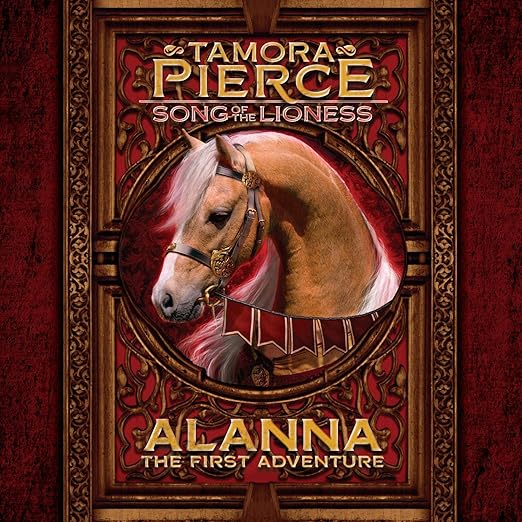
I wish I had found Tamora Pierce when I was ten. That is a sentence I have heard from adult readers across many years of working with books, and it is the sentence I most associate with the Song of the Lioness Quartet. Alanna: The First Adventure was published in 1983, which means it predated the conversation about representation in children's literature by at least a decade, and it handled the conversation better than most books written in the middle of it.
The premise is clean and the execution is efficient: Alanna of Trebond wants to train as a knight. Her twin brother Thom wants to study magic. Their family intends the opposite for each of them. So they switch. Alanna disguises herself as a boy, takes the name Alan, and begins training with the pages in the capital city. The book covers roughly two years of that training, her friendship with Prince Jonathan, her growing skill at combat and at the gift she has for healing magic, and the first stirrings of a conflict with Duke Roger that will take the whole quartet to resolve.
Where This One Lands
Pierce wrote Alanna in the tradition of bildungsroman rather than in the tradition of quest fantasy, which is why the book feels different from most of its genre neighbors despite the medieval-adjacent setting and the sword fights. The story is primarily about who Alanna is becoming rather than about what she is accomplishing. Her stubbornness is not a charming quirk but a core character trait that creates real friction, with her training partners, with her own fears, with the parts of herself she has to suppress to maintain her disguise. Pierce never softens that. She lets Alanna be difficult in the way actual determined people are difficult.
Trini Alvarado's narration dates to 2003 and carries the slightly warmer, more intimate register of audiobook recordings from that era. She is not a showman narrator. She does not reach for dramatic effect in excess of what Pierce's prose invites. For a book this direct in its prose style, that is the correct interpretive choice. Alanna works because Pierce trusts the character and the situation to carry the weight, and Alvarado extends that trust into her narration. The 5-hour runtime is also, at this remove, something of a gift. Pierce wrote tight novels and Alvarado honors that tightness.
Things to Know Before Starting Alanna: The First Adventure
The friendship between Alanna and Prince Jonathan is the emotional center of book one, and it is complicated by the fact that Jonathan does not know who Alanna actually is. Pierce handles the knowledge imbalance with real delicacy. Jonathan likes who he thinks Alan is. His affection is genuine. What that means for the relationship when the truth eventually surfaces is something book one puts in place without resolving, because that resolution belongs to later volumes. Also worth noting is the Duke Roger introduction. He is established as a threat in book one but not yet as a fully dimensional villain. Pierce is patient with him in a way that pays off across the full quartet.
Recommended For
Anyone who grew up on this series and is returning in audio form will find it holds. The values Pierce embedded in Alanna, the insistence that determination and competence matter more than gender convention, are not dated despite the 1983 publication date. They remain, unfortunately, relevant. Younger listeners encountering Pierce for the first time will find the quartet a more formally complete heroine's journey than much of what is being published for them now. Parents who want to introduce their children to the tradition of female heroes in fantasy before the current wave of YA romantasy should start here. The series gets more complex as it continues. This first volume is the cleanest entry point, built precisely for the beginning of a relationship with a character who will stay with you.
Key Details
- Performance: Trini Alvarado's 2003 recording suits Pierce's direct, unadorned prose. She gives Alanna a voice that is earnest and determined without sentimentalizing the character's stubbornness.
- What it covers: Identity claimed rather than assigned, the cost of pretending to be what others expect, female ambition in a world that calls it transgression
- Feel: Brisk and confident, like a coming-of-age story that knows exactly who it is and does not apologize for it
- Our call: One of the foundational texts of the strong female hero in fantasy, and it still holds its charge more than forty years after publication.