Key Details
- Narrator: Tom Brooks delivers the material cleanly and at a professional pace, keeping the step-by-step workflow sections from becoming repetitive.
- Subjects: AI-driven content automation, affiliate income diversification, platform-native selling strategies
- Tone: Practical and forward-leaning, occasionally breathless in its claims
- Bottom line: AI-Powered Affiliate Marketing 2026 is a dense implementation guide dressed as a business book, and whether it works for you depends entirely on whether you want tactics or strategy.
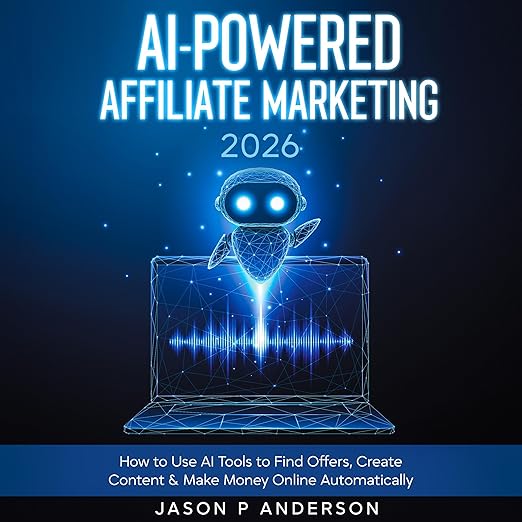
Affiliate marketing sits at a real inflection point right now. The practices that reliably generated passive income five years ago are increasingly outcompeted by algorithm changes, content saturation, and the sheer volume of people running the same playbooks simultaneously. Jason P. Anderson's audiobook, AI-Powered Affiliate Marketing 2026, is a direct response to that saturation problem: his argument is that AI tools have created a new leverage layer that early adopters can exploit before it too becomes the default, and Tom Brooks narrates the 6-hour-and-39-minute implementation guide with the professional clarity the content demands.
This is a book that covers functional ground quickly, from niche research and content engine construction to TikTok Shop strategy, email funnel automation, and what Anderson calls AI agents running your business on autopilot. There is a workflow for each of these components, which is both the book's primary strength and its most significant structural challenge. The modular chapter structure means each section can be revisited independently, but it also means the overall strategic vision can feel like an aggregation of tactics rather than a coherent system.
Beginners Lack the Frame to Tell What Will Date
The core question worth asking about any affiliate marketing guide published in 2026 is whether the specific platforms and tools it names will still be relevant by the time you finish implementing them. Anderson is aware of this problem and writes with a degree of principle-first framing that gives the underlying strategies more durability than a pure tool list would. The sections on niche selection using AI trend analysis and on building authority content rather than thin affiliate pages reflect a strategic intelligence that survives platform shifts better than tactics tied to specific apps.
That said, this audiobook is fundamentally a tactics book. The chapter on TikTok Shop and short-form video AI creatives is specific to a platform and format with real current relevance but uncertain longevity. Listeners who are already operating in affiliate marketing at an intermediate level will get the most from this material, because they have the context to evaluate which recommendations to implement immediately and which to treat as early-mover signals rather than durable infrastructure. Beginners can follow the logic but lack the frame to distinguish between what will hold and what will date quickly.
Brooks Helps Sustain Rhetorical Momentum in Audio
Brooks's narration keeps the density from feeling oppressive, and the absence of visual charts or diagrams is less of an issue here than it would be in a data-heavy investing or science book. The workflows Anderson describes are presented in sequence rather than as visual frameworks requiring parsing, which means the audio format captures them reasonably well. The areas where audio genuinely adds value are the motivation and framing sections, where Anderson builds the case for why the AI-affiliate opportunity window is real and time-sensitive. That kind of argument benefits from rhetorical momentum, which is easier to sustain in audio than on the page.
The more detailed implementation sections, particularly the email funnel and retargeting automation chapters, are the ones where listeners are most likely to want to pause and take notes or return for a second pass. Anderson covers creating multiple income streams for stability and growth, building AI content engines for SEO and authority articles, and using AI agents to automate business functions, and each of those areas is dense enough to warrant dedicated attention rather than a single listening pass. The 6-hour-and-39-minute runtime is well suited to a first orientation that you then revisit by chapter as you implement.
Distinct Categories, Each With Its Own Dynamics
The framing occasionally leans toward urgency for its own sake. Anderson's assertions about what top marketers are doing now are plausible given the industry direction but are not documented with case studies or named examples in a way that allows verification. Listeners who want independent evidence for specific claims will need to seek that elsewhere. There are also no reader reviews in the data at the time of this writing, which means the practical outcomes described in the book remain untested by independent listeners. Early adopters of this audiobook are genuinely early, for better or worse.
The chapter on high-ticket offers and Amazon FBA alongside AI tools covers ground that other audiobooks in the affiliate space treat as separate subjects entirely, and Anderson's compression of all of them into a single strategic framework is ambitious. Some listeners will find that compression clarifying; others will find it makes each topic feel shallower than it deserves. That trade-off is inherent to a book that is trying to be comprehensive within a single volume and a relatively short runtime.
One dimension of this audiobook that deserves separate note is the chapter on choosing high-converting affiliate programs, which covers Amazon FBA, SaaS products, online courses, AI tools, and high-ticket offers as distinct categories with different conversion dynamics. For listeners who are already running affiliate operations in one of those categories, the comparative framing is more useful than a generic introduction would be. Anderson treats these as strategic decisions rather than arbitrary selections, which is one of the stronger analytical contributions the audiobook makes beyond its tactical content.
Strategic Philosophy Seekers Will Be Disappointed
This audiobook suits affiliate marketers who already have a foundational understanding of the space and want to systematically incorporate AI tools into their existing workflows. It also works for people starting from scratch who want a structured framework to build from, provided they are comfortable acting on instructions before seeing independent verification of their results. Those expecting strategic philosophy, historical context about the affiliate marketing industry, or documented case studies will be disappointed. Anderson is interested in implementation, and almost every chapter returns to what you can do this week rather than what it means over the long term.
A Few Questions About AI-Powered Affiliate Marketing 2026
Is this audiobook suitable for someone who has never done affiliate marketing before?
Yes, with realistic expectations. Anderson frames the material for beginners as well as intermediate practitioners, and the step-by-step workflow structure means you can follow the implementation sequence without prior knowledge. Beginners will get more from it by listening once for orientation and then returning to specific chapters as they implement each component.
Does this audiobook cover specific AI tools by name, and how quickly might those recommendations go out of date?
The book does name specific tools and platforms, which is both its practical value and its shelf-life risk. Anderson acknowledges this by framing principles alongside tactics. Listeners in 2026 or beyond should treat specific platform recommendations as starting points for their own research rather than as permanent infrastructure choices.
How does this audiobook compare to other affiliate marketing guides in terms of AI integration?
Most affiliate marketing audiobooks published before 2024 treat AI as a supplementary tool rather than a core operational layer. Anderson builds AI integration into the workflow from the beginning rather than adding it as a single chapter at the end, which is the primary distinction between this guide and earlier entries in the genre.
Is the 6-hour runtime enough to cover all the claimed topics in real depth?
The runtime is sufficient for the overview and framework Anderson provides, but several topics including email funnel automation and advanced AI agents receive introductory rather than deep-dive treatment. Listeners interested in those specific areas will likely want to supplement this audiobook with more focused resources on each subject.