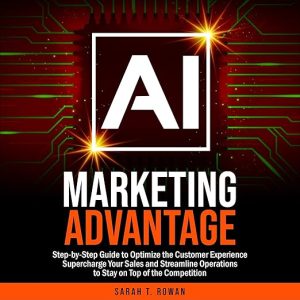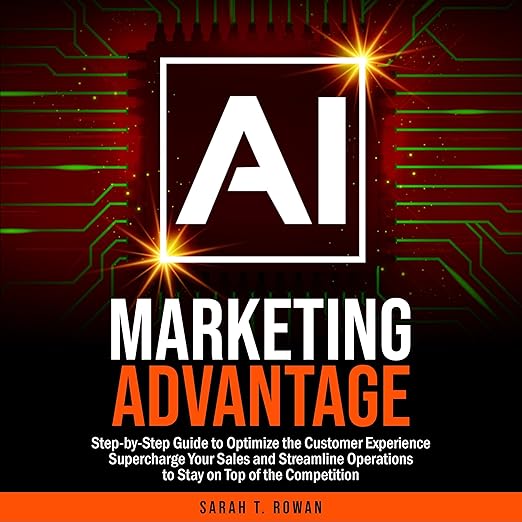
The AI Marketing Advantage audiobook arrives at a moment when most AI business titles fall into one of two categories: breathless hype that will age badly, or tactical prompt lists that are already outdated by the time you finish listening. Sarah T. Rowan's entry in the Build Your AI Advantage skills series does something more durable. It prioritizes system design over tool selection, which means the framework remains useful even as the specific tools evolve underneath it. At four and a half hours, this is the kind of audiobook that rewards a focused afternoon rather than casual background listening, and the pace of Val Caruso's narration makes that focus easy to sustain without losing the thread.
Caruso's narration is a strong fit for the material. The prose is direct and chapter-structured, and Caruso reads with a clean, slightly brisk energy that suits the field-guide format Rowan has chosen. The pacing rarely drags, which matters in a business title that needs to earn its length against the listener's working schedule. The clarity of delivery throughout reflects well on both the writing and the production choices behind this installment in the series.
The central argument of the book is a reframe that readers of marketing literature will recognize: most practitioners are chasing tactics when they should be building systems. Rowan calls the result of random AI adoption a sugar rush of prompts and tools that provides no durable competitive advantage because every competitor is doing the same thing at the same time. The alternative she proposes is what she terms an AI marketing playbook, a repeatable structure that connects goals, customer insight, content production, and measurement into a single coherent workflow that does not collapse when the tooling changes underneath it.
The chapter architecture supports this argument well. Rowan moves from strategic framing into content engine design, then into personalization at scale, then into the sales-marketing feedback loop that most small and mid-sized teams never quite manage to build sustainably. Each chapter includes what one reviewer accurately describes as action steps that build on each other rather than sitting in isolation. The comparison chart of different language models and their specific marketing use cases is a genuinely useful reference, especially for listeners who have defaulted to a single tool without interrogating whether it suits every type of task they assign to it.
The PDF Companion Is the Conversion Mechanism
The PDF companion bundled with this title deserves explicit mention, because it changes the character of the listening experience in meaningful ways. Rowan's text references checklists, worksheets, and prompt templates throughout, and these are not peripheral bonuses. They are the conversion mechanism between the audio argument and actual implementation. Listening to the audiobook without accessing the companion PDF is functional, but you will miss the scaffolding that transforms the advice from conceptual to operational. If you are considering this title in audio format, factor in fifteen minutes after each chapter to open the companion materials and apply what you just heard to your actual marketing situation before moving on.
The section on data, privacy, and responsible AI guardrails is handled with more care than similar titles typically manage. Rowan does not treat compliance as a footnote. She frames it as a trust-building asset, which is both strategically sound and practically useful for anyone working with customer data across email and advertising systems. This framing is what separates a competent practitioner's book from the category of pure hype document that populates most of this subject area currently.
Value Scales Downward From Sophisticated Teams
The book's scope is explicitly small business and growth-oriented teams, and this framing is worth taking seriously before you commit the listening time. Enterprise marketing operations with dedicated data teams and existing automation infrastructure may find the advice foundational rather than novel. The value scales downward: the less systematic your current AI usage, the more you will take from this book. If you are already running multi-channel attribution models with custom AI integrations, the early chapters will feel like review rather than revelation, and your time may be better spent elsewhere.
There is also a pace consideration worth flagging. Rowan covers a significant amount of ground in four and a half hours, which means some chapters move quickly through topics that could sustain a full book on their own. The content engine section, in particular, would benefit from more extended examples and real-world case studies showing the system in action. The structural bones are sound; the depth is compressed by the format's constraints, and listeners who want granular detail on individual topics will need to supplement with more specialized resources. The book is best understood as a strategic orientation that points you toward a direction rather than a step-by-step implementation guide for every scenario.
Caruso Guides Scattered AI Experiments to Strategy
This audiobook is well-suited for marketing professionals who have experimented with AI tools without achieving consistent results, and for small business owners who are trying to move from occasional AI experiments to a coherent strategy with measurable outcomes. Entrepreneurs preparing for a product launch who need a rapid framework will get real value from the companion materials in particular, which provide the operational detail the audio cannot always supply. Skip it if your primary interest is in specific prompt engineering techniques rather than strategic architecture, or if you are already operating at an advanced AI marketing maturity level with established systems in place. For everyone building their AI marketing practice from the ground up, this is a structured, honest, and well-produced starting point that earns its four and a half hours and leaves you with something actionable rather than just inspired.
Questions Listeners Ask
Is this audiobook appropriate for someone with no prior AI marketing experience?
Yes, with one caveat. Rowan assumes basic familiarity with digital marketing concepts like email sequences, conversion tracking, and content calendars, but does not assume any prior AI expertise. The language model comparison chart is particularly useful for listeners who are new to evaluating tools beyond the one or two they already use.
How does this audiobook differ from other AI marketing titles currently available?
Most AI marketing books are prompt collections or case study anthologies. Rowan's distinction is her focus on repeatable systems over one-off tactics. If you have already read a prompt-heavy AI marketing title and found the results did not stick, this framework-first approach offers a meaningfully different angle on the same subject.