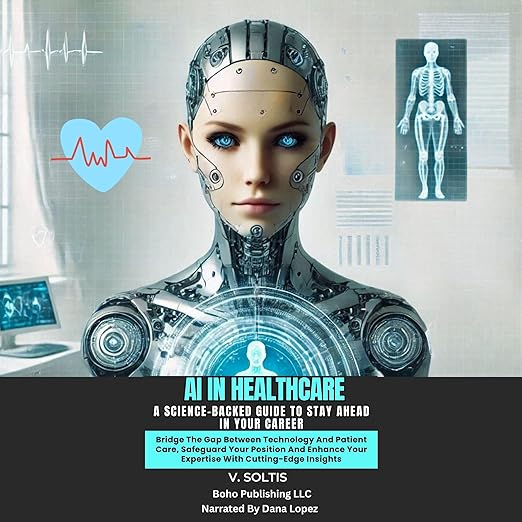
Healthcare professionals are now regularly handed two opposing messages: AI is about to transform everything, and nothing about care should feel impersonal. The tension between those positions is real, and it does not resolve itself just by adopting new software. AI in Healthcare: A Science-Backed Guide to Stay Ahead in Your Career by V Soltis takes that tension seriously, and the audiobook does something valuable by framing AI not as a replacement for clinical judgment but as a tool that can extend what thoughtful practitioners already do. At two hours and fifty minutes, it is compact enough to finish in a single listening session, which suits its function as an orientation guide rather than a comprehensive technical manual.
Dana Lopez narrates with a clean, unhurried clarity that serves the material well. The book's language is deliberately non-technical, aimed at healthcare professionals who need practical orientation rather than engineers who need implementation detail, and Lopez's delivery respects that intent. She keeps the tone informative without tipping into the breathless enthusiasm that mars a lot of AI-adjacent content. Reviewers have noted that the book turns complex technology into something practical and approachable, and Lopez's performance reinforces that quality consistently throughout the recording.
Building Patient Trust in AI-Driven Solutions
The book is structured around specific, actionable content rather than broad philosophical claims about AI's potential. Soltis offers a seven-step framework for integrating AI in clinical settings, five steps for balancing efficiency with human interaction, and material on predictive analytics, AI chatbots in mental health support, and the regulatory landscape. That list sounds like a catalog, but the audiobook format actually works in its favor here: because each section is discrete and focused, you can return to specific passages without having to reconstruct a linear argument. Listener SunBook77 highlighted the section on investment trends as particularly useful for understanding not just the clinical side but the business logic that shapes which AI tools actually reach hospitals and practices.
What Soltis handles better than most writers in this space is the question of patient trust. There is a recurring concern in healthcare AI literature that algorithmic tools will erode the interpersonal dimensions of care that patients value most. Soltis addresses this directly, with material on techniques for building patient trust in AI-driven solutions and on how to identify and address algorithm biases. These are not abstract concerns; they are the actual friction points that determine whether a clinical AI tool gets used or quietly abandoned after an initial rollout. The book treats them with appropriate seriousness rather than dismissing them as technophobia.
Emotional Connection Meets Machine Operational Accuracy
The audiobook format is a reasonable choice for this particular title for a few reasons. Most of the content is conceptual and framework-oriented rather than heavily visual, so the absence of diagrams or charts does not significantly diminish the listening experience. The book is also directly relevant to professionals who spend significant time commuting, doing rounds, or otherwise in motion, and the audio version puts the content into those gaps in the workday. Reviewer Dennis J noted that the book's combination of human emotional connection with machine operational accuracy was the most valuable takeaway, and that kind of conceptual reorientation is well-suited to the listening format, where you have time to let an idea settle rather than immediately moving to the next paragraph on a page.
The runtime of under three hours also means this audiobook can serve as a preparatory listen before a team meeting, a conference, or a technology evaluation process. It is not a substitute for deeper technical training, and Soltis does not pretend otherwise. What it provides is conceptual fluency: the ability to engage with AI discussions in your institution without feeling perpetually behind. For clinical professionals who were not trained in computer science or data science, that fluency is genuinely useful and hard to acquire from material that assumes too much background knowledge.
Virtual Health Assistants Get Only a Few Minutes
A few calibrations. At two hours and fifty minutes, the audiobook is necessarily broad rather than deep. It covers a wide range of topics, from virtual health assistants to AI vendor selection criteria to mental health chatbots, and this breadth means each subject receives only a few minutes of attention. Listeners who are already working directly on AI implementation projects, or who have a technical background, will find the treatment too introductory to serve their specific needs. The book is most useful as an orientation layer, not a reference guide. Similarly, the regulatory landscape for AI in healthcare shifts quickly, and some of the compliance guidance may evolve faster than any print or audio resource can track. Treat that material as a starting framework rather than current legal advice.
Reviewer Anne Frances Caraang described the book as clear and relevant especially for professionals wanting to stay current, which accurately captures its primary value proposition. It works as a confidence-building exercise for healthcare professionals who need to participate in AI conversations at their institutions without having the time or background to read technical literature. For that audience specifically, this audiobook delivers what it promises.
Clinical Professionals Over Healthcare IT Specialists
Clinical professionals, healthcare administrators, and anyone working at the intersection of patient care and technology who wants a clear, jargon-light introduction to AI tools will find this audiobook useful. It is also well-suited to medical students and residents who want to understand the technology landscape they will be entering. Technical professionals in healthcare IT will likely find it too introductory for their purposes. Listeners who want deep regulatory analysis, specific product comparisons, or implementation-level technical guidance should look elsewhere; this audiobook's strength is breadth and accessibility, not technical depth.
Frequently Asked Questions
Does the audiobook cover AI regulation and privacy compliance in healthcare?
Yes. The book includes material on navigating complex regulations, complying with privacy laws, and selecting AI vendors with appropriate ethical and regulatory standards in mind. Given how quickly this space changes, treat the regulatory content as an orientation framework rather than current legal guidance.
At under three hours, does this audiobook cover enough ground to be genuinely useful?
It covers ground broadly rather than deeply, which is appropriate for its intended audience. You will come away with conceptual fluency across topics including virtual health assistants, predictive analytics, patient trust, algorithm bias, and AI in mental health support. For professionals who need a solid orientation before a more specialized deep-dive, the runtime is an asset rather than a limitation.