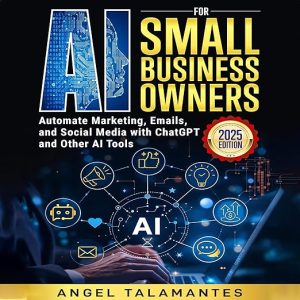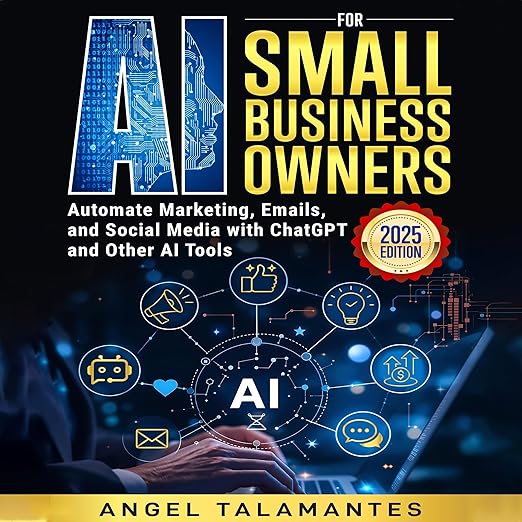
Running a small business in 2025 raises a version of this question for nearly every owner: how much of what I am currently doing manually could an AI tool handle more efficiently? The gap between understanding that AI exists and knowing which tools to trust, which workflows to automate first, and how to avoid building a fragile tech stack that collapses under real business pressure is where most entrepreneurs get stuck. This audiobook, narrated with crisp professionalism by John Wilkinson, attempts to close that gap with a practical 90-day roadmap rather than a theoretical survey of what artificial intelligence can do in the abstract. The practical framing distinguishes it from a crowded field of AI books aimed at business owners who want inspiration but receive very little implementation guidance.
Angel Talamantes wrote this as part of his AI Business Blueprint Series, and the framing reflects that context. This is not a book about understanding AI from a technical perspective. It is explicitly aimed at small business owners, solopreneurs, and local operators who want to automate marketing, email, and social media without learning to code. The 2025 edition positioning matters: the tool recommendations, including ChatGPT, Canva, Zapier, and Midjourney, reflect a specific moment in a fast-moving landscape, and some of those recommendations will age faster than the workflow logic that surrounds them.
Wilkinson's Steady Voice Carries a 90-Day Plan
John Wilkinson's narration is one of the genuinely strong assets of this audiobook. He delivers instructional content with the kind of unhurried authority that makes technical guidance easier to absorb, and he handles tool names and workflow descriptions without the stilted delivery that sometimes accompanies narrators less familiar with business and technology material. For a five-and-a-half-hour listen that covers automation blueprints, content creation workflows, AI chatbot setup, and analytics dashboards, a steady narration voice matters more than it would for a shorter title. Wilkinson provides that steadiness throughout, and his pacing through the more complex automation sequences gives the listener time to mentally map the steps before the chapter moves on.
The content itself is organized around concrete outcomes. The 90-day action plan structure gives the material a project management quality that business owners tend to respond to well: here is what you do in the first thirty days, here is what you add in days thirty through sixty, here is how you evaluate and optimize in the final thirty-day stretch. That structure also means the audiobook doubles as a planning reference. Listeners who take notes or listen with a notepad open will get more from the experience than those who treat it as background audio. The included prompt templates and automation blueprints referenced throughout the text are supplementary resources that reinforce the audio content between sessions.
Cognitive Preview Before You Touch a Keyboard
The strongest case for this audiobook over its print equivalent is that the workflow descriptions and step-by-step sequences are genuinely easier to follow when spoken aloud at a comfortable pace than when read in list form on a page. Wilkinson moves through the Zapier automation blueprints and ChatGPT prompt sequences in a way that lets you mentally map the steps before you sit down to implement them. That cognitive preview function is underrated in instructional audio: you absorb the logic of a process aurally before your hands touch a keyboard, which tends to make actual implementation faster and less error-prone.
The tool coverage is broad without being shallow on what matters most. ChatGPT gets the most sustained attention, with dedicated treatment of prompt engineering for marketing copy, email campaigns, and customer service scripts. Zapier's automation logic gets meaningful space. Midjourney and Canva appear in the content creation sections with enough practical context to be actionable immediately. The ethics and compliance section near the end of the audiobook is brief but genuinely useful, covering data privacy considerations, AI disclosure requirements, and responsible deployment in ways that many similar guides skip entirely, which is an omission that can create real business risk.
Setting Up Zapier Still Needs a Screen
This audiobook is firmly entry-level. Business owners who already have AI tools in their workflows and are looking for advanced automation architecture or technical depth will find the content introductory. The 2025 edition positioning also means some specific tool recommendations may already be outdated or superseded. The core workflow logic remains useful even when particular tools change, but listeners should approach tool-specific guidance with the understanding that the AI software landscape shifts frequently enough to require regular updating of any implementation plan built on this foundation.
One limitation worth naming is that the audiobook format, for all its strengths in narrative and concept delivery, is less ideal for the hands-on technical content. Setting up a Zapier automation or configuring a ChatGPT-powered autoresponder is the kind of task that benefits from seeing a screen. The audio serves as a strong primer and planning tool, but actually implementing the workflows will require sitting in front of the tools themselves. That is not a flaw in the audiobook so much as a structural reality of translating technical how-to content into audio form, and Wilkinson navigates it as well as the format allows.
Overwhelmed Business Owners Get a Structured Start
This audiobook is well matched to small business owners, freelancers, and solopreneurs who feel overwhelmed by AI's pace of change and want a structured starting point rather than a scattered collection of tips from blog posts and YouTube videos. If you have heard about ChatGPT and Zapier but have not yet built a coherent workflow around either tool, the 90-day framework here will give you a usable plan with enough specificity to actually execute against. Listeners who absorb process information well through audio will get particular value from Wilkinson's delivery. Skip it if you are already running mature AI workflows, if you need deep technical implementation guidance, or if you are primarily interested in AI from an academic or strategic perspective rather than an operational one.
Before You Press Play
- Narrator: John Wilkinson delivers with steady professional authority; his unhurried pacing makes complex workflow descriptions and tool sequences consistently easy to follow.
- Subjects: AI automation for small business, ChatGPT and no-code tools, 90-day implementation frameworks
- Tone: Practical and accessible, optimistic without veering into tech-hype territory
- Bottom line: A well-narrated, entry-level guide to AI business automation that gives small business owners a concrete 90-day roadmap without requiring any technical background.
A Few Questions About AI for Small Business Owners
How does John Wilkinson's narration handle the technical content in this audiobook?
Wilkinson narrates the technical workflow and tool description sections with clear, unhurried delivery that makes the step-by-step guidance accessible. His pacing and authority are consistent across the full five-hour-plus audiobook runtime.
Will the tool recommendations in this audiobook still be relevant given how quickly AI changes?
Core tools like ChatGPT, Zapier, and Canva are widely established and will remain relevant for the near term, though their features evolve. Listeners should treat specific version-level guidance as a starting point and check current documentation for any tool they plan to implement. The 90-day workflow framework holds up regardless of specific tool updates.