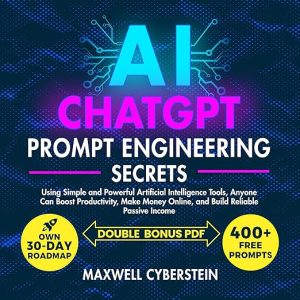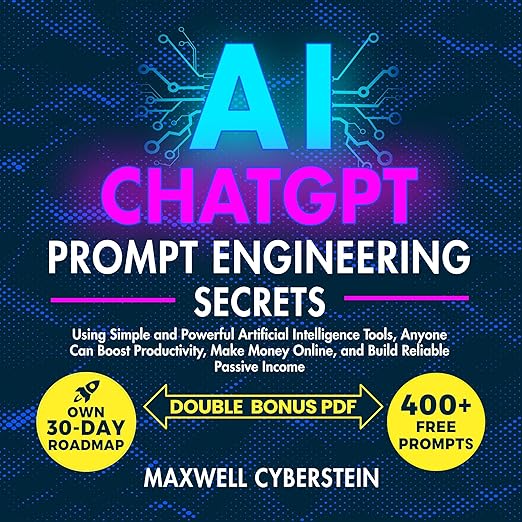
Prompt engineering is a subject that fights the audiobook format harder than almost anything else I cover. The discipline lives inside text you type into a box, where the placement of one clause changes what comes back, and here it arrives as two hours and three minutes of speech read by Millian Quintero. Maxwell Cyberstein self-published this one in June 2025, with the same name in the publisher field as on the byline, and the listing pairs the audio with a companion PDF. Ten people have rated it and the average sits at a flat five. None of them wrote a sentence explaining why.
Quintero Faces a Text That Must Become Sound
Two things that titles in this corner usually blur get separated in the publisher's summary. One is the craft of writing a prompt that returns something usable on the first attempt. The other is a way of relating to the tool, put as learning to think with it, build with it and grow with it rather than merely talk to it. Cyberstein aims that at entrepreneurs, marketers and freelancers, then widens the target to anyone who wants to save time and work with more clarity. Two hours is a scope decision rather than an accident.
Underneath the adjectives sits a list, and the list rewards far more attention than they do: how to craft prompts that produce high-quality content, the most common mistakes people make and how to avoid them, examples of entrepreneurs and creators scaling with ChatGPT, strategies covering content creation, marketing, automation and customer engagement, ethical considerations aimed at protecting your ideas and your brand integrity, and the tools and communities meant to support you after the last chapter. Six areas, one short book. Expect a pass over each rather than a long stay in any.
Millian Quintero is the credited narrator, and the production problem in front of that reader is one nobody handling this material can dodge: a prompt is a piece of formatted text, and formatted text has to become sound. Line breaks, bracketed variables and the exact wording of an instruction all need to survive the conversion, which is presumably why a PDF ships alongside the recording at all. Sample before you commit, and sample a passage where an actual prompt gets spoken rather than a passage of general encouragement, because that is where this format either works for you or does not.
A Reading List Outlasts Any Single Technique
Brevity is the strongest argument on the page. Most of what gets published about prompting is either a short blog post or a technical volume written for engineers, and a book that fits inside a couple of commutes occupies a gap that genuinely exists. If your working knowledge of ChatGPT currently stops at asking it questions and hoping, an orientation this compact costs very little to try.
Ethics is the item on that contents list I would not have predicted. Protecting your ideas, your voice and your brand integrity is a live practical concern for a freelancer feeding client material into a chat window, and it usually gets a single apologetic paragraph in books that would rather sell you speed. Giving it a named place in the outline is a small sign that the author thought about the person doing the work and not only about the output.
Another quiet asset is the closing promise of tools and communities that outlast the book itself. Anything written about this software in 2025 will be partly wrong by the time you hear it, and an author who points you toward where the conversation carries on has at least admitted as much. A reading list is worth more than a technique in a field moving this fast, and the companion PDF is the first place I would go looking for one.
Nobody Disappointed Enough to Grade It Down
Begin with the number that is missing. Ten ratings, a five-star average and an empty review field add up to a page carrying no testimony whatsoever. A perfect score across ten people tells you that nobody has been disappointed enough to grade it down, and it tells you nothing else at all. You cannot learn from this listing whether the worked examples land, whether the reading suits your ear, or whether a buyer felt the evening was well spent. Anyone who wants corroboration before pressing play should know that none is on offer.
Dating is the second caution. June 2025 is recent enough to be useful and old enough to matter on this particular subject, and any specific instruction about what a model will or will not agree to do is the part of a book like this that spoils first. Framework advice about clarity, context and iteration outlasts the software; the worked examples do not. Listen for the first and treat the second as illustration rather than as instruction.
Last, weigh the register of the marketing before you decide. The summary closes on a direct instruction to buy and a promise that your AI-powered future starts today, which is the voice of a landing page rather than of a manual. That is not automatically a mark against the content. It does set an expectation about how the pages will sound out loud, and a listener who bristles at motivational framing should sample for that reason as much as for any other.
A Manager Just Wants Shared Vocabulary Here
Daily ChatGPT users who were never taught a thing about the tool are the target here: the small-business owner writing their own marketing copy, the freelancer tired of rewriting the same request five times before it works, the marketer whose team has started asking questions nobody on it can answer yet. One framework, no jargon, a couple of drives to work. That is a fair trade. It also serves the manager who has to supervise people already using these tools and wants enough shared vocabulary to ask a useful question, which is a different need from writing the prompts yourself and is rarely addressed anywhere.
Pass on it if you already build structured prompts with system instructions and worked examples, because an introduction has nothing to hand you. The same goes if what you actually want is a library to copy from, since a copy-paste resource belongs on a screen and the PDF here is a workaround rather than a design. And if you buy on the strength of other people's accounts, hold off: ten ratings and a blank review field leave you nothing to weigh.
Does an audiobook really work for a subject built around text you type?
Partly. The reasoning behind a good prompt, the common mistakes and the ethical questions all travel well as speech. The prompts themselves do not, because line breaks and bracketed variables have to be spoken rather than seen. That is why the companion PDF matters more here than on most business titles.
What does the companion PDF add to the audiobook?
The listing states that a PDF accompanies the audio. On a title whose central content is formatted text, that document is where prompt templates, example structures and any recommended tools would sensibly live. Treat it as part of the product rather than as a bonus, and download it before you start listening.
Is a five-star average from ten ratings worth trusting?
Treat it as a weak signal. Ten graders agreeing means nobody felt let down enough to mark it lower, which is genuinely something. With no written reviews at all on the page, you get no account of what worked, for whom, or at what level of prior knowledge, so the score carries the whole burden.