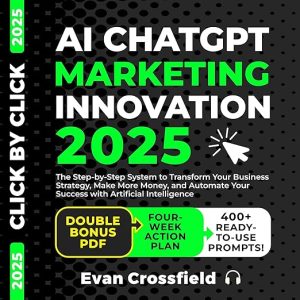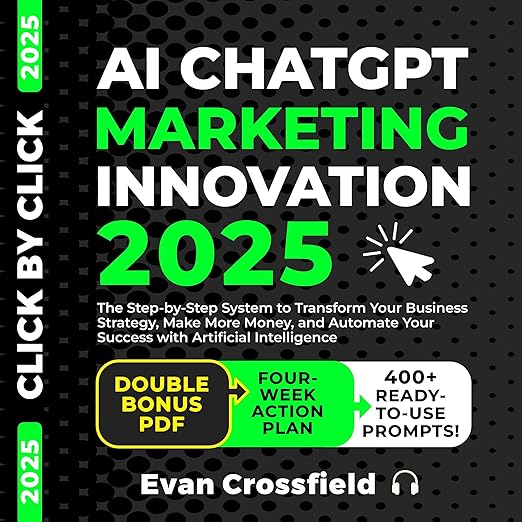
Evan Crossfield promises an unfair advantage in this third entry of his Click by Click series, and the pitch arrives at full volume from the opening minutes of the audiobook. Automate eighty percent of your marketing tasks, double your results in thirty days, outperform human copywriters by three hundred percent: the claims stack up fast across three hours and thirty-eight minutes, and narrator Millian Quinteros reads every one of them in a composed, corporate-training register that never tips into the breathless energy the text itself is reaching for. That gap between delivery and copy turns out to be the most interesting thing about the listen.
The Checklist Alone Has Real Starting Value
Strip away the superlatives and a genuinely broad instructional outline sits underneath: email automation sequences, social media content systems, ad copy formulas, automated customer service handling, SEO content workflows, lead generation setup, sales funnel testing, and competitor research, all reframed through prompting large language models rather than doing each task by hand. For a solopreneur or small business owner who has never systematically used AI for any of this, the checklist alone has value as a starting map of where automation could plausibly help.
The title itself is worth a note, since the book's own synopsis text refers to itself internally as 'AI ChatGPT Marketing Mastery' even though the listing title reads AI CATGPT MARKETING INNOVATION 2025, an apparent rebrand or renamed edition within Crossfield's catalog. It does not affect the content, but it is worth knowing before you search for it again later.
An Apparent Rebrand Hiding Inside the Synopsis
The competitive intelligence chapter is one of the more genuinely useful modules, walking through how to have an AI model synthesize a rival's publicly available marketing footprint into a digestible strategy summary rather than manually combing through a competitor's social feeds and website copy by hand. It is a real time-saver for a task most small business owners currently skip entirely because it's tedious, even if the module doesn't quite live up to its cover promise to 'reveal your rivals' strategies.'
The lead generation and sales funnel chapters work through a specific loop: using AI to draft outreach sequences, then testing variations against each other automatically rather than manually split-testing subject lines and calls to action by hand. It's a genuinely practical application of the technology, and one of the few places in the book where the promised automation matches what current AI tools can actually deliver without much operator babysitting.
Quinteros Has Become a House Style for Hype
Millian Quinteros is the reason to give this a chance despite the marketing-copy excess. His delivery stays composed through lines that would tempt a lot of narrators into either irony or forced enthusiasm, reading phrases like 'your unfair advantage in the AI revolution' with the same even, instructional pace he'd use for a tax form. That restraint keeps the listening experience closer to a business seminar than an infomercial, which matters a great deal for a book this dependent on hype language to sell its premise.
Structurally, Crossfield organizes the material into clearly separable modules rather than one continuous argument, which suits audio: a listener commuting can drop into the social media chapter one day and the sales funnel chapter the next without losing much continuity, since each topic largely stands on its own.
Millian Quinteros turns up across a cluster of similarly styled self-published AI business guides, and that recurring presence is worth knowing if you listen to more than one title in this specific corner of the audiobook catalog: his composed delivery has become something like a house style for hype-heavy AI entrepreneurship content, and it works because he never breaks character into either parody or genuine excitement.
The synopsis pitches this at solopreneurs, small business owners, and marketing professionals alike, though in practice the material is calibrated most usefully for the first two groups. A marketing professional already embedded in a company with existing tools and workflows will recognize most of these tactics already; a solopreneur juggling every function alone is the listener who stands to save the most real time.
Fifty Perfect Ratings, Not One Written Word
No reviews are attached to this listing yet, only fifty ratings averaging a perfect five, which means no listener testimony exists yet to check the boldest claims against, like the three-hundred-percent copywriting improvement figure. Treat any number that specific as a marketing flourish rather than a measured result, and judge the book instead on whether its actual strategies make sense for your business, not on the promised multipliers.
Two of the advertised bonuses, a four-week plan and a four-hundred-plus prompt library, arrive as companion PDFs rather than audio content, so listeners who want the complete package will need to be at a computer at some point rather than absorbing everything through headphones alone. And because this is book three in the Click by Click series, some framing assumes familiarity with Crossfield's earlier AI business titles, though the content here is specific enough to marketing that a newcomer will not be lost.
Take the claim that AI content can 'rank number one on Google without the guesswork' as a useful example of where to apply skepticism. Search ranking depends on far more than the words in a piece of content, including site authority, backlinks, and competition in a given niche, none of which an AI prompt alone can manufacture. Crossfield's actual SEO chapter is more measured than that cover-level claim suggests, focused on using AI to speed up keyword research and drafting rather than promising guaranteed rankings, but a listener skimming past that nuance could walk away with unrealistic expectations.
The Module Structure Doubles as a To-Do List
Solopreneurs and small business owners who have dabbled with AI tools but never organized their use into a repeatable system will get the most out of this, particularly anyone already comfortable with the idea of prompting a chatbot and looking for a structured checklist across marketing functions rather than a single trick.
It's also a reasonable pickup for anyone who has specifically felt overwhelmed trying to figure out where to even start automating marketing work, since the module structure doubles as a prioritized to-do list rather than a wall of undifferentiated tips.
Marketing professionals at larger organizations with existing automation stacks will likely find the material too introductory to justify the runtime, and readers allergic to hype-driven business copy should know that the sales language runs thick even when the underlying advice is reasonable. Anyone who wants their business audiobooks anchored in verifiable case studies rather than promised percentages should sample a chapter before committing.
Does this audiobook require familiarity with the earlier Click by Click books?
No. It is billed as book three in Evan Crossfield's Click by Click series, but the marketing-specific content stands on its own without assuming you have listened to the previous entries.
Are the bonus materials mentioned in the audiobook description included in the audio itself?
Not entirely. The four-week plan and the prompt library are delivered as companion PDFs alongside the audio rather than narrated content, so getting full value means pairing the listen with those files separately.
How does narrator Millian Quinteros handle the audiobook's heavy sales language?
Evenly. He reads hyperbolic lines in the same composed, corporate-training tone throughout rather than leaning into the hype, which keeps the listening experience calmer than the text on its own would suggest.
Is there listener feedback available for this audiobook beyond the star rating?
Not yet. The listing shows fifty ratings averaging five stars but no written reviews, so there is no detailed listener testimony to weigh against the book's more ambitious claims.