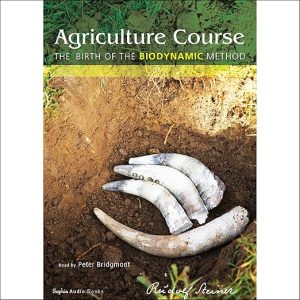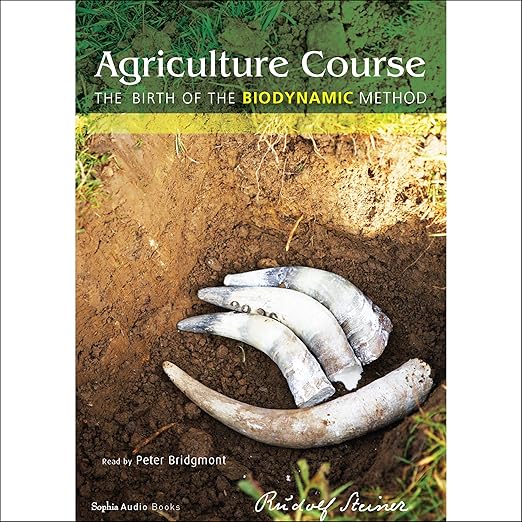
Somewhere between my third and fourth listen to these lectures, sitting outside with coffee on a cool morning as one reviewer wisely recommended, I started to understand why Rudolf Steiner's Agriculture Course has maintained its influence for a century while most farming manuals from the 1920s have been forgotten. It is not because Steiner's prescriptions are straightforward or even fully verifiable by conventional agricultural science. It is because the book does something that almost no farming guide attempts: it asks the listener to consider soil, plants, animals, and human beings as part of a single living system that extends from the earth's microbial communities to the movements of the planets. Whether you follow him all the way to that conclusion or not, the scale of the question is bracing.
These eight lectures were delivered in 1924 to a group of farmers in Koberwitz, in what is now Poland. Steiner had been asked by a group of agriculturalists concerned about the declining quality of food and the increasing dependence on synthetic fertilizers that industrial farming was imposing. Industrial agriculture was ascendant, organic methods were being dismissed as unscientific, and the farmers who approached Steiner were looking for a coherent alternative grounded in something deeper than nostalgia for pre-industrial practices. What Steiner gave them was both more practical and more philosophically challenging than they may have anticipated.
Century-Tested Preparations, Wrapped in Anthroposophy
The book operates on two registers simultaneously, and the listener needs to hold both. On one level, Steiner is making specific practical recommendations: particular preparations for the soil made from plant materials packed in animal organs, planting calendars tied to lunar and cosmic cycles, approaches to composting that integrate the farm as a living organism. These recommendations have been tested, refined, and adopted by practitioners for nearly a century. The biodynamic movement now encompasses thousands of farms and vineyards worldwide, including some of the most celebrated wine producers in France, as one reviewer noted. The wines, the cheese, the vegetables from certified biodynamic operations have a reputation that extends well beyond committed Steinerians.
On the other level, the book is rooted in Anthroposophy, Steiner's spiritual science, and his cosmological understanding of the relationships between the planets, the elemental beings he describes as working within the soil, and the life forces he sees animating organic matter. Some of this language is accessible as metaphor even to secular readers; some of it requires genuine openness to Steiner's philosophical system to be meaningful at all. One reviewer said honestly that they did not agree with everything in the book but found surprising nuggets of wisdom regardless, and that seems to me like the right posture for listeners approaching this for the first time.
Bridgmont's Speech-Teacher Cadence, Kept Fully Unabridged
Peter Bridgmont, described in the liner notes as an actor and speech teacher, is an ideal narrator for this material. These are lectures, not essays, and Bridgmont reads them with the cadence of spoken instruction rather than written text, which is the appropriate register. His delivery is measured and unhurried, which is what Steiner's frequently complex sentences require. There is a warmth in Bridgmont's voice that keeps even the most abstruse passages from feeling cold or inaccessible, and at ten hours and forty-six minutes, that quality matters.
The audiobook is complete and unabridged, which matters for a foundational text like this one. Abridged versions of Steiner inevitably lose context that makes the remaining passages harder to understand, since his arguments build on one another across the lecture series in ways that are not always obvious until you've heard the whole arc.
Missing Scaffolding for Newcomers, Solved by Study Groups
Listeners with no prior exposure to Steiner or Anthroposophy may find the early lectures particularly challenging. Steiner assumes some familiarity with his broader philosophical framework, and certain concepts, the etheric body, elemental beings, the role of silica and calcium in mediating cosmic forces, arrive without the extensive scaffolding a newcomer might want. One approach, recommended by readers who have worked through the book with study groups, is to listen through once for overall orientation and then return to specific sections with secondary literature. John Paull's commentary and other Steiner study guides can be useful companions.
The study group recommendation is worth taking seriously. Multiple reviewers noted that the book rewards communal engagement. Steiner's ideas are dense enough that discussion illuminates passages that listening alone can leave opaque.
Essential for Biodynamic Growers, Light on How-To
This is the essential text for anyone practicing or seriously considering biodynamic farming. It is also an important listen for readers interested in the history of the organic agriculture movement, the philosophical and spiritual traditions that shaped it, and the ongoing debate about what food quality actually means beyond nutritional metrics. Vineyard owners, small farmers, and market gardeners who want to understand what biodynamic certification actually entails will find the primary source invaluable.
Listeners looking for a practical how-to guide without the philosophical framework will find this challenging. Steiner is not writing a manual in the conventional sense. He is laying out a way of seeing the farm, and the practical prescriptions only make full sense within that larger vision.
Is it necessary to believe in Anthroposophy to get value from the Agriculture Course?
No. Many practitioners treat the spiritual framework as metaphor or bracket it entirely while still finding the practical recommendations useful. The biodynamic preparations and planting calendars can be applied without accepting the cosmological claims.
How does Peter Bridgmont's background as an actor and speech teacher affect the narration?
Positively. His training in spoken delivery makes Steiner's complex, lecture-based sentences sound natural rather than labored, and his unhurried pacing gives the listener time to absorb each idea before the next arrives.
Is this the complete text of the Agriculture Course or are some lectures omitted?
The audiobook is complete and unabridged, which is important for this title since Steiner's arguments build across the full lecture series.
Are there biodynamic vineyards or farms that have publicly credited these lectures with influencing their practices?
Yes. Several highly regarded wineries in Burgundy, Alsace, and elsewhere farm biodynamically and have cited Steiner's work as foundational. Practitioners like Nicolas Joly have written extensively about applying these principles to viticulture.