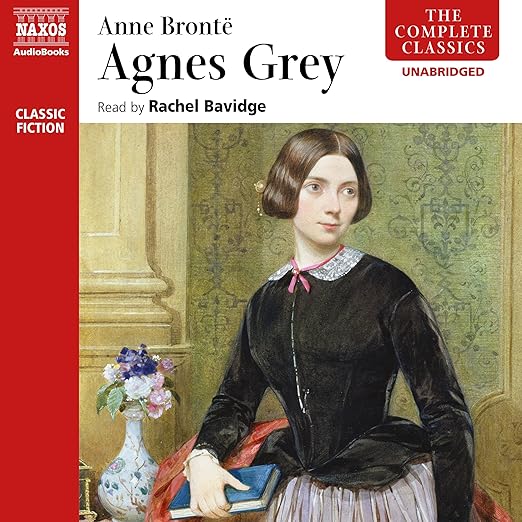
- Voice: Rachel Bavidge narrates for Naxos AudioBooks, a publisher built around exactly this kind of quieter literary classic.
- Big ideas: governess narrative, Victorian social critique, restrained romantic hope
- Atmosphere: Measured and clear-eyed rather than gothic or sweeping
- Worth it?: Go in expecting Anne Bronte's dry social observation, not her sisters' drama, and this holds up well.
Why does Agnes Grey keep getting filed as the minor Bronte novel, the one read only after Jane Eyre and Wuthering Heights, when one review attached to this audiobook argues that Anne actually has more in common with Jane Austen than with either of her own sisters?
What We Made of It
Anne Bronte's novel introduces Agnes Grey as an honest, perceptive, and charming heroine who takes a position as governess for the Bloomfields, a family the synopsis describes as considerably less appealing than she is, embodying the suppressed cruelties and hypocrisies of the Victorian age. When Agnes moves to a second, marginally less alarming household, one of her new charges sets out to disrupt the one romantic hope she has managed to find. Pippi's review, written from a teacher's perspective, calls Agnes as likable and relatable as the families and children she works for are arrogant and deplorable, and notes that the novel has drawn criticism for not letting Agnes visibly improve her own moral character the way Victorian heroines were conventionally expected to.
Leonard L. Wilson's review makes the strongest comparative case among the reviews attached here, calling Anne Bronte the neglected sister and arguing she actually reminds him more of Jane Austen than of either Charlotte or Emily, since this novel lacks the gripping Gothic elements so prominent in Jane Eyre and Wuthering Heights while still delivering an excellent picture of real Victorian domestic life. suziqn6's review adds a piece of publishing history worth knowing: the original edition carried three pen names because Agnes Grey was first released bundled together with Wuthering Heights and Jane Eyre, written by Anne's two sisters, before later editions separated the three novels out.
The synopsis itself is careful, almost clinical, in how it introduces Agnes: critical, satirical, direct, and honest are the four words it settles on, and each one shows up clearly across the reviews here. This is not a novel built on plot incident so much as one built on a governess's clear-eyed observation of the family employing her, which puts real weight on the narration to keep that observation from ever feeling flat or repetitive across seven and a half hours.
Why Agnes Grey Works as an Audiobook
Rachel Bavidge narrates for Naxos AudioBooks, a publisher whose whole catalog is built around exactly this kind of quieter literary classic, the kind of production that tends to prioritize clarity and restraint over dramatic flourish. That fits the material well: Agnes Grey is a critical, satirical, and direct novel rather than a Gothic or sweeping one, and a narrator who trusts the prose to carry its own weight seems like the right match for it.
Sarah's review flags a detail worth knowing going in: several scenes depict the children Agnes tutors mistreating animals, difficult material even though it effectively illustrates just how badly behaved and unaccountable those children are allowed to be. The same review calls the book's final stretch wonderful, suggesting the payoff is worth pushing through the harder middle chapters for. A review from Brazil, signed ecnrb, calls this a little-known book that deserves a wider readership, a nice reminder that Anne Bronte's reputation as the overlooked Bronte extends well beyond English-language readers.
Naxos AudioBooks releasing this in 2010 also means Agnes Grey has had over a decade to accumulate exactly the kind of patient, engaged reviews on record here, from a teacher's professional read to an international reader's simple recommendation, instead of the rush of early hype a brand-new release generates. That slower accumulation of considered reactions arguably suits a novel this understated better than a wave of opening-week enthusiasm would.
What Might Not Land
Set expectations correctly before starting: this is not Wuthering Heights or Jane Eyre in tone, and listeners hoping for that kind of Gothic sweep may come away disappointed. What Agnes Grey offers instead is a more clear-eyed, socially critical account of a governess's working life, closer in spirit to Austen's social observation than to either of Anne's sisters' more dramatic instincts, according to the reviews on record here.
The listed 4.2 rating only reconciles with the four counted votes shown if you assume a truncation-style rounding convention rather than standard rounding, worth knowing but not worth dwelling on, since five written reviews actually appear against those four counted votes regardless of which rounding method produced the displayed number.
Pippi's review raises a genuinely interesting structural point worth sitting with: Agnes does not undergo the kind of visible moral improvement Victorian heroines were conventionally expected to display by a novel's end, which some readers have read as a flaw and others, including Pippi, have read as one of the book's more honest, less sentimental choices.
Worth noting too: Agnes Grey runs seven hours and thirty-three minutes, a real commitment for a novel this quiet in tone, and one that rewards a listener willing to sit with incremental social observation instead of plot momentum. Anyone approaching this expecting the pace of a modern novel may need to recalibrate slightly, though nothing in the five reviews here suggests the pacing itself was ever a serious complaint.
Who Should Listen to Agnes Grey
This suits listeners who want the quieter, more socially observant Bronte novel, readers drawn to governess narratives in the Jane Eyre tradition but looking for something more grounded and less Gothic, and anyone curious what the least-discussed Bronte sister actually sounds like on her own terms. Go in expecting Anne Bronte's dry social observation, not her sisters' drama, and this holds up well. Only skip this if gripping Gothic tension is specifically what you came for, since multiple reviewers agree that is not what this particular novel is built to deliver.