Key Details
- Subjects: Context engineering versus prompting, agent design, mission and memory, teaching by parable
- Tone: Conversational and briskly argued, closer to a keynote than a manual
- Bottom line: A genuinely useful vocabulary lesson for non-engineers, and too thin for anyone already building agents.
Writing a book about collaborating with autonomous software, then publishing it read aloud by autonomous software, is a decision worth pausing over. This audiobook carries a Virtual Voice credit. David Gillette's argument is that most people treat artificial intelligence as "a glorified chatbot" when they ought to be designing systems that reason, remember, and execute. The edition you would buy in order to hear that argument was itself produced by handing text to a machine. The listing states as much openly, so nothing sinister attaches to it, but the symmetry is difficult to unsee once noticed.
Three hours and forty-seven minutes is brief for a technical subject and about right for the thing it turns out to be, which is not a manual so much as a sequence of stories. Arvind Sathi puts it exactly: instead of giving readers "templates and best practices," the book uses "practical examples to illustrate the difference between transactional prompting and context engineering." Four reviewers out of five describe the method arriving as narrative. Anyone wanting configuration files and evaluation harnesses has come to the wrong shelf.
Christopher Smih Restores a Missing Subtitle
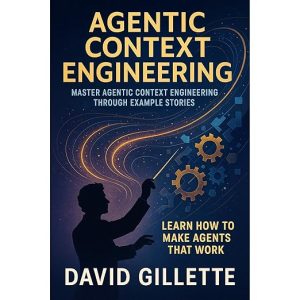
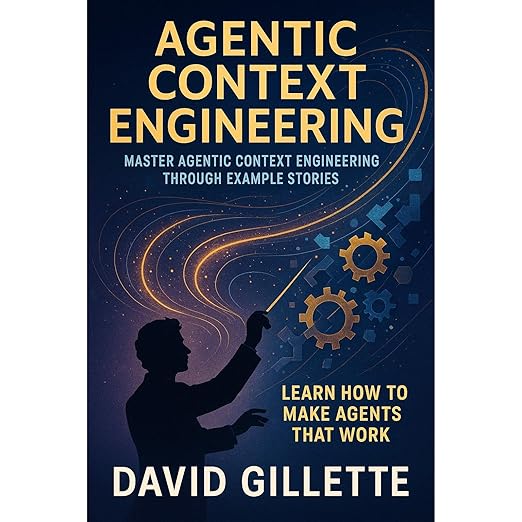
The title on this listing runs shorter than the one its readers saw. Christopher Smih opens a four-star notice by naming the book "Agentic Context Engineering: Master Agentic Context Engineering Through Example Stories" and so restores a subtitle that appears nowhere in the metadata attached here. That amounts to more than a cataloging quibble, because the missing words state precisely what the book is. It teaches through example stories. Strip the subtitle away and what remains sounds like a technical reference, which is not the book the reviews describe at all.
Only fifteen ratings underpin the score here, of which five are readable, and those five average 4.6 against a listed 4.5. A base that small means one review moves the aggregate, so read them individually rather than as a verdict. Two of the five sit at four stars, and one of those two says exactly what was missing. NCC writes, "while I hoped he would have went deeper, that's probably reserved for another book of his." That is a reader who finished convinced and still hungry, which for a book this short beats the alternative of finishing bored.
Vocabulary Travels Better Than Any Template
Storytelling is the reason to choose this format rather than merely tolerate it. A book teaching through scenarios instead of syntax survives being heard intact. Saskia Knöpfle reports that it "reshaped how I think about working with AI" and that it teaches you "to think like a system designer" in place of a prompt writer. Neither of those gains requires a screen. Both are conceptual reframings, and reframing is the one thing audio delivers as well as print, occasionally better, because you cannot skim past the reasoning to reach the conclusion.
The frame the description sells is the "Agentic Shift," a move from using these systems to becoming, in the copy's own words, "an architect of intelligence." Grandiose, and the readers keep quietly deflating it into something more usable. What the book seems to actually hand over is a vocabulary: context engineering as a thing distinct from prompting, agents as entities with missions and memories rather than as text boxes you type into. Vocabulary travels. You can carry it into your own work the same afternoon you finish, and unlike a template it does not go stale when the tooling changes underneath you.
The description also lists what the stories are for. Building AI tutors that adapt to individual learning styles. Avoiding "the pitfalls of disastrous automated assistants." Designing partners with clear missions, reliable memories, and effective tools. That third item is doing the real work, because it locates the difficulty in scope and memory rather than in phrasing. Whether that emphasis is correct is not something a review settles, but it is at least a claim with content, which is more than the average book in this category manages.
Every Review Predates This December Recording
PK76 files the reservation that matters most for this format, and it deserves quoting whole: "My only suggestion would be to include some visuals or graphics to break up the text between chapters." A request for pictures, filed by a five-star reader, against the printed edition. The recording answers it by removing the possibility altogether. If the text already read as an undifferentiated block to somebody holding the physical object, close to four unbroken hours of synthesized reading will not feel any less so.
The dates want stating plainly. The recording went out on December 11, 2025, and every visible review predates it. Three were filed on July 15, 2025, a fourth on July 17, and the last on November 13, all of them weeks or months before the audio existed at all. Nothing irregular attaches to that for a title with an earlier print or digital life. The consequence is that the whole of that 4.5 is a verdict on words on a page, and that not one syllable of it applies to the edition you would be buying.
Shelf placement wants watching too. This is filed under programming and software development, yet not one readable review mentions code, and the ones that describe the contents describe parables. Arriving from that category expecting implementation guidance ends in disappointment. What is actually on offer is closer to a design philosophy delivered through worked scenarios, which is a legitimate thing for a book to be and a poor match for the category it has been given.
Founder or Manager Gets More From This Book
Coming to this as a developer who already ships against model APIs, you will find the vocabulary useful and the depth thin. Coming to it as a founder, manager, or teacher who keeps hearing about agents and cannot picture what one actually is, you will find it does more for you in under four hours than most longer treatments manage. That second listener is who the book is built for, whatever the programming category implies about the first. The gap between those two readings of the same short recording is wider than anything the star rating can express.
Engineers who need code, configuration, or benchmark numbers will finish frustrated, and so will anyone wanting more technical weight than a short book can carry. Give it a miss as well if business-book storytelling grates on you, because that mechanism is not a wrapper around the argument here, it is the argument. What survives all those caveats is a compact, clearly reasoned case that the interesting work with these systems is design work rather than phrasing work, and five readers all found that case worth their time.