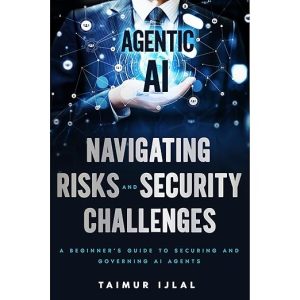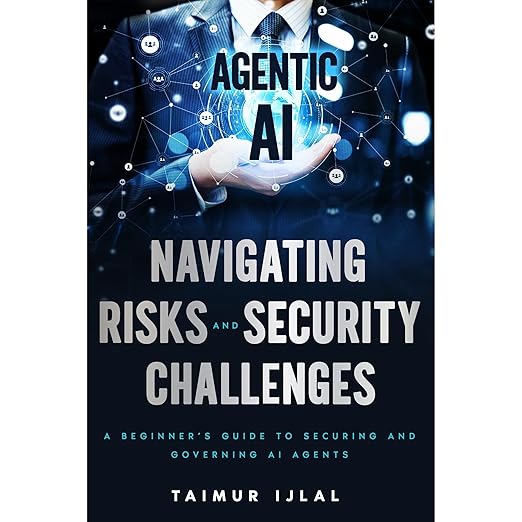
A machine reads this book aloud to you, which would be unremarkable except that the book is about deciding where to let machines act on your behalf. Taimur Ijlal has written a briefing rather than a manual, aimed at security professionals and at the non-technical colleagues who have started hearing the word agentic in meetings and want to know what it changes. The audiobook makes good on the brevity. Whether it makes good on the authority is a question the listener has to settle personally, and the reason that question arises at all is unusual.
Independent Decision-Making and Self-Directed Goal Pursuit
The distinction the book is built on is the right one. Ijlal separates systems that follow instructions from systems capable of "independent decision-making, self-directed goal pursuit, and autonomous action", and then works outward from that difference: which risk categories are genuinely new, what autonomy and alignment and intent mismatch actually mean in an enterprise context, how to assess the risk level of a given system with a simple threat model, and how to fold all of it into the security policy an organization already runs. The sequence is sensible and the scope is honest.
Ijlal presents himself as "a seasoned security leader and AI governance advisor", and the register matches that claim. This is written the way a good internal briefing is written, with the hype stripped out at the top and the practical question, what do we actually do about it, kept in view throughout. The listing marks it as the second entry in a series on AI risk and security, though the copy gives no indication whether the earlier volume is assumed, and nothing in the content summary suggests you would be lost without it.
Acronym Load Is the Reviewers' Main Friction
The audience the book claims is the audience that turned up. MMind12 opens by identifying as a common user rather than a technical one and reports that "this book was very informative and enlightening of many aspects of agents systems." Jen calls it "well written and organized" and adds a detail that matters: "Terms were explained and the bullet points helped to organize bit size out takes." The review closes with "I'm new and followed most of it well!" For a book about autonomous systems written for people who do not build them, that is the review you want.
Even the four-star notice concedes the substance. Bmf, who titles the review "Solid book about Agentic AI", grants that the information provided holds up and that the acronym load is the main friction, before a sentence about what a beginner's manual could have added stops in the middle. Nobody here disputes that Ijlal knows the material. The reservations are about how it is packaged, which is a much better position for a technical book to be in than the reverse.
Two hours and thirty-six minutes is a defensible length for this. A field moving as fast as agentic systems punishes long books, because by the time a comprehensive treatment arrives the vocabulary has shifted underneath it. What a listener actually needs is a shared set of definitions, a way to reason about risk, and enough structure to ask better questions of a vendor. That fits comfortably in a single commute each way, and the brevity is the book working as intended rather than the book falling short.
One promise in the contents deserves naming, which is the integration step: taking agentic risk and putting it inside the controls a company is already operating. That framing separates the book from the general-audience commentary crowding the same shelf, because it assumes a reader with policies already in place and a working question about where the new risks attach to them. The task on offer is integration rather than revelation, which is a far more useful thing to hand a professional than another explanation of what an AI agent is.
Synthetic Narrator Reads a Book About Machine Autonomy
Now the production. This edition is read by Virtual Voice, a synthetic narrator, and the difficulty is not a question of whether the voice is pleasant. It is that the book's argument concerns being deliberate about where an organization lets a machine act on its behalf, and the book itself has handed a machine the job of speaking for the author. A listener is entitled to notice that. The content does not become less true, but a governance argument carries some of its weight through the care visible in how it is presented, and this presentation is the one that took the least care.
That question is sharpened by the four-star review. Bmf writes: "I thought the book was well-written, but it reads like the author used AI to generate a lot of the material." Take it as one reader's impression rather than an established fact. Even at that weight, a listener ends up holding two independent suspicions about the same product, and this is a title where I would spend two minutes on the sample before spending anything else.
The other caveat is structural, and Jen identified it without meaning to. The bullet points that review praises are the reason the book works on a page and the reason it will fight you aloud. A bulleted taxonomy of risk categories, delivered by a synthetic voice that cannot be relied on to mark where one item ends and the next begins, is genuinely harder to absorb by ear than to scan by eye. Anyone planning to actually use the threat model rather than simply hear about it should have the text to hand.
Working Vocabulary for Security and Compliance Teams
Security professionals, compliance officers, product managers and executives who need a working vocabulary for agentic systems quickly, and do not want a research paper, are the core audience. It also suits the non-technical reader Ijlal explicitly courts, the one who has been handed responsibility for something they were never trained to evaluate. Anyone whose organization is currently piloting autonomous agents will find the risk framing immediately usable, and the running time means it costs a single day of commuting to acquire.
Machine learning engineers and AI safety researchers will find nothing new; the book says as much by describing itself as beginner-friendly. Anyone who reacts badly to synthetic narration should look for the text instead, since the reading is a constant rather than an occasional presence, so the reaction will not fade. Treat it as a briefing document that happens to be available in audio, sample the voice before committing, and keep the written version nearby if you plan to put the risk framework to work rather than merely follow the argument.