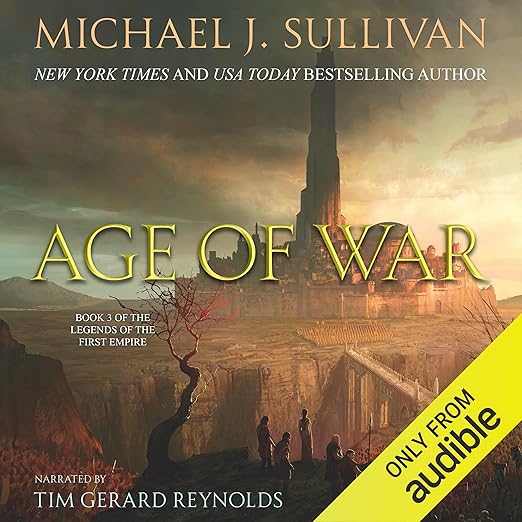
I had been waiting for Age of War for longer than I expected. After the first two Legends of the First Empire books, I was convinced Michael J. Sullivan had built something genuinely different in the epic fantasy space: a prequel series set tens of thousands of years before his Riyria Chronicles, asking how humanity fought its way free from godlike overlords and what that cost. The third book is where the promises of that premise are cashed in, and Sullivan does not spare his characters in the process.
The setting is a world where humans and renegade Fhrey, the near-divine beings who have ruled over humanity, are forming an uneasy alliance against the Fhrey empire. Persephone, the human chieftain who has managed to hold the fractious clans together through sheer will and compassionate intelligence, faces the most complex political challenge of the series: keeping both sides of the alliance from destroying each other before the real enemy arrives. Nyphron, the Fhrey rebel leader, is pursuing his own agenda through a loveless political marriage, and it is Persephone who will pay the personal price.
Sullivan's greatest strength as a writer is his character work, and Age of War is where that strength faces its most demanding test. The large cast he has assembled across two books is now operating under pressure, and the distinctions between characters who seemed similar in quieter moments become stark when the stakes are existential. The alliance's fragility is not an abstract political problem; it is made concrete through specific conversations, specific betrayals, and specific kindnesses that arrive at the wrong moment.
The novel also shows Sullivan's maturing confidence with tragedy. The Riyria Chronicles were largely adventurous and optimistic in register; the Legends series has always been darker, but Age of War commits to that darkness in ways the earlier entries approached cautiously. Reviewers noted the book becomes deeper and darker as it progresses, and that the storyline became more fascinating under that pressure.
The Best Parts of Age of War
Tim Gerard Reynolds has been the voice of Sullivan's fantasy worlds for long enough that his narration feels like part of the text's identity. His performance in the 2026 re-recording carries the weight of the story without tipping into melodrama. Reynolds understands that Sullivan's prose is built for clarity and emotional precision rather than ornamental language, and he honors that register throughout the fifteen-hour runtime.
Going back to listen to the first two books before starting this one is genuinely the optimal approach. Sullivan writes series fiction where each installment builds on accumulated character investment, and the emotional payoffs in Age of War are substantially richer for listeners who carry the preceding books with them into the listening experience.
Before You Commit to Age of War
Readers who came to this series from the Riyria Chronicles expecting the same adventure-forward energy should know that Legends operates with a different emotional center of gravity. The world-building is quieter and more anthropological, the violence more consequential, the resolutions less clean. One reviewer found it slightly disappointing that so much was resolved in this volume, preferring open ends. Others will find the resolution satisfying. Sullivan is threading a needle between narrative closure and series continuation, and not every choice will land perfectly for every listener.
The political maneuvering, particularly around Nyphron's ambitions and the question of leadership succession, requires close attention. Listeners who listen passively may find the strategic landscape muddy.
Should You Listen to Age of War?
This book is for readers who have invested in the first two Legends of the First Empire novels and are ready for the series to escalate. Standalone entry is not advisable. For fantasy readers looking to begin the series, Age of Myth is the correct starting point, and Sullivan's patient worldbuilding in that first book earns everything that Age of War then does to the characters you will have come to care about.
Is Age of War the final book in the Legends of the First Empire series?
No. The series continues for three more volumes: Age of Legend, Age of Death, and Age of Empyre. Age of War is the midpoint of the six-book series and functions as an escalation rather than a conclusion.
How does Tim Gerard Reynolds manage the large cast of human and Fhrey characters?
Reynolds gives the Fhrey characters a slightly more formal, measured vocal register that distinguishes them from the human characters without making them sound alien. After two books of established voices, the differentiation is clear throughout the fifteen hours.
The synopsis mentions a loveless political marriage and the betrayal of Raithe. How significant is the romantic dimension of the plot?
The relationship between Persephone and Raithe is central to the emotional logic of the series, and what happens to it in Age of War is the novel's most affecting throughline. Sullivan does not overplay the romance, but its consequences shape every political decision Persephone makes.