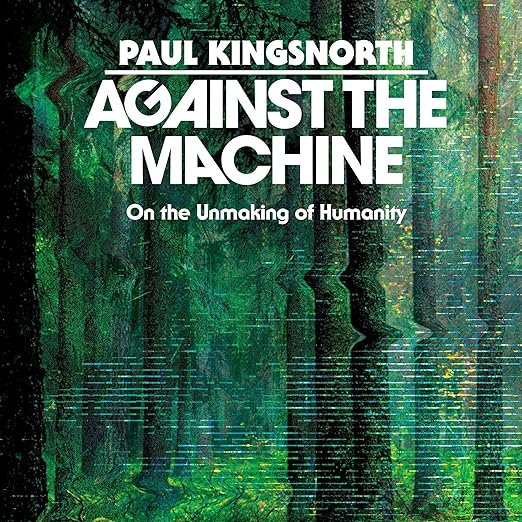
In Brief
- Performance: Owen Hall reads Kingsnorth's dense, prophetic prose with gravitas and appropriate weight; the delivery has the seriousness the text demands without becoming portentous.
- What it covers: Techno-capitalism, spiritual resistance, the erosion of the human
- Feel: Dark and urgent, with the cadence of a sustained jeremiad
- Our call: A formidable, uncomfortable argument that earns its ambition, particularly for listeners willing to sit with ideas they may not fully accept.
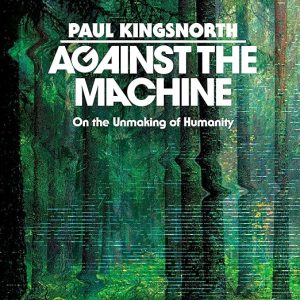
I started Against the Machine on a Sunday evening when I was feeling vaguely irritated at my phone and could not precisely say why. By midnight I was significantly more irritated, and the feeling was considerably more articulate. Paul Kingsnorth has written a book that gives language to a specific kind of modern malaise, the sense that something is being taken from us by systems we helped build and now cannot quite see around. Whether he is right about the causes, and the remedies he suggests, is another matter. But the diagnosis is difficult to dismiss.
Kingsnorth is a British writer whose earlier work included a celebrated environmental manifesto called Confessions of a Recovering Environmentalist and several novels, including The Wake, written in a reconstructed Old English. He converted to Eastern Orthodox Christianity in recent years, and that conversion is central to Against the Machine, which is as much a spiritual text as it is a cultural critique. His argument draws on Wendell Berry, Jacques Ellul, and Simone Weil, three thinkers who shared a deep suspicion of the idea that technological progress is inherently good. Kingsnorth extends their critiques into the present and arrives at a conclusion that is genuinely his own: that what he calls the Machine, the interconnected system of techno-capitalism, digital mediation, and materialist ideology, is not merely a political or economic problem but a spiritual one.
Tracing the Machine Back to the Enlightenment
One of the book's most useful moves is its historical scope. Kingsnorth traces the Machine's origins not to Silicon Valley or even the Second Industrial Revolution but to the philosophical shifts of the Enlightenment and the First Industrial Revolution, when the Western world began systematically privileging the measurable over the experienced and the efficient over the alive. That longer arc does two things: it prevents the book from becoming a simple complaint about smartphones, and it forces a more serious reckoning with how deeply embedded the Machine's assumptions are in institutions we rarely think to question.
The NYT Bestseller designation reflects the breadth of the audience this argument has found, which is wider than you might expect for a book with explicit spiritual and even mystical dimensions. The reason, I think, is that Kingsnorth is describing something that a lot of people have felt without being able to name. One reviewer described sitting in a restaurant and watching people at every table staring at screens, a recognition that the digital world has colonized the social world in ways that feel genuinely wrong, even to people who have no framework for explaining why. The Machine gives readers that framework, or at least the beginning of one.
Hall Resists the Urge to Overperform
The narration is one of the harder casting problems in contemporary nonfiction audio. Kingsnorth writes with a prophetic intensity that could easily tip into self-parody in the wrong hands. Owen Hall avoids that by reading with conviction rather than performance. He does not underline Kingsnorth's most dramatic passages with vocal emphasis. He reads as if he trusts the words to carry their own weight, which they do. Over eleven hours, that restraint is essential. A narrator who matched Kingsnorth's rhetorical temperature with theatrical delivery would make this exhausting. Hall makes it listenable even when the ideas are uncomfortable.
The length is appropriate to the ambition. Kingsnorth is not making a simple argument that could be compressed, and the eleven hours include enough historical context, philosophical development, and concrete example that the central thesis arrives with genuine support rather than assertion alone.
Stronger on Diagnosis Than on Solutions
A thoughtful four-star review from someone who found the book both inspiring and disappointing raises the fair objection that Kingsnorth's proposed remedies are neither practical nor, in some cases, clearly desirable. He is significantly better at diagnosis than prescription. The book's positive vision, connection to land and nature, spiritual practice, healthy suspicion of entrenched power, is real but deliberately non-programmatic. Kingsnorth is not offering a policy platform. He is describing a disposition, a way of being in relation to the Machine rather than a set of steps for dismantling it.
For readers who want actionable recommendations, this limitation is genuine. For readers who find that most proposed solutions to the problems Kingsnorth describes are inadequate to the scale of what is wrong, his willingness to sit with the difficulty without false resolution may feel more honest than frustrating.
Suited to Readers of Wendell Berry and Illich
This is for readers who feel the diagnosis of techno-capitalism's spiritual costs is not adequately addressed by conventional secular critiques. It is for listeners who have engaged with Wendell Berry or Ivan Illich and want a contemporary voice working in that tradition. It is also for readers who have no existing framework for this kind of argument but have felt, on some less articulate level, that something important is being lost. It is not for listeners who require empirical social science as the primary register for cultural criticism, or for those who find explicitly spiritual frameworks incompatible with serious intellectual engagement.
A Few Questions About Against the Machine
Do you need to share Kingsnorth's Orthodox Christian faith to engage seriously with Against the Machine?
No, and several reviewers describe being persuaded by the cultural and historical critique without sharing or adopting the book's spiritual framework. The religious dimension is present throughout and shapes Kingsnorth's proposed alternatives, but the diagnosis of techno-capitalism's costs is accessible to secular readers.
How does Against the Machine differ from other tech-skeptic books like those by Shoshana Zuboff or Cal Newport?
Primarily in scope and register. Zuboff and Newport are primarily concerned with policy and behavior modification respectively. Kingsnorth operates at a more philosophical and spiritual level, tracing the Machine's roots to pre-digital modernity and treating the problem as fundamentally a matter of human identity and soul rather than platform regulation.
The book is described as prophetic. Is this a fair label, or is it hyperbole from admiring reviewers?
It is reasonably fair. Kingsnorth writes in the tradition of cultural prophets who describe what is happening rather than what will happen, and he makes predictions about the consequences of current trajectories that are grounded in historical argument rather than speculation. Whether you find the tone inspiring or overwrought will depend on your temperament.
At 11 hours and with dense philosophical content, is this practical to listen to without taking notes or pausing frequently?
The argument is sustained and builds on itself, so continuous listening rewards more engagement than passive background play. That said, Owen Hall's narration manages the complexity well, and the book's structure is clear enough that losing your place for a few minutes does not derail comprehension of the whole.