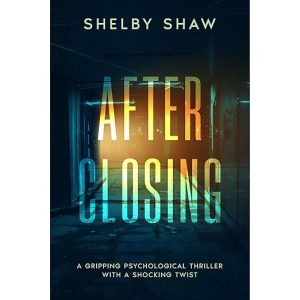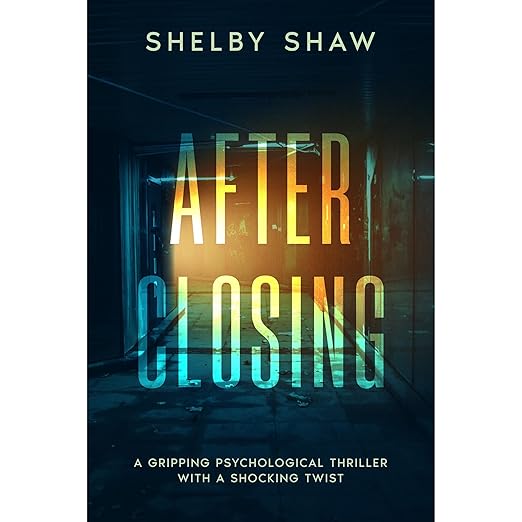
Fifteen years after a child vanished from the play area of a shopping mall, the sister who was supposed to be watching her works nights in the same building, walking empty corridors under flickering fluorescents. Shelby Shaw writes the description in that sister's own voice, first person and unguarded, which is an unusual choice for sales copy and a persuasive one. The audiobook runs seven hours and thirty-four minutes, and the reader credit reads Virtual Voice.
Guilt is the engine, and the setup installs it efficiently. Audrie was eight. Her sister was seventeen and responsible. The police gave up, the parents gave up, everybody moved on except the one person who cannot, and the job she took is the purest expression of that refusal: security work in the building where it happened, night shift, alone with the corridors. Nothing about that arrangement is healthy, and the book plainly knows it.
What turns the obsession into a plot is the footage. Working alongside a security guard named Jeremy, she starts reviewing old recordings and finds gaps: missing time, hours that simply do not exist, and those hours tie back to the night her sister disappeared. It is a strong device because it makes the evidence itself unreliable, which is the same move the book is making on the narrator's perception.
From there the story opens outward into the building: sealed-off wings, forgotten service tunnels, and a growing certainty that somebody has noticed the digging. The description is blunt about the shape, promising mounting tension, unreliable truths and relentless twists before an ending that refuses to let go. Set expectations for a psychological thriller about control and perception rather than a procedural, because no competent police work is coming to rescue the plot.
Why It Works in Audio
A dying mall is one of the great audio settings and this book knows what it has. Empty retail space is a place of specific sounds, extractor fans, a distant shutter, footsteps carrying much too far, and a story set almost entirely inside one after hours gets its atmosphere free in a way no domestic thriller ever does. Surveillance horror also works by ear, since what you can hear but cannot see is the whole mechanism.
The first-person frame is the other argument. A narrator carrying fifteen years of guilt, describing her own building and telling you what she believes she saw, is exactly the kind of text audio was built to carry, and the description proves the voice works by being written in it. A blurb that reads as testimony is rare on this shelf, and it sells the book harder than any list of comparable titles would.
Seven hours and thirty-four minutes makes this a full novel rather than a novella, which matters for a story of this type. Slow accumulation is the method: the gaps in the footage, the sealed rooms and the sense of being watched all need time to gather before a twist can pay for them. A shorter version would have to announce its threat early, and announcing the threat early is the one thing surveillance horror cannot afford.
Weak Spots in After Closing
Now the credit, which is the thing to weigh hardest. The reader is a text-to-speech system, stated plainly on the page rather than buried, so what reaches your ears was assembled by software. On instructional material that costs little. On a psychological thriller whose entire method is mounting tension, unreliable narration and a voice you are meant to half-trust, it costs a great deal, because pacing, hesitation and the choice to go quiet are the genre's working tools.
Be specific about what that means in practice. A synthesized reader delivers the sentence about missing time at the same speed and pitch as the sentence about a vending machine, so every emphasis the prose does not carry explicitly simply disappears. Shaw's writing may be strong enough to place that weight inside the sentences themselves, which is what would make the whole thing work. A sample will tell you, and nothing else on this page will.
The rating counter is the second problem. This listing displays 4.3 across five ratings, and five whole-star votes cannot produce that number: twenty-one stars would show 4.2 and twenty-two would show 4.4, with nothing available in between. The nearest achievable figures sit on either side of the one printed. Retailers weight verified purchases, so the display is not necessarily wrong, but it is not a plain average of five votes either.
None of those five raters wrote anything, nine months after this listing went live, so the trope list is the only guide to content the page provides, and it arrives as an emoji checklist: cold case disappearance, abandoned mall setting, watched protagonist, corrupted footage, guilt-driven obsession, amateur investigation, sealed rooms, surveillance horror, buried secrets and a disturbing final twist. Ten items doing the job a blurb usually does. The content warning printed beneath them is the more important line.
Who Will Get the Most From It
Cold-case readers who want the amateur rather than the detective are the target here, and the abandoned-mall setting does much of the recruiting by itself. It suits anyone who enjoys an unreliable frame, a protagonist whose judgment you are meant to question, and a long build toward a single reversal. Readers who came up on surveillance-footage horror in other media will recognize the grammar of the missing hours straight away.
Pass on it if the content warning applies to you, and read that warning before deciding: the description states the book involves the disappearance and deaths of children, not graphically depicted but central to the story. Anyone who needs a capable investigator on the page should look elsewhere too, since the police gave up in the opening lines. And listeners who cannot tolerate a synthetic voice across a full novel should treat the sample as decisive.
What Shelby Shaw has built looks solid on paper: a strong setting, a real device in the corrupted footage, a narrator with a legitimate reason to be unreliable, and a warning attached honestly rather than hidden. What the page cannot demonstrate is whether any of it survives being spoken by software, and with no written responses to consult, that sample is the entirety of the available evidence. Spend five minutes on it before you spend an evening on the rest.
Questions Listeners Ask
Is the audiobook frightening, or is it tension without scares?
Tension more than scares, on the evidence of the description. The label is psychological thriller and the machinery is control, perception and how easily reality can be manipulated, which points toward dread rather than shocks. The horror attached to the surveillance trope concerns the device, gaps in footage and hours that do not exist, rather than anything leaping out of a service tunnel.
Does the mystery resolve, or does the twist leave it open?
The description promises a disturbing final twist and a finish designed to linger, so expect resolution with a sting rather than an open ending. Whether the reversal earns fifteen years of build is the one thing nobody on the page has said, since not a single rater wrote a word. Judge it on how carefully the early chapters plant their gaps.
How much of the story happens inside the mall itself?
Nearly all of it. The narrator works nights there, the search runs through sealed-off wings and forgotten service tunnels, and the footage being reviewed was shot inside the building. That single-location design is the book's biggest asset in audio, because a place you can hear becomes a place you can map, and the map is what makes the sealed rooms frightening.
Is seven and a half hours long for an audiobook like this?
It is a normal novel length for the genre, and the slow build needs it. The runtime lets the missing hours, the sealed corridors and the surveillance dread accumulate before anything gets explained, which a shorter version could not manage without tipping its hand. The length is only a risk if the delivery cannot hold your attention across it.