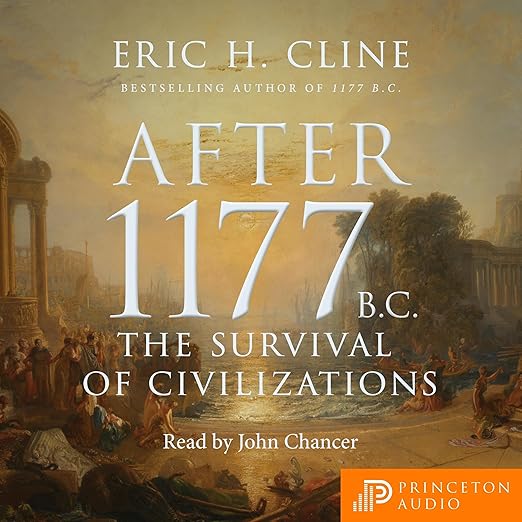
Eric Cline's After 1177 B.C. earns the compliment one reviewer gave it almost as a warning: this is not an easy read, but it is a genuinely satisfying one, and John Chancer's narration in this audiobook is measured enough to survive four centuries of collapsing and reforming civilizations without losing the thread. Picking up exactly where Cline's bestselling 1177 B.C. left off, this sequel tracks what happened across the Aegean and Eastern Mediterranean after the Late Bronze Age world came apart, following the rise of the Phoenicians, Philistines, Israelites, Neo-Hittites, Neo-Assyrians, and Neo-Babylonians out of that collapse.
Part of the Turning Points in Ancient History series, and narrated by John Chancer, this 9-hour-and-18-minute audiobook holds a 4.4 rating from 464 ratings, with Cline's own FAQs included as bonus content at the end.
Dismantling the Sea Peoples Myth, Almost Scholarly
The book's real achievement is correcting a popular myth head-on: reviewer Rico specifically credits After 1177 B.C. with dismantling the idea of a single mysterious force, the so-called Sea Peoples, responsible for ending the Bronze Age kingdoms, replacing that simplified story with a more accurate, more interesting picture of gradual adaptation, failure, and reinvention playing out differently across different regions over roughly four centuries.
Cline traces that reinvention all the way up to the first Olympic Games in 776 B.C., along the way covering how genuinely world-changing innovations, the spread of ironworking and the development of the alphabet, emerged directly out of the chaos of collapse rather than despite it. Rico's review calls the book almost scholarly, citing hundreds of supporting references, a level of rigor that separates this clearly from more speculative popular-history treatments of the same period.
Cline's Credentials, and an Alphabet Still in Use
Eric Cline's own standing as a working archaeologist and professor at George Washington University gives the book's more assertive claims real weight, since the corrections he makes to the Sea Peoples myth come from someone who has spent an academic career excavating and interpreting the physical evidence directly rather than synthesizing secondhand accounts of other people's fieldwork.
The alphabet's spread out of this period carries a legacy still visible today: the Phoenician script that emerged from this exact era of reinvention is the direct ancestor of the Greek and, eventually, Latin alphabets, meaning the letters used to write this very sentence trace back to precisely the world Cline is describing. That kind of throughline, from four centuries of chaos to a tool still in daily use, is what gives the book's scholarly detail real stakes for a general listener.
Reviewer mmm summed up the appeal in the simplest possible terms, calling it an easy read that made ancient history genuinely interesting rather than a chore, and specifically praised the reference material for opening up further reading beyond the book itself. That is a useful counterweight to the denser, more scholarly impression the citation-heavy structure can otherwise give: this is demanding in places, but multiple listeners came away describing it as approachable rather than punishing.
Chancer Moves Between Registers, Grab a Map Too
John Chancer moves cleanly between the book's analytical and narrative registers, a skill this particular material demands given how often Cline shifts from dense archaeological evidence to the more sweeping, connective storytelling needed to hold four centuries and half a dozen emerging civilizations together in one coherent narrative arc.
For listeners who already read or heard the original 1177 B.C., this functions as a direct continuation using new evidence rather than a simple rehash of the same material with a new cover, and Cline's own bonus FAQ content at the end gives the audiobook something close to a live question-and-answer session tacked onto the scholarly material that precedes it.
As part of the Turning Points in Ancient History series, this entry benefits from a format built specifically around moments of genuine historical rupture and reinvention, and Cline's four-century scope, following half a dozen successor cultures rising out of a single collapsed world order, is exactly the kind of long-arc transformation that series format rewards.
Listeners who pair this audiobook with a physical map of the ancient Aegean and Eastern Mediterranean open nearby will get considerably more out of it than those relying on audio alone, given reviewer Best Reviewer's fair point about the format's lack of visual geography. That small bit of preparation goes a long way toward keeping the shifting regional narrative oriented.
The synopsis is direct about the book's ambition beyond ancient history for its own sake: it promises lessons for today about why some societies survive massive shocks while others simply do not, and Cline mostly earns that claim by staying specific rather than reaching for easy modern parallels. The comparison to present-day resilience and adaptation is implicit in the material rather than spelled out heavy-handedly chapter by chapter, which keeps the history from being flattened into a simple morality tale.
Missing Maps and a Primer, but Patient Rewards
Reviewer Best Reviewer raised a specific, credible critique: the book could use maps and more quantitative support for some of its arguments, a limitation that matters even more in audio format than in print, since listeners have no way to glance at a map to orient themselves across the shifting geography of the Aegean and Eastern Mediterranean the narrative covers.
Listeners who have not read or heard 1177 B.C. first may find themselves missing context on the initial Bronze Age collapse itself, since this sequel assumes at least passing familiarity with that earlier book's central argument rather than re-explaining it in full before moving forward into its own separate territory.
The iron and alphabet material rewards patience specifically because Cline resists treating either innovation as a simple, single-cause story. Listeners expecting a tidy explanation of how ironworking spread should be ready instead for a genuinely more complicated, regionally uneven account, which is more accurate to the archaeological record but demands more sustained attention than a simplified version would.
Rigorous on Israelites, Demanding Without the First Book
Fans of the original 1177 B.C. looking for a direct continuation, ancient Mediterranean and Near Eastern history enthusiasts, and listeners drawn to the broader question of why some societies adapt to catastrophe while others simply disappear will find this a genuinely rewarding, well-supported listen across its full runtime.
General ancient history enthusiasts, not just readers who already finished the first book, and listeners of history-focused podcasts built around civilizational rise and fall will find this a satisfying, well-supported entry, provided they are willing to meet Cline's more scholarly register rather than expecting a breezier, more casual treatment of the period.
Because the Israelites are among the successor cultures Cline traces emerging from this period, listeners with an interest in biblical-era history specifically, not just classical archaeology in the abstract, will find real relevant material here, situated within a rigorously sourced account rather than a devotionally framed one.
Anyone hoping for a fully standalone introduction to the Bronze Age collapse, without reading the earlier book first, or who relies heavily on visual maps to track shifting ancient geography, may find themselves working harder than necessary to stay oriented across the book's four-century scope.
The Short Version
- Read by: John Chancer moves cleanly between scholarly analysis and sweeping narrative, suited to four centuries of shifting ancient history.
- At its heart: Bronze Age aftermath, civilizational adaptation and collapse, ancient Mediterranean history
- Vibe: Rigorous and quietly urgent
- Short version: A well-supported, if demanding, sequel best heard after Cline's original 1177 B.C. rather than as a cold open.
Before You Listen
Do I need to listen to 1177 B.C. before this audiobook?
It helps. This sequel assumes some familiarity with the original book's account of the Bronze Age collapse rather than fully re-explaining it.
Does the After 1177 B.C. audiobook include maps or visual aids?
No, and one reviewer specifically notes the book could use maps and more visual support, a real limitation in audio format given the shifting ancient geography covered.
Is this audiobook a difficult listen for casual history fans?
It can be. One reviewer calls it almost scholarly with hundreds of citations, though another found it an easy, engaging read overall, so difficulty may vary by listener.