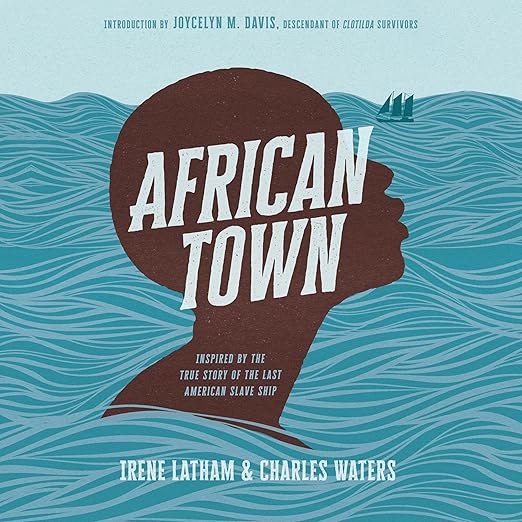
Fourteen distinct voices tell this story, the description says, and one name appears in the audiobook's narrator credit. That gap is the first thing worth knowing about the record. The book is a novel in verse about the 110 men, women, and children taken from Benin and Nigeria in 1860, more than half a century after the United States outlawed the importation of enslaved people, and carried to Mobile, Alabama aboard the Clotilda. Among the fourteen speakers, according to the description, are the founder of African Town and the ship itself. A vessel given a speaking part is the kind of formal decision that either justifies itself immediately or collapses, and this one is the reason the book works.
What Charles Waters Delivers
One hundred and ten people survive a Middle Passage that should never have happened, are hidden in the swamplands along the Alabama River while their captors wait out the risk of being caught, and are then parceled out to plantations where they try to hold on to their culture and fit themselves into captivity at the same time. The description is careful with that double bind, which is the most interesting thing the book does. At the end of the Civil War the survivors build a community and name it African Town, and it is still standing. All of it gets covered in fragments rather than in chapters, because the verse form does not permit anything else.
Verse is doing real work here, not decoration. A four-star from January 21, 2022 makes the case as well as anyone could, praising the economy of novels in verse for using few words to carry a heavy story and calling this a good example of how spare, evocative language expresses more than paragraphs would. That response also went looking for the afterword, which explains the different poetry styles assigned to each character and why each style reflects the person speaking. The afterword is print material. Nothing in the listing says whether a listener receives it, which counts for more than it might seem on a book whose formal choices are the argument.
What Charles Waters Gets Right
Authors, plural, is the word a September 6, 2023 five-star uses when praising the verse forms chosen for each character. The byline on this record names one person. Nothing anywhere on the page acknowledges a second writer, and a reader who has finished the book is describing a collaboration the listing does not admit to. That same response bought it as a substitute for another verse novel assigned in a tenth-grade honors class and reports learning that African Town existed at all, which is the honest measure of a history book aimed at teenagers. Two people read it and both loved it, and the buyer reports never having heard of the place before opening the first page.
Listening Library credits Cassandra Campbell and stops there. Fourteen speakers, one of whom is a ship, is an unusual demand to place on a single reader, and the record never clarifies whether that is what happened or whether other performers went uncredited. One concrete audio asset does appear: a downloadable PDF carrying a glossary and additional resources, which matters more than usual on a book whose speakers use names, places, and terms a young listener will not recognize. Six hours and fifty-three minutes is short enough for the whole thing to be assigned across a single weekend, and short enough to hear twice.
Where Charles Waters Loses Some Ground
Essays is the word a three-star from September 15, 2023 reaches for, describing the book as short one-page pieces about the individuals involved and saying it was not what was expected. That is a genuine mismatch worth taking seriously, because it is exactly how a novel in verse lands on a reader arriving without warning: fourteen speakers, each given a handful of pages, and no continuous narrative thread to hold on to. It is also a page-based description, counting pages rather than minutes, which tells you which edition was being graded. In audio the same structure is harder still, since the visual cue of a new name at the top of a page disappears entirely.
Eighty-two ratings prop up the 4.3 badge, and the written column beneath it needs correcting before you weigh any of it. Among the five responses on show, one consists of the words love the reviews plus a frank note that the reviewer has not yet opened it, which leaves four accounts from people who actually finished. Two of those four run to a single line each. The written column therefore offers two responses of any real length, which is a thin evidence base under a number this confident and a good reason to read the column rather than trust the badge.
Who Should Pick Up African Town
Classroom buyers get the most from this. It is filed as young adult, it runs under seven hours, it arrives with a glossary, and it covers a piece of American history that most syllabi skip entirely, which is the strongest argument for putting it on a reading list. Anyone who came to the Clotilda through news coverage will find the human scale here that reporting cannot supply, because the book is interested in what people did with the decades afterward rather than only in the crossing. Adults who normally avoid verse should try it anyway, since the compression is what makes this material bearable.
Not for you if you need continuous narrative. Fourteen speakers across a novel in verse means fragments, abrupt shifts, and a structure that rewards attention rather than carrying you along on its own momentum. Anyone reading for a specific historical account should also know that this is a novel rather than a history, and that the record supplies no bibliography, no source note, and no author's introduction. Fourteen speakers, one credited voice, and a page that accounts for neither.
Before You Listen
Does this audiobook come with the glossary mentioned in the description?
Yes. The listing states that a downloadable PDF containing a glossary and additional resources is included, which is worth collecting before you start. Fourteen speakers using unfamiliar names, places, and terms is a great deal to hold by ear alone, and the PDF is the only supporting material the record mentions anywhere.
How difficult is the audiobook for a younger teenager?
The record files it as young adult and it runs six hours and fifty-three minutes, which is a manageable length. Verse keeps the sentences short, though the subject matter covers the Middle Passage and enslavement in unflinching terms. No content advisory appears in the listing, so a parent should preview rather than assume.
Who exactly are the fourteen voices?
The description names only two of them: the founder of African Town and the ship that carried the captives across. The remaining twelve are described simply as distinct voices, so the listing never sets out the full cast. Expect the book itself to introduce each speaker rather than the page to preview them.