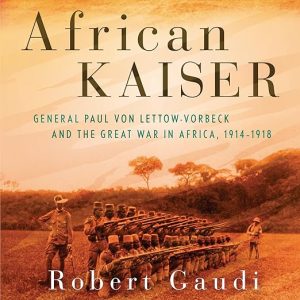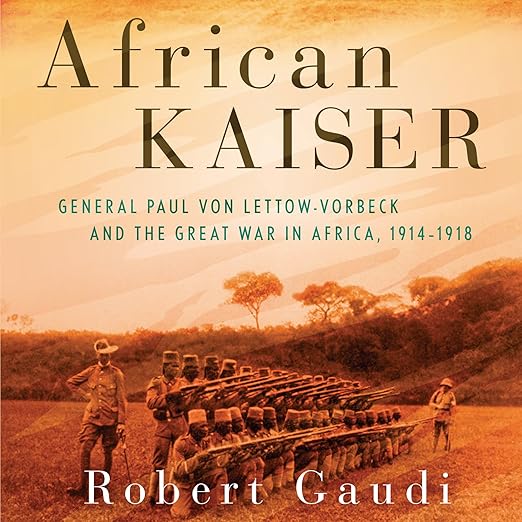
How does an undefeated German commander end up as one of World War I's least-known figures? This audiobook spends eighteen hours answering that exact question, tracing General Paul von Lettow-Vorbeck's campaign across East Africa with his legendary Schutztruppe, a force built on something genuinely radical for 1914: German officers and African soldiers fighting as equals, the first fully integrated army of the modern era, in a theater of the war most listeners have never heard described in any detail at all.
The details Gaudi builds the narrative from sound almost too strange for straight military history: officers riding bicycles into battle through dense bush, a battleship hidden in a crocodile-infested jungle river, Zeppelin resupply missions, soldiers surviving on hippo lard when rations ran out. Von Lettow-Vorbeck never lost a battle in the field and was the last German commander of the war to surrender, and Gaudi treats that entire improbable run as the spine of the book rather than a footnote to the more familiar trench-warfare story of 1914 to 1918.
Paul Hodgson delivers a genuinely strong performance, maintaining biographical warmth for von Lettow-Vorbeck as a person alongside genuine operational urgency for the military sequences, two registers that have to coexist across more than eighteen hours without either one going flat, a balancing act that gets harder rather than easier as the campaign drags into its fourth year. He also handles the German and Swahili names throughout with real precision, which matters more than it might seem in a book moving constantly between European officers and African soldiers and place names across an entire unfamiliar theater of war.
One reader cited the exact review that had sent them to the book in the first place: Michael Dirda's Washington Post write-up, headlined 'African Kaiser: A sweeping military history that reads like a novel'. That headline holds up as an accurate summary of Gaudi's approach, prioritizing narrative momentum, vivid incident, and a genuine sense of place over dry troop-movement recitation, without sacrificing the underlying research.
Von Lettow-Vorbeck's campaign is often cited among historians as the longest continuous resistance of the entire war, four years of guerrilla operations that tied down a wildly disproportionate number of Allied troops relative to his own small force, and did not end until after the armistice had already been signed in Europe, since word of the war's end took time to reach his column in the field. Gaudi builds real tension from that fact alone, a war that, in this one theater, effectively refused to end on schedule.
Nearly Four Hundred Ratings for an Overlooked Theater
The audiobook format suits sprawling narrative military history unusually well, since Gaudi's prose leans heavily on scene and incident rather than statistics, and Hodgson's steady pacing across eighteen-plus hours gives that scene-driven writing room to build rather than rushing through it the way a denser academic history might demand. A 4.7-star average across nearly four hundred ratings for a niche WWI-Africa history is a genuinely strong signal for a subject this underexposed.
A second reviewer offered real specificity worth noting: comparing Gaudi's treatment favorably against Michelle Moyd's Violent Intermediaries, arguing Moyd's title itself misrepresents the actual role African askaris played in the campaign, and praising that Gaudi 'spent several chapters' properly grounding the askaris themselves rather than treating them as background to von Lettow-Vorbeck's story alone. That comparison points at exactly what makes this book distinct within its own subgenre: real attention to the African soldiers, not just the German officer commanding them.
A third reviewer described von Lettow-Vorbeck as 'a unique Prussian who took service seriously and believed in war fought by the rules that should apply to gentlemen,' and that specific old-world code of conduct, genuinely rare even by the standards of 1914, gives Gaudi's narrative an unusual moral throughline for a military history: a commander whose personal sense of honor shaped tactical decisions as much as strategy did.
The Zeppelin resupply mission the synopsis references alone is worth pausing on: a purpose-built airship dispatched toward a jungle campaign from thousands of miles away, ultimately turned back before completing its delivery. Gaudi treats episodes like this not as curiosities but as evidence of how seriously the German high command, against all logic, still believed in one distant, half-forgotten theater of a war most of Europe assumed was being decided entirely in the trenches.
Eighteen Hours Centered on One Commander's War
Eighteen hours is a real commitment before the first chapter even starts, and this is dense, detail-rich narrative history rather than a brisk overview, so listeners wanting a shorter, more general introduction to World War I's African theater should expect this to run considerably longer and deeper than that. It rewards patience rather than skimming.
The story centers heavily on von Lettow-Vorbeck and the German command structure, which means broader colonial politics, the experience of civilians caught in the campaign, and Allied strategy get somewhat less sustained attention than the Schutztruppe's own operational history. Listeners hoping for an evenly balanced multi-perspective account of the East African campaign specifically should know the book's center of gravity leans toward its title character.
Listeners drawn to narrative history in the Erik Larson mold, real events assembled with a novelist's sense of pacing and character, will recognize the same basic approach here, though Gaudi's subject sits in far less charted territory than that comparison's typically well-trodden ground, meaning less cultural familiarity to lean on going in and correspondingly more work for the narration to establish context clearly from the very first chapter.
Pronunciation and geography both demand real attention from a listener unfamiliar with East African colonial history specifically, since German East Africa's borders bear little resemblance to the modern nations that replaced it. Hodgson's careful, precise delivery of unfamiliar place names becomes genuinely load-bearing here rather than a nice-to-have detail, since a mispronounced or blurred name would cost a listener real geographic orientation across eighteen hours of shifting terrain.
Like Bingeing a Whole Season of War
Military history listeners already comfortable with long-form narrative nonfiction, and anyone specifically curious about World War I outside its familiar Western Front trenches, are the clearest audience, especially given how rarely this theater gets covered with this much depth and narrative craft in a single audiobook.
Eighteen hours of audio is, for context, comparable to bingeing a full prestige-television season, and listeners already comfortable with that kind of sustained fictional commitment should find the equivalent commitment to one sweeping true story, itself an almost serialized experience, an easy adjustment to make.
Readers wanting a quick, general World War I primer rather than an eighteen-hour deep dive into one specific campaign and commander should start somewhere broader first and treat this as a later, more specialized listen. For anyone already sold on the premise, an undefeated army fighting an unconventional war in an unfamiliar theater, this earns its length.
Does this audiobook cover the Western Front, or is it focused entirely on Africa?
It stays focused on the East African theater and General von Lettow-Vorbeck's campaign specifically, not the trench warfare most World War I histories center on.
How does Paul Hodgson's narration handle the German and African names throughout this audiobook?
With real precision, according to multiple listener impressions, which matters given how constantly the book moves between European officers, African soldiers, and unfamiliar place names.
Is this eighteen-hour audiobook worth it for a casual World War I listener, or is it too specialized?
It rewards listeners already comfortable with long-form narrative history more than casual newcomers, who may prefer a broader introduction to the war before committing to this one campaign in this much depth.