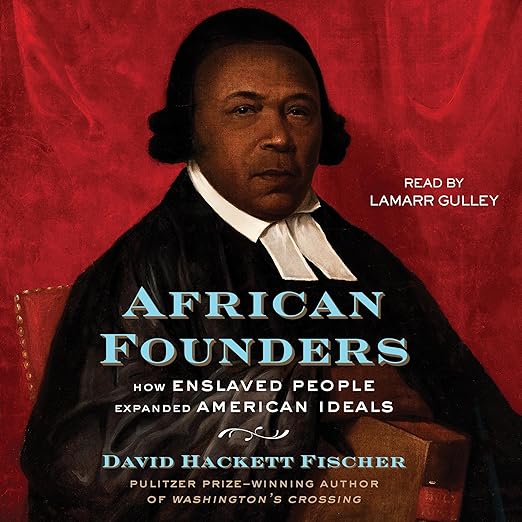
How many distinct regional American cultures trace part of their DNA to enslaved Africans who rarely appear in the history most listeners were taught? That is the question Pulitzer Prize winning historian David Hackett Fischer spends nearly thirty-six hours answering in this audiobook, and his answer is regional rather than singular: Puritan New England absorbed African influence differently than Dutch New York did, which differed again from Quaker Pennsylvania, cavalier Virginia, coastal Carolina, and the Gulf world of Louisiana and Texas. African Founders argues that enslaved Africans and their descendants enlarged American ideas of freedom in ways that varied sharply by region, and Lamarr Gulley narrates the full, dense argument from start to finish.
Phillis Wheatley Anchors a Region-by-Region Argument
Fischer builds his case from extensive research, some of it conducted directly in western Africa, tracing how enslaved people from different African regions carried specific, identifiable skills into the colonies: linguistic knowledge, techniques of animal husbandry and farming, and generations-old ethical principles among them. The synopsis frames this as a book about interaction rather than imposition, enslaved Africans and European-descended colonists actively shaping new regional cultures together, and that framing runs through the reviews too. Victoria C Leo's review specifically praises Fischer for moving past a simple binary in favor of, in her words, 'nuanced reality', crediting his 'meticulous research' into how slavery itself began across the early Americas.
Where the book earns its length is in specificity. Reviewer Michael singles out a section on Phillis Wheatley, the poet, whom he notes was respected by George Washington, as a highlight of how Fischer balances big regional argument with individual human detail. SPC's review captures the book's actual shape well: chapters organized region by region, each one covering how slavery operated differently there, what specific challenges enslaved people faced, and how they navigated their circumstances, rather than one continuous chronological narrative trying to cover the entire colonial period at once from a single vantage point.
Fischer's own credentials are worth naming plainly: he won the Pulitzer Prize for Washington's Crossing, a study of the Revolutionary War, and has spent a career writing large-scale, deeply researched narrative history rather than narrow academic monographs. That track record matters for a book this ambitious in scope, since African Founders asks a listener to trust one historian's synthesis across multiple distinct regional case studies spanning roughly two centuries, a synthesis this size only really works if the underlying research is genuinely as deep as the subject demands.
Gulley Shifts Registers Across Thirty-Six Hours
At just under thirty-six hours, this is a genuine commitment, and Lamarr Gulley's narration is built for exactly that kind of sustained academic listening. He brings a warm, steady authority to the material and, more importantly for a book that shifts registers constantly between broad historical argument and close-focus regional case studies, handles those shifts cleanly rather than flattening everything into one uniform lecture tone. That register control matters more here than in a typical single-narrative history, since Fischer's whole structure depends on a listener tracking distinct regional threads without losing the throughline connecting them.
Fischer is best known for Albion's Seed, his earlier landmark study of British folkway culture in colonial America, and African Founders functions as something like a companion volume to that project, examining influences Albion's Seed largely left out. Listeners who already know Fischer's regional-culture framework from that earlier book will recognize the method here immediately; listeners new to his work still get a self-contained argument, just one that pairs naturally with further reading if the regional-culture approach resonates with them.
For a book this substantial in scope, spanning multiple distinct colonial regions across roughly two centuries, audio offers a genuine practical advantage: momentum. A reader confronting a project this size in print can find the sheer scope discouraging before ever starting, while a listener can begin with a single regional section during a commute without needing to survey the whole undertaking at once, letting Gulley's steady pacing carry them naturally from one region into the next.
Closer to Several Novels Than One Book
Thirty-six hours is a serious time investment by any measure, closer to several novels than a typical nonfiction audiobook, and reviewer SPC calls it plainly: 'a very long book'. This is not a casual pick for a single road trip. Listeners should go in expecting to return to it across multiple weeks, likely in the same way they would approach a dense print history, a chapter or region at a time rather than in long unbroken sessions that risk losing the thread.
Because the book is organized by region rather than by a single chronological story, it also does not build toward one climactic narrative payoff the way character-driven history sometimes does. Each regional section essentially restarts the argument in a new context, which is intellectually rewarding but means listeners looking for sustained forward momentum, rather than a series of related but distinct deep dives, should adjust their expectations before committing to the full runtime.
Fischer also assumes a listener already has at least a rough grasp of the colonial period's basic timeline and major regions before starting; this is a book of deep synthesis and comparison, not an introductory survey that builds that foundation from zero. Listeners without much prior background in colonial American history may want a shorter general overview first, simply to have somewhere to hang Fischer's more granular regional comparisons, rather than starting completely cold with a project this large and this specific.
It also helps to know the book's own comparative method before starting: Fischer builds each regional argument through repeated concrete detail, specific farming techniques, specific naming customs, specific legal disputes, rather than sweeping generalization, so listeners hoping for a quick thematic summary of each region will instead get an accumulation of small, carefully sourced particulars that only add up to the larger argument gradually, region by region.
Save This for After Your First Exposure
Serious history listeners already comfortable with long-form academic nonfiction will get the most out of this, especially anyone interested in colonial regional culture, the specific mechanics of early American slavery, or Fischer's other work generally. Gulley's steady narration makes the length manageable, but the book still rewards patience and a genuine interest in the subject over casual curiosity alone.
Fischer's reputation and Pulitzer-winning track record alone will draw plenty of listeners who read serious narrative history as a standing habit rather than an occasional project, and for that specific audience this ranks among the more substantial recent entries in the broader colonial American history conversation, especially for anyone who enjoyed the regional-culture approach Fischer established in Albion's Seed and wants to see the same method extended to material that earlier book left out entirely.
Newcomers to American colonial history looking for a shorter introduction should probably start somewhere more compact and treat this as a later, deeper dive once the broader outline is already familiar. That kind of runtime is a lot to ask of a first exposure to the period.