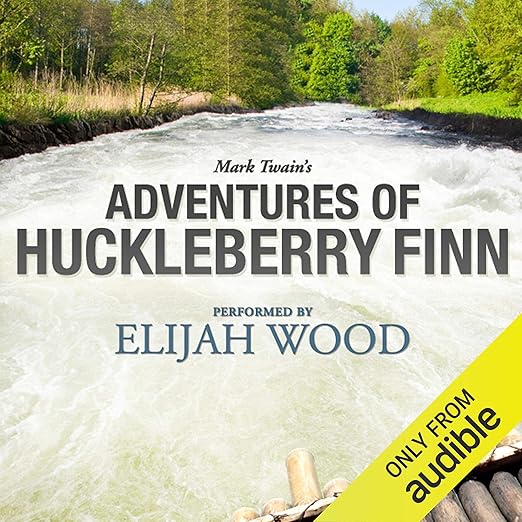
Huck Finn's voice is one of the great technical achievements in American fiction, and whether it works on audio has always depended entirely on who is doing the reading. Mark Twain built the novel on vernacular: on the rhythm of speech, the texture of regional dialect, the particular music of a boy who thinks in run-on sentences and arrives at moral truths sideways. The audiobook titled Adventures of Huckleberry Finn: A Signature Performance by Elijah Wood answers the casting question as well as any edition of this novel has managed: Wood reads Huck in what the production notes describe as the closest interpretation to Twain's original intent, and the Earphones Award from AudioFile Magazine suggests that judgment holds up to scrutiny.
Wood Finds Huck's Voice Through Adolescent Energy
The question this recording sets itself is simple but difficult: can a contemporary actor inhabit Huck's voice without making it feel like a performance of the past? Wood's answer, across ten hours and ten minutes, is that the key is not period accuracy but adolescent energy. Huck is not a historical artifact in Wood's reading. He is a specific kind of boy, the kind who would rather sleep under stars than sit in a school desk, who trusts his gut over every authority figure he meets, and who arrives at the decision to help Jim escape not through moral reasoning but through the accumulated weight of lived experience. Wood gives him a quickness, an eagerness, that keeps the novel from settling into the reverence that often traps classic literature recordings.
The moral core of the novel, the raft scenes where Huck and Jim build their friendship against the backdrop of the Mississippi and the legal reality of slavery, is where Wood's performance earns its keep most fully. Reviewer Sakuteiki describes the novel as a comedy that highlights the moral dilemma of supporting slavery versus breaking the law, and that framing captures something essential: Twain wrote a funny book about an unfunny subject, and the humor is not decoration but the mechanism through which the moral argument is made. Wood understands this. His Huck is not solemn when he reasons himself into deciding to help Jim. He is a kid making a decision the way kids make decisions, through feeling rather than philosophy, and the lightness Wood brings to those scenes makes them more devastating rather than less.
Reviewer Rick O notes the novel's linguistic ambition, calling it one of the first novels written in the vernacular with local color, and the audio format is where that ambition becomes physically audible. Reading Twain's dialect notation on the page is an exercise in decoding. Hearing it performed by someone who has internalized the rhythms turns the text into something closer to what Twain actually heard when he wrote those lines. Jim's speech patterns, the various con men Huck and Tom encounter, the different regional accents that populate the river towns: Wood does not attempt theatrical accents but he differentiates voices with enough clarity that the river's population stays distinct across a ten-hour listen.
Hemingway's Claim and an Unabridged Ten Hours
Hemingway's famous claim, quoted in the production materials, that all modern American literature comes from Huckleberry Finn is the kind of statement that inspires argument in equal measure with agreement. But there is something to the underlying point: Huck's voice, his narrative perspective, his willingness to report what he sees without fully understanding its implications, maps directly onto a tradition that runs through Salinger and McCarthy and Morrison. Hearing Wood perform that voice is a useful reminder of where so many of those registers come from.
At ten hours and ten minutes, this is a full unabridged reading. The novel's digressive structure, the episodes with the Duke and King that can feel like detours in text, flow more naturally as spoken narrative because the rhythm of Huck's voice carries you through them. Twain wrote in speech, and hearing that speech performed removes an interpretive layer that printed dialect notation always imposes between reader and text.
Unsoftened Racial Language Despite Only Twelve Ratings
The novel contains racial language that Twain used as a reflection of the period's speech patterns, and that language is present in this unabridged recording. This is not a surprise to anyone familiar with the book's history, but it is worth noting for listeners approaching the text for the first time or returning with a contemporary classroom context in mind. Wood does not soften or editorialize these moments, which is the right call for an unabridged performance but which should factor into any listening decision made with children present.
The low review count here, twelve ratings at a 4.5 average, reflects more on the recording's discoverability than on its quality. The AudioFile Earphones Award is a meaningful credential in audiobook criticism, and Wood's casting is genuinely appropriate rather than simply famous-name marketing. This is a recording that delivers on its promise.
For Readers Who Want to Hear Twain's Dialect
This audiobook suits readers returning to Twain who want to hear the novel rather than parse the dialect on the page, literature students approaching the text for the first time, and listeners who appreciate when narration enhances rather than merely delivers a classic text. Wood's performance is specific and energetic enough to reward listeners who already know the novel well.
Those who need a very short or abridged introduction to the story should seek a condensed version. And listeners who are already certain they dislike nineteenth-century American vernacular fiction will not find Wood's performance transformative on that count, but for everyone else, this is the recording that makes the strongest case for Huckleberry Finn in audio form.
The Short Version
- Narration: Elijah Wood delivers a youthful, kinetic Huck that AudioFile Magazine honored with an Earphones Award, capturing the voice of a boy who is simultaneously funny, morally alert, and perpetually in motion.
- Themes: freedom and conscience, friendship across racial divides, the hypocrisy of civilization
- Mood: Vivid, irreverent, and quietly moral
- Verdict: Wood's Earphones Award-winning performance makes this the version of Huckleberry Finn to reach for first, bringing Twain's vernacular prose to life with an energy that justifies the audio format completely.
Before You Listen
Is this audiobook of Huckleberry Finn the full unabridged text?
Yes. At ten hours and ten minutes, this is a complete unabridged performance of Twain's novel, including all of the dialect passages and the river episodes with the Duke and King that some abridged editions cut.
Does this audiobook handle the novel's racial language and historical content appropriately?
The recording is unabridged, which means the period-specific language Twain used is present throughout. Wood reads it without editorial adjustment, preserving the historical accuracy of the text. Listeners approaching the novel in educational contexts should be aware of this before using it with students.
How does this audiobook compare to other recorded versions of Huckleberry Finn?
The Elijah Wood recording is widely considered among the strongest available versions. Multiple other editions exist, but Wood's combination of youthful energy and technical accuracy is what earned the Earphones Award designation, making it the recommended first choice for new listeners to this novel.