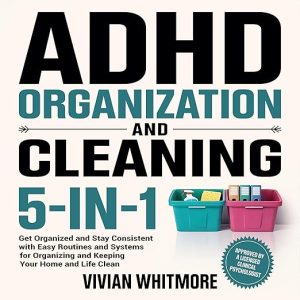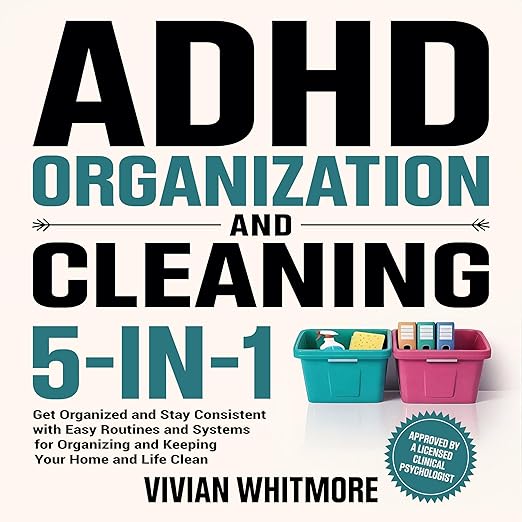
Vivian Whitmore's ADHD Organization and Cleaning 5-in-1 audiobook does something most home-organization titles refuse to do: it starts from the assumption that the problem is the system, not the person. That framing shift - stated plainly at the outset and reinforced throughout all five guides - is what separates this collection from the generic decluttering advice that fills the self-help shelf. For anyone who has watched a Pinterest-perfect routine collapse by Wednesday, that distinction matters.
Heard in one sitting or across several shorter sessions, the 6 hours and 26 minutes of content unfolds in a sequence that genuinely builds. Guide 1 lays the philosophical groundwork - what a flexible routine actually means when working memory is unreliable and dopamine drops without novelty. Guide 2 moves into habit formation, acknowledging that ADHD brains respond differently to reward timing. Guides 3 and 4 turn practical, covering decluttering methodology and what Whitmore calls the cleaning toolkit. Guide 5, on consistency and bouncing back from setbacks, may be the most honest of the set: it accepts from the start that systems will break down and frames that not as failure but as the inevitable rhythm of an ADHD life.
The five-guide structure pays off. Rather than one stretched-out book padded to length, each section feels proportional to its content. Guide 3 on decluttering in particular lands a specific insight that reviewers have flagged: a method for reducing decision fatigue during the sorting process. For ADHD listeners, decision fatigue is often where decluttering efforts collapse - you get through two boxes and then spend forty-five minutes staring at a birthday card from 2011. Whitmore's approach provides decision criteria upfront, so the choices during the session are pre-made rather than improvised. That is a meaningful difference in practice.
Lance Adams reads the material in a measured, non-urgent tone that suits the subject well. Organization guides can sometimes tip into motivational-speaker energy, which tends to age badly and feel hollow on re-listen. Adams keeps things grounded. He reads like someone explaining a process rather than selling an outcome, and the steady pacing makes the content easy to absorb even for listeners whose attention drifts. The audiobook format works particularly well here because the conversational tone lands more warmly than print, and listeners can use the audio as a companion while doing the actual work - sorting, folding, creating the systems as they hear about them.
Kind Rather Than Lecturing Wins a Gift Buyer
One of the reviews in the listing comes from a listener who purchased the book as a housewarming gift for a younger sibling with ADHD, specifically because the tone felt kind rather than lecturing. That observation reflects something real about Whitmore's approach: she does not position ADHD as a deficit to be overcome through discipline. She treats it as a cognitive style that requires different infrastructure. The "flexible daily rhythm" concept in Guide 1 is the practical expression of that - instead of prescribing a fixed morning checklist, the guide offers a skeleton structure that listeners can reorder based on what is actually working that day.
Another listener, Pete Holanda, described coming to the book as someone dealing with a deceased relative's belongings - a mountain of school and art supplies accumulated over a lifetime. His note about needing an outline and structure to address decision barriers resonates with the collection's core argument: that getting started is often harder than the task itself, and that the right system lowers the activation energy required to begin. Whitmore's approach throughout is to make the entry point as low-friction as possible, which is easier said than engineered - but the five-guide sequence, where each builds on the last, is a genuine attempt at doing so.
Little-Known Method Rests on Old Behavioral Science
The collection's greatest strength is also its limit: the flexibility it advocates can make the advice feel nonspecific at moments. Listeners looking for a strict 30-day plan with daily assignments will not find it here. The guides are intentionally open-ended in places, which is philosophically consistent but can occasionally leave a listener wanting more concrete examples. The section on habit formation, in particular, covers the science at a fairly general level - anyone already familiar with the ADHD-specific research on dopamine and reinforcement may find it covers familiar ground without pushing into new territory.
The "little-known decluttering method" referenced in the synopsis also turns out to be more repackaged than proprietary. The underlying principle - batch decisions before you begin rather than during the sort - is not new, but Whitmore's framing of it for an ADHD context is genuinely useful. It is worth knowing going in that this is a practical guide built on existing behavioral science rather than original research. That does not undermine its value, but listeners expecting a groundbreaking system may want to calibrate their expectations toward "well-organized and compassionately framed" rather than "revolutionary."
Six and a Half Hours of Grounded Listening
This audiobook is well suited for adults with ADHD who have tried and abandoned conventional organizing systems, and for people who recognize that their struggles with clutter and consistency are not a matter of effort or character. It is also a reasonable choice for caregivers, parents, or partners of people with ADHD who want to understand what makes standard advice ineffective. Those looking for a rigid, prescriptive daily plan or original clinical research will find the collection too open-ended. But for listeners who need to hear that the system was never designed for how their brain works - and who want a structured but forgiving framework for building something new - all five guides offer genuine, usable direction across six and a half hours of consistently grounded listening.
Good to Know
Does the audiobook work as a standalone, or do you need to read the print version alongside it?
It functions as a complete standalone. The five-guide structure is designed to be listened to sequentially, and no companion workbook or print materials are required. Some listeners find it useful to pause and take notes after each guide, but the audio is self-contained.
Is this audiobook specifically for people with a formal ADHD diagnosis, or is it useful for anyone who struggles with clutter and routines?
Whitmore's approach targets ADHD-specific challenges, but the underlying methods, reducing decision fatigue, building flexible rather than rigid routines, and designing low-activation-energy entry points, apply broadly to anyone who has found standard organizing systems unsustainable. A formal diagnosis is not a prerequisite for getting value from the content.
How does Lance Adams's narration hold up across the full six-plus hours?
Adams maintains a consistent, calm register throughout all five guides without allowing the pacing to become monotonous. There is no dramatic performance here, the narration is workmanlike in the best sense, keeping the focus on the content rather than the delivery. For a practical guide meant to be absorbed and applied, that restraint works in the listener's favor.