At a Glance
- Voice: Greg Hawks self-narrates with the timing of someone who has delivered this material live for years, and the humor lands because of it.
- Big ideas: workplace culture, ownership mindset, employee engagement
- Atmosphere: Brisk and practical, closer to workshop energy than lecture
- Worth it?: A tightly built, self-narrated leadership framework that rewards managers more than it rewards passive listeners.
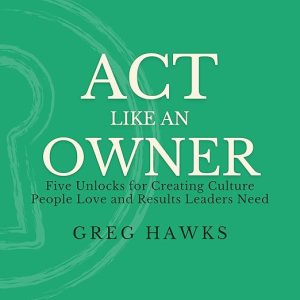
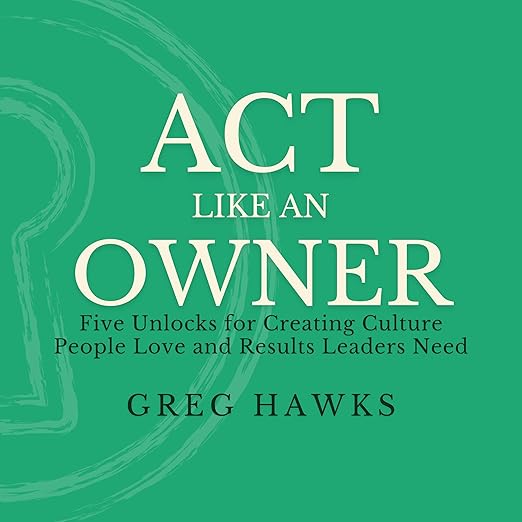
Owners, Renters, and Vandals sat through the same staff meetings long before Greg Hawks gave them those names, and figuring out which one you have been recently is the uncomfortable opening move of this audiobook. Hawks, who narrates his own material, built Act Like an Owner around that three-part metaphor: Owners bring heart, head, and hands to their work, Renters show up with only their hands, and Vandals actively bring division and strife into a team. Reviewer Sarah traces her own use of the framework back more than fifteen years, to a keynote where Hawks first introduced it, and says she has 'lived as an owner ever since'. At three hours and forty-nine minutes, this is a tightly built listen rather than a sprawling business epic, organized around five specific practices Hawks calls the Unlocks of an Owner's Mindset.
Five Unlocks, Under Forty-Six Minutes Each
The heart of the book is a five-part structure: Risk Bold Commitments, Activate Lasting Change, Reach for Responsibility, Widen the Circle, and Think Whole House. Spread across under four hours, that works out to well under forty-six minutes of material per Unlock on average, which forces Hawks to stay concrete rather than circling each idea with padding. Each chapter pairs a story, some genuine humor, and research with reflection questions meant to be applied immediately rather than filed away for later. Reviewer Tom calls the result 'refreshingly practical', and the design supports that read: this is a framework built for chapter-by-chapter use at work, not a single continuous argument that only pays off at the very end.
Hawks pitches the Owner-Renter-Vandal metaphor as a diagnostic tool as much as a motivational one, giving leaders and teams language to name a cultural problem before trying to fix it. Reviewer Randy Nail specifically credits the book with supplying 'new language to help frame the challenge' of employee engagement, language he describes as drawn from the marketplace and easily understood, which tracks with how plainly the synopsis itself talks about turning disengagement into buy-in and compliance into contribution. It is a business book aimed squarely at the daily friction of running or working inside a team, not at abstract organizational theory floating above it.
Hawks also grounds the framework in a short, specific list of business outcomes rather than vague aspiration: employee engagement, leadership development, organizational culture, performance, and talent retention. That specificity matters because it gives a reader or listener a way to test the framework against their own workplace's actual pain points rather than nodding along to abstract talk of culture in general. The synopsis promises 'stronger trust, greater accountability, and cultures that attract top talent while delivering measurable growth', concrete enough outcomes that a team could plausibly check progress against them months after finishing the book, not just feel briefly inspired by them.
Naming an Active-Harm Category Most Books Skip
Hawks narrating his own book is close to a necessity here rather than a nice bonus. Sarah's review makes clear he has been delivering this exact material live, on stages, for well over a decade, and that kind of rehearsed clarity is audible in how cleanly the chapters move between story, humor, and direct instruction. A hired narrator could read the words accurately, but the timing on the humor specifically, the thing multiple reviewers single out unprompted, is much harder to fake without having actually told these jokes to a live room many times before this recording.
Because each Unlock gets its own short, self-contained treatment, this is also an easy audiobook to return to for a single fifteen-to-twenty-minute chapter rather than a full relisten from the start. That structure suits a manager who wants to revisit 'Reach for Responsibility' specifically before a difficult conversation, without needing to remember which hour of a longer, less segmented business book that idea lived in originally. Short runtime, in this case, functions as a feature of the format rather than a shortcoming to work around.
What keeps the Owner-Renter-Vandal framework from feeling like corporate jargon is how blunt the third category is. Most workplace culture books stop at two categories, engaged versus disengaged, but naming an active saboteur category, Vandals, who bring 'division and strife' rather than just apathy, is a sharper and more honest acknowledgment that some culture problems come from active harm, not passive disengagement. Reviewer Tom's praise for the book's 'very actionable concepts' seems to trace directly back to that willingness to name an uncomfortable category most similar books soften or skip over entirely.
Hawks Reads Aloud While You're Driving
The reflection questions built into each chapter are the one place the audio format shows real friction. Hawks reads them aloud the way he would in a live workshop, pausing for effect, but a listener driving or exercising has no way to actually stop and write down an answer in the moment the way the print or workbook version invites. Pairing this audiobook with a notebook, or planning to revisit specific chapters later with pen in hand, gets a listener closer to the full intended experience than one straight listen-through alone will.
At under four hours, Act Like an Owner also does not have room to build out extended case studies the way a longer leadership book might attempt. The five Unlocks get real, workable definitions and enough story to illustrate each one, but listeners hoping for a deep, book-length dive into any single practice, say a full hour just on Widen the Circle, will find the treatment brisk by design. This is a framework delivered efficiently rather than one explored exhaustively from every angle.
New-hire onboarding is a natural secondary use case worth mentioning specifically, since the Owner-Renter-Vandal framework gives a new employee vocabulary for company culture within their first weeks rather than months of picking it up by osmosis. The full audiobook still works better as an intentional team read or manager-led discussion than as a passive first-day orientation video replacement, but individual chapters translate cleanly to that narrower onboarding use if a team wants to introduce the language early.
This Stays Practical Instead of Exhaustive
Managers and team leads looking for shared vocabulary to diagnose a struggling culture are the clearest audience, along with anyone who has sat through Hawks's live keynote before and wants the fuller version of the framework. The short runtime also makes this a realistic pick for a single commute-length introduction ahead of a team read or an offsite discussion.
Teams already using some version of shared culture language, an annual engagement survey, a values statement pinned to a wall, will find the Owner-Renter-Vandal vocabulary layers cleanly on top of whatever framework already exists, giving otherwise abstract survey results a concrete, conversational shorthand to use in an actual one-on-one or team meeting. That is a lower bar to clear than introducing a wholly new framework from scratch, which is part of why the book reads as immediately usable rather than aspirational.
Executives hunting for a comprehensive change-management text with extensive data and case studies should look elsewhere. This works best as a practical, quickly absorbed framework rather than an exhaustive business school treatment of organizational culture.
Frequently Asked Questions
Does Greg Hawks narrate the Act Like an Owner audiobook himself?
Yes, and reviewers who have seen him speak live describe his delivery as carrying the same keynote energy into the recording booth.
Is the Act Like an Owner audiobook long enough to cover all five Unlocks in real depth?
At under four hours it moves briskly through each of the five Unlocks rather than exploring any single one exhaustively, prioritizing usable clarity over exhaustive depth.
Can I use the reflection questions from Act Like an Owner while listening to the audiobook?
You can hear them, but answering in the moment is harder without pausing to write, so pairing the audio with a notebook or the print edition gets closer to the intended workshop experience.