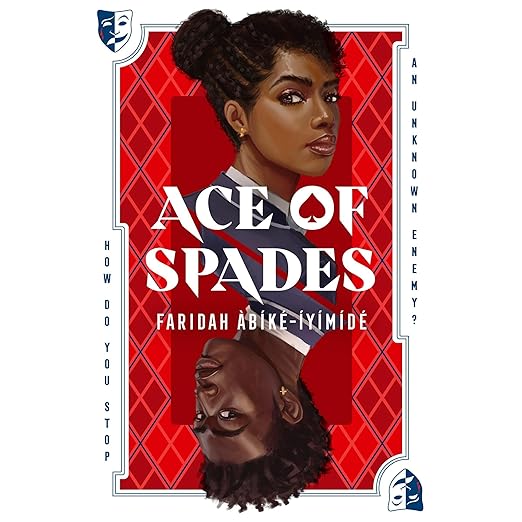
Quick Take
- Voice: Jeanette Illidge delivers the alternating Devon and Chiamaka perspectives with emotional precision, capturing the very different ways these two characters experience the same institutional hostility.
- Big ideas: Racism within elite institutions, the weaponization of secrets, the cost of assimilation and its limits
- Atmosphere: Propulsive and unsettling, with sharp social edges beneath the thriller surface
- Worth it?: A debut YA thriller that earns its Gossip Girl meets Get Out premise by making both the social drama and the institutional horror genuinely disturbing; the social commentary is built into the plot rather than added on top of it.
I finished this one in an afternoon and an evening, which is exactly the pace Faridah Abiké-Iyimide designed it for. Ace of Spades is the kind of book that grabs you early and then refuses to let you settle. By the time the anonymous texter called Aces begins systematically dismantling the lives of Devon Richards and Chiamaka Adebayo, you are already too invested in both of them to step back.
The Gossip Girl meets Get Out comparison in the marketing materials is both accurate and, for readers who have not encountered the book yet, potentially misleading in one specific direction. The Gossip Girl element is real: the anonymous message campaign, the elite private school setting, the way social status and secrets become weapons. But Get Out is the more important half of that equation. Aces is not a surface-level commentary on racism; it is a book about the specific violence of institutions that accept Black students while systematically refusing to protect them.
Is Ace of Spades Worth Your Time?
Devon and Chiamaka could not be more different as characters, and Abiké-Iyimide is deliberate about that contrast. Chiamaka is ambitious, polished, and operating within Niveus Private Academy's systems with full awareness of what she is trading for her position there. Devon is quieter, less comfortable with the compromises the school demands, and carrying secrets that would cost him more given the homophobia woven through the institution's culture. One reviewer admitted to not particularly liking either character, then immediately noted that this does not matter because what matters is what happens to them. That is exactly right. This is a book about an environment, and the characters are partly vehicles for revealing it.
The plot mechanics around the Aces messages are carefully constructed. The escalation from social embarrassment to genuine physical danger is paced well enough that each new revelation hits harder than the last. The twist the book builds toward, which reviewers describe in terms that suggest it changes everything that came before it, is earned by the setup rather than conjured out of nowhere.
The Best Parts of Ace of Spades
Jeanette Illidge's narration is one of the more technically impressive performances in the recent YA audiobook space. Devon and Chiamaka are both first-person narrators in alternating chapters, and Illidge gives each of them a genuinely distinct voice, not just a vocal register difference but a different emotional relationship to what they are describing. Chiamaka's sections carry a particular controlled quality, her narration reflecting the self-management her ambition requires. Devon's have more uncertainty in the texture. The contrast is doing real character work.
The alternating structure also suits the thriller format well. Each chapter ends at a point that makes it uncomfortable to stop listening, which is a structural choice Abiké-Iyimide executes with considerable skill for a debut novelist.
Before You Commit to Ace of Spades
The social commentary in this book is not separate from the thriller plot; it is the thriller plot. The racism Devon and Chiamaka experience at Niveus is not background texture for a mystery about an anonymous bully. The anonymous bully's actions are themselves an extension of the institutional racism the school embeds in its operations. Listeners who approach this as primarily a plot thriller may be surprised by how much the book asks them to think about the systems Devon and Chiamaka are navigating before the crisis begins.
The ending has generated strong reactions. One reviewer described it as the most amazing plot twist they had ever read. Another found it required time to process. Both reactions suggest Abiké-Iyimide is swinging for something larger than genre convention, and largely connecting.
Should You Listen to Ace of Spades?
YA readers who want their thrillers to carry real institutional weight alongside the plot mechanics will find this among the better recent examples of the form. Listeners who enjoy books where social commentary and genre plotting are genuinely integrated rather than awkwardly layered will find the construction smart. Those looking for a lighter mystery or a primarily character-driven YA without significant darkness should be aware that this book becomes genuinely disturbing in its second half. The author's note, read by Abiké-Iyimide herself in this production, adds meaningful context for listeners who want to understand the roots of the story.