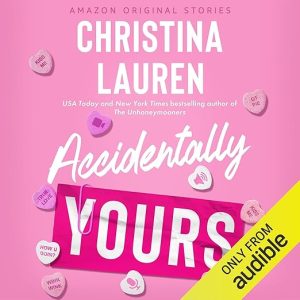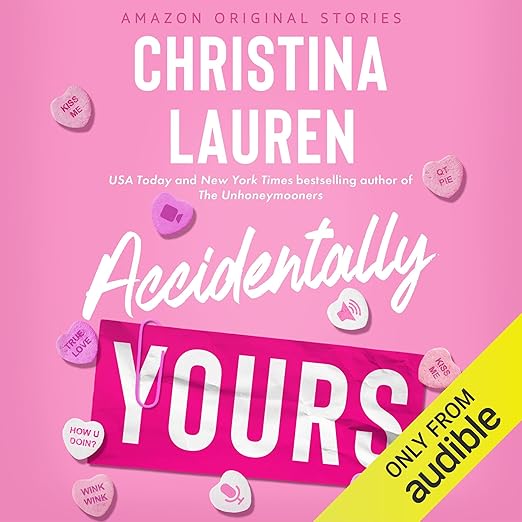
- Read by: Dominique Salvacion handles both halves of an email flirtation alone, which is harder than the short runtime makes it sound.
- At its heart: meet-cute by video call mishap, office email flirtation, a Valentine's deadline.
- Vibe: light, quick, deliberately weightless.
- Short version: a well-built single-sitting romance, worth judging as a short story rather than as a compressed novel.
One hour and forty-four minutes is the whole audiobook, which puts this closer to a lunch break than to a listening project, and the copy says as much outright: the stories in this set can be read or listened to in a single sitting. Everything about how it deserves to be judged follows from that. A short story owes you no subplot, no slow burn, and no fully furnished second lead, so the only fair question is whether the hour and three quarters is well spent.
How Accidentally Yours Holds Up
Christina Lauren is the byline, and the description leans hard on recognition, name-checking The Unhoneymooners and My Favorite Half-Night Stand before it gets anywhere near the plot. For a novella built to be sampled by people who already know the house style, that is the right order of operations: banter first, emotional beat second, resolution well inside the runtime. The review column suggests the machinery works, since four of the five visible grades sit at four stars or higher. A short story is also the cheapest way to test whether a name still sells, and this one arrived on January 20, 2026, timed to land ahead of the holiday it keeps referencing.
Veronica, a marketing consultant, crashes the wrong Zoom meeting, demolishes a presentation that was never meant for her ears, and comes away with a job offer from the company's intriguing chief executive. Her attention, meanwhile, keeps drifting toward a reserved and gorgeous new neighbor. The blurb keeps those two hooks carefully apart and lets an approaching Valentine's Day supply the deadline, which is about as much structure as a story this length can carry without buckling. Almost nothing about the neighbor makes it into the description, which reads as coy or as thin depending on how generously you treat marketing copy written for a set rather than for a book.
Dominique Salvacion reads it, and that credit raises a specific craft problem rather than a general one. A real share of this story happens in email, by the publisher's account and by two reviewers' accounts, and email is among the hardest things in romance to perform aloud. Played straight it goes flat; pushed too hard it turns into a sketch. One reader handling both halves of a flirty exchange is doing considerably more work than the runtime implies.
Eighteen votes sit behind the 4.2, and the five grades that arrived with text run 5, 4, 3, 5, and 4. The lone three-star is easily the most useful of them: it calls the meet-cute a tad improbable, praises the banter, finds Veronica a little juvenile, and adds that a longer version might have fixed the problem with more room for her character. That is a review doing its job properly, and it is the one to read first. The remaining votes arrived without a word attached, which is ordinary for a title this new and this short, and it does leave the badge resting on opinions nobody can inspect.
Jude is the name two reviewers use for the love interest, and the description never uses it once. Anyone who likes going in clean should know that before scrolling, because the blurb's structure points toward a reveal and the responses underneath hand over a piece of it. Nothing catastrophic gets ruined. The page and the people reviewing it are simply telling slightly different versions of what happens, and only one of them was written to sell you the story. The blurb, for its part, names nobody but Veronica.
Amazon Original Stories sits in the publisher line, and that format explains much of what this actually is. These sets are commissioned as quick single-sitting reads with recognizable names attached and released in clusters, which is why the pacing feels engineered rather than merely brisk. One reviewer counts six novellas in the collection; another describes working through the whole set of authors as the real attraction, with this entry as the opening move.
Weak Spots in Accidentally Yours
Five written responses, and they do not agree about what kind of romance this is. Two describe a second-chance story, one of them writing about watching two people stumble back into each other's orbit and realize the timing had simply been wrong before. Another describes a first meeting between people who turn out not to be strangers after all. The series name says Second Chances. Read that disagreement as a hint about how the reveal is built. A split like that one usually means the story is doing something structural, not that five people read carelessly.
Novella pacing means the emotional turns arrive fast, and the reviewers who loved it loved exactly that: sharp banter, a quick slide from professional email into playful flirtation, a lot of heart packed into very little space. The cooler responses point at the same compression from the other side. Under two hours, a character has time to be charming or time to be complicated, and only rarely gets to be both at once. Worth noting too that the responses call it a quick read rather than a quick listen, which is a small tell about where this collection's audience currently sits.
Second-guessing the heat level is reasonable, because the record gives you nothing to work with. The copy calls it funny and flirty, the category tag reads Romantic Comedy, and not one of the five responses mentions explicit content in either direction. Treat it as safe for shared headphones until proven otherwise, and note that a promise of the perfect match by Valentine's Day is not the sort of ending anybody here is pretending to hide.
The Right Listener for Accidentally Yours
Listeners who want a palate cleanser between two long books are the obvious audience, along with anyone who has already read the collection on paper and wants this particular entry in audio. It also works as a first taste of Christina Lauren for someone deciding whether to commit to a full novel, though a novella is an unfair sample of any writer who normally has three hundred pages of room to work in.
At this length the wrong pick is easy to describe. Anyone wanting a developed romance with a real middle should go straight to a novel, and anyone who finds epistolary flirting tedious will find a sizable portion of this story unreachable. What is left is a well-made short with a strong hook, a reader working both sides of an inbox alone, and a rating friendlier than its most thoughtful review. Under two hours is the right size for this, and the listing does not pretend otherwise.