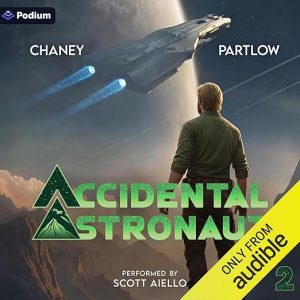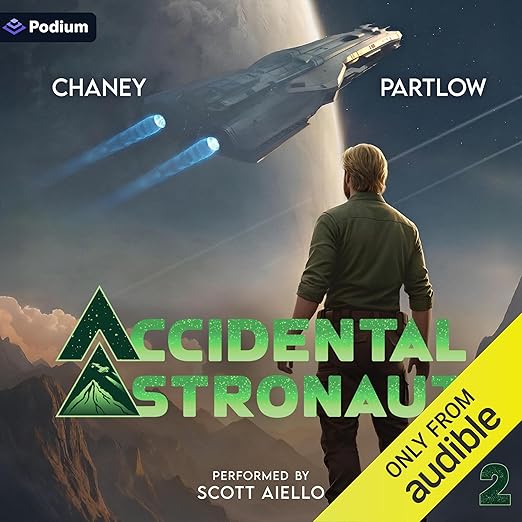
Sunlight now falls on a world whose people have never known day or night, and Dravos is not handling it well. Jack Schafer saved Earth by accident in the first book; here he is holding a frightened kingdom together while its nobles plot, its king demands answers he does not have, and the Archon Draven, the centuries-old tyrant Jack thought he had disposed of, recovers somewhere in the mountains. Scott Aiello reads the eight-hour-and-fifty-two-minute audiobook for Podium Audio, published in March 2026.
Chaney's second volume is a consolidation book and it knows exactly what it is. The first one had a premise to spend; this one has a kingdom to run. Rebellion spreads, old enemies turn into uneasy allies, and Jack, Lisa and Erik spend most of their time holding something fragile in place rather than storming anything. That is a harder book to write than a rescue, and a more interesting one to sit with.
Four clauses from a 24 January 2026 five-star set expectations well: tons of action, strong characters, mild romance, some death. Both of those last two are worth taking literally. The romance stays genuinely mild and the deaths genuinely land, which is a fair calibration for anybody deciding whether this counts as a comfort read or something with teeth in it.
What lifts it above faction bookkeeping is the situation underneath. A planet dropped into a new star system, with permanent sunlight arriving on people who have never had a sun at all, is a strange and productive starting condition, and the terror the copy describes is the right response to it. Chaney uses that as pressure on the politics rather than as backdrop, which is why the palace scenes carry weight.
Why Accidental Astronaut 2 Works as an Audiobook
Factions are the reason. A five-star from 30 January 2026 lists them without pausing for breath: the lion people consolidating inside the city, the Ellians arriving alongside Jack, the Barons attempting a usurpation, androids prowling and fighting whoever is nearest, and the Archon's plans surfacing beneath all of it. Keeping six interests audibly separate across nearly nine hours is a specific and difficult job, and it decides whether a battle scene is followable or simply loud.
Register is the second demand and it comes straight from the setting. This is a world with electricity and blaster-style weapons where people ride horses and fight with swords, spears and arrows, so one reader has to make both halves sound native to the same place. Done badly, every scene turns into a joke about anachronism. Done well, the mixture becomes the planet's signature and stops feeling like a contradiction at all.
Eight hours and fifty-two minutes is well judged for the material. Long enough to give the maneuvering room to breathe, short enough that the holding pattern never becomes the entire book, and easily taken in two decent sittings. The copy promises a strike back after the defensive stretch, and a runtime this size leaves honest room for both halves of that shape.
Weak Spots in Accidental Astronaut 2
Science Fiction is the tag, and the strongest dissent on this page disputes it. Gary S. Brown, filing three stars in January 2026, calls it a good book that is much more a historical novel than a science fiction one: an alien world carrying a medieval-England-style kingdom, electricity and advanced blasters available but horses, swords, spears and arrows doing most of the actual fighting. That response came looking for spaceships and technology and did not find them, which makes it the single most useful paragraph on the page.
Dates repay attention as well. All four written responses were filed between 24 January and 2 February 2026 while this recording was published on 10 March, so every one of them predates the audio by five to seven weeks. They grade the text edition that reached readers first, which is legitimate and not the same product. Four accounts also stand against 457 counted ratings, and by coincidence their grades, three fives and a three, average exactly the 4.5 the page displays.
Two of those four give away a great deal, which matters more than usual here. A five-star from early February walks through late developments in detail, including where one pursuit ends up and who is left standing at that point, in enough depth that a listener would reach the final hour already knowing its shape. Read the responses afterward rather than before, or read only the three-star, which stays at the level of genre and setting throughout.
Spelling is the last flag. The villain's name is not stable on this page: the description calls him the Archon Draven and one response agrees, while another spells him Dervin twice over. Nothing reconciles the two spellings, so anybody searching out series discussion will need to try both before concluding that nobody is talking about this book.
The Right Listener for Accidental Astronaut 2
Series readers coming straight off book one are the obvious audience and will find this a natural continuation, since the copy treats the Earth rescue, the adopted home and the Archon's first defeat as settled background. Anyone who enjoys planetary adventure in which politics carry as much weight as combat will get on with it too, because roughly half the running time is spent on who owes what to whom.
Look elsewhere if you want hard science fiction. The three-star on this page is a fair warning rather than a hostile one: expect a kingdom, barons, cavalry and blades with a technological layer laid over the top, and expect the wonder to come from the planet's predicament rather than from engineering. Nobody arriving for spacecraft will be satisfied by the compromise.
Newcomers should start at book one regardless. Jack's accidental heroism only reads as accidental if you witnessed the accident, and this volume opens with a relationship to Dravos, to its king and to the Archon that took a whole book to build. A war already in progress makes a bad introduction to a man whose defining characteristic is that he never wanted the job.
Quick Take
- Narrator: Scott Aiello has six factions to keep separable, from lion people to Barons to androids, on a planet where blasters and cavalry share a battlefield.
- Subjects: Accidental heroism, a world dropped into a new sun, rebellion and uneasy alliances
- Tone: Busy, martial and good-humored
- Bottom line: A solid second volume, once you accept that this kingdom plot is wearing a science fiction tag.
Before You Listen
Is the Accidental Astronaut 2 audiobook really science fiction?
Partly. The setting is another planet, and most of the fighting happens with swords, spears, arrows and horses inside a medieval-style kingdom despite the technology lying around it. The three-star on the page makes that objection directly, having arrived hoping for spaceships and technology. Take it as planetary adventure with a technological layer.
Can you start here, or is book one required?
Book one is required. The copy opens with Jack having saved Earth by accident, having adopted Dravos as home, and having already beaten the Archon Draven once. All three facts carry weight and none is explained again. Regulars will slot straight in, while newcomers spend the first hour reconstructing what they missed.
Does the eight-hour-and-fifty-two-minute audiobook move quickly?
It divides between a holding action and a counterattack, which keeps momentum through the political stretches. Podium Audio published it in March 2026 with Scott Aiello reading. Under nine hours makes a comfortable two-sitting listen, and the faction shuffling in the middle is the part that rewards continuous attention most.
Does the permanent daylight get explained, or is it just scenery?
The copy treats it as an active problem. Dravos has fallen into a new star system, its people are terrified by sunlight they have never had, and the king wants answers Jack cannot give him. That pressure is what drives the nobles to plot and the rebellion to spread, so the premise does real work.