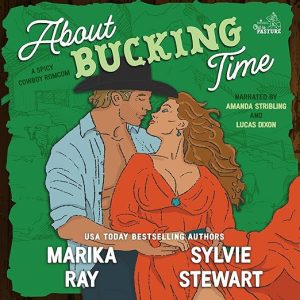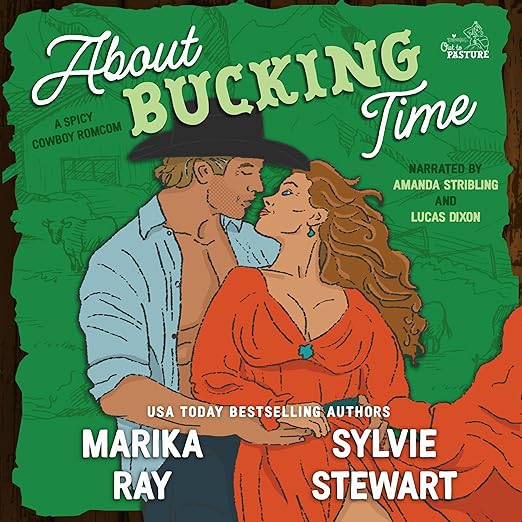
The friends-to-lovers trope has a long and well-mapped history in romance fiction, but Marika Ray's approach in About Bucking Time, the first audiobook in her Out to Pasture series, reconfigures the formula in a way that feels genuinely distinct. The protagonist is approaching forty, navigating perimenopause, recently out of another disappointing relationship, and specifically not interested in being rescued. Her best friend Dallas Gamble blurts out a public engagement claim to protect her, and from that impulsive moment the book's central tension develops: what happens when a man who has always been impulsively protective finally tries, deliberately and sincerely, and disaster still follows him everywhere?
Ray writes comedy as structural architecture rather than as decoration, and that discipline shows throughout. The chaos, the weed-smoking Meemaw, the runaway heifer, the drunken marriage pact, the herd of siblings with opinions, none of it is arbitrary. Each disaster lands the two protagonists in closer proximity and forces a reckoning that a less chaotic setup would never produce. Fans of the genre who have read Ray's other work will recognize the fingerprint: physical comedy layered over genuine emotional vulnerability, always moving toward honesty rather than away from it.
Our Take on About Bucking Time
What separates About Bucking Time from the broader landscape of cowboy romance is the protagonist's age and her complete awareness of her own history. She is not a woman who has not yet figured herself out. She is a veterinarian who knows exactly who she is, knows what she has been through, and knows precisely why the stakes of crossing a line with her best friend are higher than they would be for someone younger with less to lose. That self-awareness drives the central conflict in a way that feels earned rather than contrived. The tension is not about miscommunication. It is about a woman doing the math on what a genuine risk looks like when you are no longer willing to rebuild from scratch.
Ray is explicit in her synopsis that this book does not have a third-act breakup, and that the heroine refuses to play that game. This is a statement of craft philosophy rather than just a plot detail. Many romances earn their emotional peaks through the false crisis of a late-act separation. About Bucking Time finds its emotional altitude through escalation of genuine feeling and grand gestures, plural, that the synopsis promises and the book delivers. Several reviewers singled out Dallas as the quintessential cowboy romantic lead: impulsive, protective, and utterly committed once he finally commits. One reviewer described Stribling and Ray as keeping readers on their toes, finding heartstrings, and creating laughter simultaneously, which is an accurate description of the reading experience.
Why Listen to About Bucking Time
Amanda Stribling's narration is a significant asset in an audiobook where the comedy is heavily physical and situational. The Meemaw scenes, which reviewers identify with obvious delight, require a performer who can calibrate broad humor without tipping into farce, and Stribling handles that balance well. The romantic moments, which arrive with more sincerity than the comic exterior of the book might suggest, need a different register, and Stribling shifts between those modes cleanly. The banter between the two protagonists, which is the engine of the early chapters, lands with the timing it needs to sustain the longer sequences of comedic misfire.
At 8.5 hours, the listen is substantial enough to develop genuine affection for the supporting cast, who function as a preview of the wider Out to Pasture series. The sibling dynamics, the community interference, and the extended family system that orbits Dallas and the protagonist are clearly being constructed with the series arc in mind. Reviewers noted the supporting characters as a particular draw, anticipating their own books within the series.
What to Watch For in About Bucking Time
Readers coming to this book expecting a quieter, introspective treatment of later-in-life romance will find the comic register louder than anticipated. Ray commits to farce in her setpieces, and the perimenopause detail, while handled with both honesty and humor, is central rather than incidental. This is a romcom that leans into the comedy half of the label. The emotional sincerity is real but arrives through, not despite, the chaos.
As the series opener, About Bucking Time also does significant world-building work for the Out to Pasture series. Readers who prefer self-contained romances without attachment to a larger ensemble may find the number of introduced characters slightly crowded. The payoff for that investment is a richly populated small-town community that functions as a living ecosystem around the central couple. Spice level, for readers who calibrate by that metric, is present but not the dominant feature of the audiobook.
Who Should Listen to About Bucking Time
This is exactly the right audiobook for romance listeners who have grown impatient with heroines who do not know their own minds, or with protagonists whose age and life experience feel unconvincing. Shelby, the veterinarian at the center of the story, is a fully formed adult with a history and a specific set of concerns that the book takes seriously even while surrounding her with mayhem. Readers who love small-town cowboy romance, friends-to-lovers dynamics, or romantic comedies with genuine comedic infrastructure will find this satisfying.
Listeners who strongly dislike ensemble setups or who prefer the third-act breakup as a structural element may find the book's deliberate subversion of that convention unsatisfying. But for those who have been looking for a later-in-life romantic comedy with a heroine who refuses to be a passive subject of the plot, About Bucking Time is a confident series launch.
What is the spice level of the About Bucking Time audiobook?
The book has romantic heat, but the dominant tone is comedic rather than explicit. The synopsis promises grand gestures and a happily ever after without a third-act breakup, and the emotional and comedic elements take more real estate than the steamy content. Reviewers describe it as a banter-forward friends-to-lovers romance rather than a heat-first read.
How does Amanda Stribling handle the comedic and emotional range of this audiobook?
Stribling manages the tonal shifts well. The Meemaw scenes and the comedic disaster setpieces require a broad performance register, while the quieter moments of Dallas and Shelby's evolving relationship need something more restrained. Reviewers describe the listening experience as laugh-out-loud funny while also landing emotionally, which reflects Stribling's ability to navigate both registers across 8.5 hours.