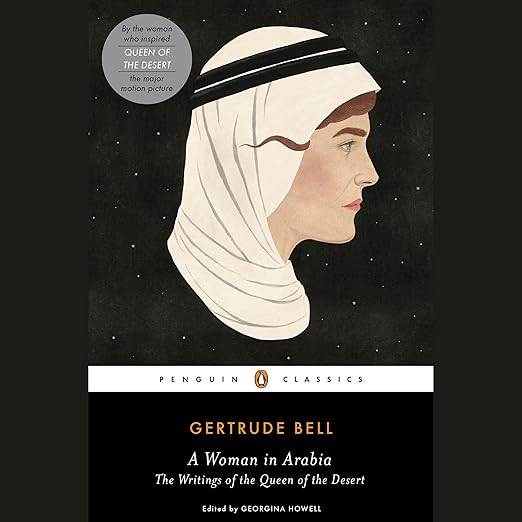
Gertrude Bell wrote her letters and dispatches knowing they would be read, and in some cases knowing they would be acted upon by governments and commanders in the field. That awareness, of an audience both personal and political, gives this audiobook compilation a particular double quality: it is intimate and strategic simultaneously, often in the same paragraph. Sian Thomas narrates the assembled writings with the precision and tonal range that this kind of primary source collection genuinely requires from a skilled performer.
The volume that Penguin Classics assembled here draws from Bell's letters, military dispatches, diary entries, and travel writings to build what amounts to an autobiography by selection. The editorial choice to organize by theme rather than strict chronology, a decision that one reader noted distinguishes this collection from Bell's complete diary, has the effect of sharpening the portrait of Bell as a mind and a force rather than simply narrating her timeline from birth to death. The result is a collection that reveals character rather than events, though the events are extraordinary enough on their own terms.
The range she occupied is almost absurd when viewed all at once: mountaineer, archaeologist, linguist, Arabist, military intelligence operative, and the chief architect of British policy in the post-World War I Middle East, the person most responsible for drawing the borders that define the region today. She turned her back on Victorian society to study at Oxford at a time when women could not receive degrees from the institution, and she did not stop there. Bell was leaning in 100 years before that phrase existed as cultural shorthand for female professional ambition, as the book's own framing observes.
The line she wrote in one of her letters, that it is a bore being a woman when you are in Arabia, is characteristic of her voice throughout: forthright, self-deprecating, drily funny, and entirely aware of the structural conditions she was operating inside without being defined or limited by them. Thomas renders that voice with appropriate complexity and range.
Sian Thomas Moves Between Letters and Dispatches
The audiobook carries the dual authority of primary source material and contemporary relevance. Bell was instrumental in the political architecture of a region that remains central to global affairs, and her on-the-ground accounts of the Arab leaders, tribal dynamics, and colonial pressures she navigated are not historical curiosities. They are testimony from someone who was in the room where decisions were made, who held strong and well-informed views about what those decisions should be, and who sometimes succeeded in shaping them in significant and lasting ways.
Thomas's narration handles the tonal range of the assembled materials with genuine skill. The personal letters, addressed to family members with affection and humor, require a different register than the military dispatches or formal travel writing. Thomas moves between these modes without jarring the listener. The effect is of hearing a complete person across different professional and personal contexts, which is precisely what the best primary source collections accomplish when the subject is worth the attention being paid.
Thematic Order Filters Bell's Own Voice
Listeners should be aware that this is a curated compilation, not a complete or chronologically arranged memoir. The thematic organization means that the reader encounters Bell's voice as organized and filtered through an editorial perspective rather than in the sequence in which she lived and wrote. That organization is clearly signaled throughout, and for most purposes it works very well, producing a coherent portrait rather than an overwhelming archive of correspondence. Listeners who want strict chronological narrative, or who want all of Bell's writing on a particular period or region, should note the structural choice and consider supplementing with a full-length biography.
The contemporary resonances are difficult to ignore and should not be. Bell's role in drawing the borders of Iraq in particular, and her accounts of the competing pressures from Arab nationalist aspirations, British imperial interests, and emerging regional power dynamics, read differently now than when this collection was first assembled. Her championship of the Arab cause was genuine, even as it operated within a colonial framework she did not fundamentally question. The audiobook presents that complexity without resolving it artificially, which is the honest approach to this kind of primary source material.
Sustained Listening Rewards Patient History Readers
This audiobook is the right starting point for anyone who encountered Gertrude Bell through the PBS documentary Letters from Baghdad, voiced by Tilda Swinton, or the Werner Herzog film Queen of the Desert starring Nicole Kidman, and wants to hear Bell's actual voice rather than a dramatized version. It is also essential for anyone with serious interest in Middle Eastern history, the political settlements after World War I, or the history of women operating within and against imperial structures in the early twentieth century.
Listeners looking for narrative biography with the shape and pace of a single driving story should look at secondary sources rather than this compilation. A Woman in Arabia is an edited primary source, and it rewards the kind of sustained, attentive listening that primary sources require. The effort is more than repaid in the quality and specificity of Bell's own writing, and in Thomas's ability to make it feel immediate across the distance of more than a century between Bell's pen and the listener's ears, reminding the listener throughout that these words were written by someone who genuinely believed they could shape the world, and who was right.
Is this audiobook accessible to listeners who know nothing about Gertrude Bell or the history of the Middle East?
Yes. The Penguin Classics edition includes editorial framing that provides context for Bell's life and the historical situations she operated within. No prior knowledge is assumed, though listeners with background in the period will find additional layers in her accounts of specific people and decisions.
How does Sian Thomas handle the variety of source material in this audiobook, from personal letters to military dispatches?
Thomas navigates the tonal range with real skill, distinguishing the register of private family correspondence from formal military or policy documents. The variety of source types is one of the audiobook's structural strengths, and her narration honors those distinctions consistently throughout.
Does this audiobook cover Bell's role in drawing the post-World War I borders of the Middle East?
Yes. Bell's military dispatches and correspondence from that period are among the most significant materials included. Her views on Arab political self-determination and her complex relationship with British imperial policy appear in her own words, unmediated by later interpretation.