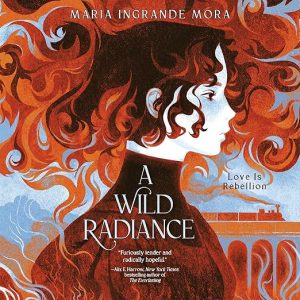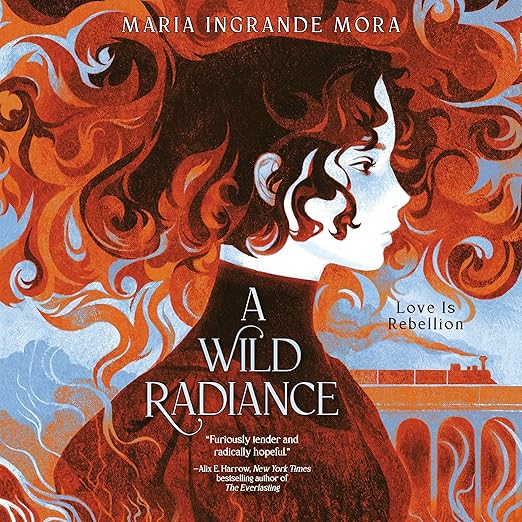
Radiance in this book is electricity that has been taught to want things, and the audiobook spends thirteen hours refusing to let that idea settle into decoration. Maria Ingrande Mora builds a school, a state, and an entire industrial program on a magic that behaves like current, then points, in the publisher's own framing, at the War of the Currents as the historical armature underneath. That was a real fight, Edison against Westinghouse, direct current against alternating, fought with patents and press releases and a good deal of cruelty. Borrowing it gives a young adult fantasy something most of its shelfmates never bother to acquire: an engineering argument sitting at the dead center of its politics.
Josephine Haven is a student at the House of Industry, where children who can wield radiance are trained under a single governing rule: never form attachments. She is bad at it. Her outbursts are described as infamous, and the book's sharpest early question is one she asks herself in something close to despair, which is why her emotions run so hot if she was built to feel nothing. Banished after graduation to a remote Mission in Frostbrook, she lands under Julian, the former golden boy who seems to be waiting for her to fail, and beside Ezra, a stranger asking too many questions about how the Mission actually runs. It is a tidy engine, and Mora does not waste it.
The four-star response in the review column puts a finger on the one structural problem worth naming before anything else. 'Parts of the book in the beginning felt a bit rushed,' that reader writes, while still crediting the book with world building that 'was very easy to understand' and a story finished in one sitting. Both halves of that verdict matter. The clarity is real, and it is not a small achievement in a book that has to teach you an economy, a school system, and a magic in short order.
Compression in the first act lands differently through headphones, though. A reader who feels hurried can slow down, flip back two pages, and re-anchor a name before continuing. A listener has no such lever. When four proper nouns and a governing ideology arrive inside the same ten minutes, the only recovery available is scrubbing backward through a waveform, which nobody enjoys. The book earns its footing well before the halfway mark, but the first ninety minutes ask more of an audio listener than of a reader holding the same text.
What Makes A Wild Radiance Worth Hearing
What lifts this above a competent magic-school entry is that Mora treats indoctrination as a process with a timeline rather than a switch to flip. The response that arrived with a fan-list attached names it precisely, crediting the book with 'deprogramming from propaganda with nuance' and with 'giving Josephine time in the story to learn and question things,' then framing the whole novel around a question aimed straight at the audience: 'when did you first start to question what you had been taught?' Few books in this category are willing to make the questioning itself the plot. Most hand their protagonist a revelation in chapter three and spend the remaining hours on logistics.
The romance is braided into that argument rather than parked beside it. Josephine has been trained that attachment is a defect, so every step toward Julian or Ezra is also a step away from the House's core tenet, and desire becomes a political act instead of a subplot. The comp titles the publisher reaches for, Arcane and Iron Widow and Wicked, all share that instinct: they use longing as the crack through which a system starts to fail. Mora is working the same seam, and the LGBTQ+ tag on this listing is load-bearing, not decorative. Worth noting too that the House's prohibition is not a religious vow or a personal wound but a workplace policy, issued by an institution that needs its wielders interchangeable. Framing celibacy as an industrial efficiency measure is a genuinely sharp move, and it keeps the love story from ever feeling like a break from the argument.
Things to Know Before Starting A Wild Radiance
A plague arrives partway through, spreading across the countryside while Frostbrook argues about whether Progress is worth having at all, and the book asks it to carry a great deal at once: a corruption plot inside the House, a resistance among people who never wanted the new machines, and a revelation about the radiance in Josephine's own body. Three loads, one third act. Listeners who want each thread resolved with equal care should know going in that the disease strand is the one most clearly built to serve the other two.
The review column is also thin in an instructive way. Twelve ratings have produced three visible responses, and one of those is not an assessment at all: filed under the heading 'Above All Else, Love Endures,' it reproduces a passage from the novel itself, set in stylized characters, in which people are compared to machines that stay reliable only until they stop being reliable. It cuts off mid-word. As a signal of what moved that reader it is genuine. As guidance on whether you will like the book, it offers nothing. The three written responses also average higher than the 4.4 shown across twelve ratings, which means the nine silent votes pull the number down rather than up.
Who Maria Ingrande Mora Is Writing For
Anyone who finished Arcane wanting the labor politics rather than the fight choreography will find this squarely aimed at them, as will listeners who like their magic systems welded to an economy. The queer romance is central and unhedged. Thirteen hours is a comfortable length for the genre, long enough to let the Frostbrook section breathe and short enough that the Mission never becomes a slog. Listening Library, the youth audio arm behind it, has put a single voice on the whole thing rather than splitting the cast.
Skip it if compressed openings genuinely cost you the plot, because this one front-loads its vocabulary and expects you to keep up. Readers who want a self-contained resolution should also note that the record carries no series name and no volume number at all, so nothing here promises a second installment either way. And listeners looking for the industrial-revolution fantasy without the romantic weight will be reaching past a great deal of the book to get at it, since Josephine's attachments are the mechanism by which she starts seeing the House clearly.
At a Glance
- Narrator: Mia Hutchinson-Shaw is the sole credited voice across thirteen hours, carrying a cast that keeps Josephine, Julian, and Ezra in constant close orbit.
- Subjects: magical industrialization, class revolution, deprogramming from a doctrine of detachment, queer first love
- Tone: charged and combustible, with a slow-burn ache under the sparks
- Bottom line: worth your time if you want Arcane's politics in prose form, though the opening stretch moves faster than the world it is building.
A Few Questions About A Wild Radiance
Do you need to know Arcane to follow the A Wild Radiance audiobook?
Not at all. The comparison is marketing shorthand for a shared texture, magic tangled up with industry and class conflict, rather than a shared universe. Mora explains the school, the governing ideology, and this book's own version of wielded power from scratch. The reference tells you the flavor, not the prerequisites.
How does the thirteen-hour runtime of this audiobook compare to similar YA fantasy?
It sits at the roomy end of normal. Most single-volume young adult fantasy lands between nine and twelve hours, so thirteen buys extra space, and that space goes to the Frostbrook section and to Josephine's slow shift from obedience toward suspicion rather than to additional set pieces.
Is the romance a love triangle between Josephine, Julian, and Ezra?
The setup certainly gestures that way, with both men positioned as obstacles and temptations at once. What the book is actually interested in is why wanting anyone at all violates everything Josephine was raised to believe, so the tension runs between her and her training as much as between the three of them.
How heavy is the content for a teen listener?
A deadly epidemic, an authoritarian school built on emotional suppression, and institutional corruption all feature, and the book gives Josephine real desire rather than a chaste sketch of it. Nothing on the record flags explicit sexual content, but the political violence and the disease plot are handled without much softening.