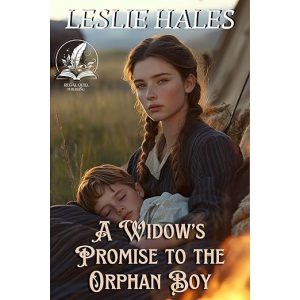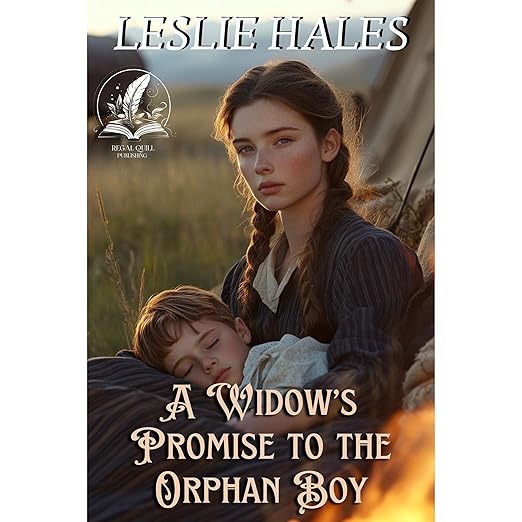
Evelyn Grant is running when this book opens, and the audiobook of A Widow's Promise to the Orphan Boy does not waste time getting her onto a wagon train with a stolen secret and a hired lawman she has not yet realized is coming for her.
The premise stacks a lot of genre furniture into one setup, and it works because Leslie Hales commits to it fully. Evelyn is a young widow fleeing a powerful man determined to reclaim her nephew for his inheritance, and Samuel Reid is the man hired to bring the boy back, joining the wagon train convinced he is hunting a criminal rather than protecting one. The synopsis lists its tropes without embarrassment: Forced Proximity, Guardian of an Orphan child, Widowed heroine, Brooding Hero, Second Chance at Love, and the book delivers on that promise across roughly eighty thousand words. It is also explicit about its guardrails, stating plainly that no cheating and no cliffhangers appear anywhere in the story, and that a happily ever after is guaranteed, which tells a listener exactly what kind of tension to expect: emotional and circumstantial, not the will-they-betray-each-other kind.
A Clean and Wholesome tag also sits on the listing, which lines up with the guardrails already spelled out in the description. That combination, a guaranteed ending stated upfront alongside a clean content label, tells you plainly what kind of risk this book is and is not taking; the suspense is meant to come from the wagon train's circumstances, not from doubt about where Evelyn and Samuel end up.
Why A Widow’s Promise to the Orphan Boy Works as an Audiobook
Samuel's slow fracture in certainty is the real pull, described in the synopsis as the quiet devotion of the woman guarding the boy wearing down the story he was paid to believe. That reversal, a hired man realizing his target might be the one telling the truth, drives the middle stretch, and it holds up once a fellow passenger exposes both Evelyn's lies and Samuel's real purpose, turning the wagon train itself against them, which raises the stakes from a private romantic complication to a genuine physical danger for both of them and the boy they are protecting. Readers of Hales's Rugged Hearts of the West series, or anyone drawn to western settings for a forced-proximity romance, will find the genre elements assembled with care.
Forced Proximity specifically does a lot of structural work in a wagon train setting, since a moving caravan gives two people who might otherwise avoid each other no real way to keep their distance for weeks at a stretch. That built-in closeness is likely a big part of why Samuel's suspicion erodes as slowly and believably as the synopsis suggests it does; he is not choosing to spend time near Evelyn, he simply cannot avoid it, which tends to make a hero's change of heart read as earned rather than convenient.
Reviewer C3 describes the emotional arc in blunt, effective terms, writing that the story "will make you angry at evil deeds, then make you wonder if evil can be overcome and then it will make you happy to see what ultimately happens in the end." That progression, anger toward resolution, matches the guaranteed happy ending the publisher promises upfront, and it suggests the book is less interested in surprising its readers on outcome than in making them feel every step of getting there.
Weak Spots in A Widow’s Promise to the Orphan Boy
This one is worth flagging plainly: the narrator credit on file is Virtual Voice, which indicates synthetic, text-to-speech narration rather than a human performer. That is a real difference for a book leaning on tone and quiet devotion as its emotional hinge, and it is worth knowing before you spend a credit if narration style matters to you. None of the three written reviews mention narration specifically, and given that all three use language like Viola Frere's description of it as "a very nice book to read" about a widow who "tries very hard to keep" her promise "no matter what," it is possible those reactions reflect the story generally rather than the audio experience in particular. Frere adds that it is "a well written book with a few surprises in it," again phrased around reading rather than listening.
One reviewer, J. Bard, raises a craft note worth passing along: several characters share a first initial, an Evie, an Eliza, an Edwin, and an Elenor, which the reviewer found genuinely disorienting and flagged with visible irritation. That is the kind of detail a listener, unable to glance back at a page to double-check a name, might find even more disorienting in audio than a reader flipping pages would.
Who Should Listen to A Widow’s Promise to the Orphan Boy
Clean historical western romance readers who want their tropes delivered honestly and their happy ending guaranteed in advance will find exactly that here, and it also suits anyone who does not mind synthetic narration in exchange for a reliable, low-drama listen. It also suits listeners who like a wagon train setting doing double duty as both a romantic pressure cooker and a genuine physical danger, since the synopsis makes clear the other passengers eventually turn against Evelyn and Samuel both. It won't work for you if the human quality of a narrator's voice is part of what you are paying for; go in aware that Virtual Voice, not a credited performer, is reading Evelyn and Samuel's story here. Listeners who prioritize a specific narrator's delivery in their romance listening, the kind of pacing and vocal warmth a skilled human performer brings to a slow reveal, should treat that absence as the deciding factor rather than an afterthought.
The Short Version
- What it covers: Forced proximity on a wagon train, a hidden child and a stolen inheritance, trust rebuilt after deception
- Feel: Tense but guaranteed to land softly, clean historical romance
- Our call: A solid pick for clean western romance fans who don't mind synthetic narration standing in for a human performer.