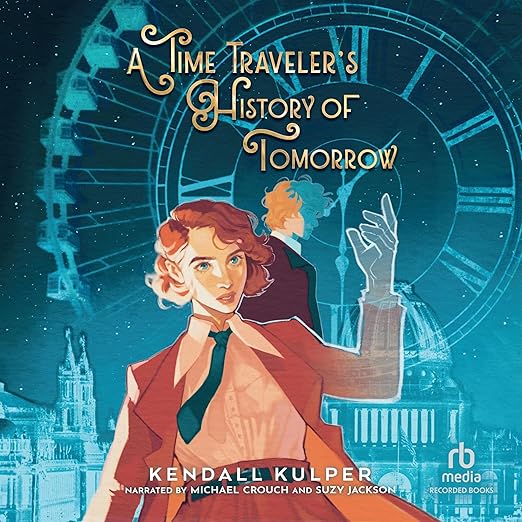
I picked up A Time Traveler's History of Tomorrow on a whim after a heavier reading week, looking for something that would move quickly and not ask too much of me emotionally. What I got was a book that moved very quickly and then quietly surprised me by being smarter than I expected. Kendall Kulper writes with a lightness of touch that can make her actual ambition easy to miss on first listen.
The setup: at the 1934 Chicago World's Fair, two gifted eighteen-year-olds meet under catastrophic circumstances. Genevieve Newhouse, a fastidious science prodigy who can turn invisible, is running a physics experiment that produces an apocalyptic explosion. Ash Hargreaves, who has just escaped a sheltered and vaguely cultish upbringing and can manipulate time, gallantly tries to rewind things by a few minutes and instead sends them both back to 1893. They are now stranded in an era that is not only historically different but actively unwelcoming, with no way home and a genuine question about whether their own time still exists.
How A Time Traveler's History of Tomorrow Holds Up
Kulper's premise is a direct conversation with questions that physics and philosophy both find genuinely interesting: if you can manipulate time, do you have more or less agency over outcomes? Ash assumes he can fix anything. Gen knows that fixing assumes you understand the system you are operating on, and she does not understand why her experiment exploded. The book does not resolve this tension cheaply. The scientific content referenced by reviewers, the physics that forms the backdrop of Gen's worldview, is not decorative. It actually shapes how the characters think about their situation, which gives the time travel plot a coherence that more casual genre treatments lack. Booklist praised the action and heart of the story alongside the unexpected twists, and described Gen as a spunky lead worth following through historical fiction that carries genuine adventure in it.
Why A Time Traveler's History of Tomorrow Works as an Audiobook
Michael Crouch is a reliable narrator for energetic, dialogue-driven stories, and this book has both qualities in abundance. The dual POV structure, alternating between Gen and Ash, gives him two distinct registers to work with: Gen's clipped, evidence-based worldview and Ash's warmer, more intuitive one. At just over ten hours the listen moves at a pace that the dual-timeline structure helps maintain. The 1893 Chicago setting is rendered with enough period detail to feel inhabited rather than designed. A reviewer who read through the local library's digital program described the book as fun to read despite scientific content that was above their head at times, and noted that the dual timelines and points of view made it fast-paced for readers of all ages. That range of accessibility is a genuine achievement.
Weak Spots in A Time Traveler's History of Tomorrow
The will-they-won't-they dynamic here is complicated by the time manipulation element in a specific way. When one character can rewind moments, the question of whether romantic tension can ever fully resolve takes on a different quality. Kulper uses that complication deliberately rather than just as a backdrop. Also worth tracking is how 1893 Chicago responds to Gen and Ash's visible differences from period norms. Gen as a woman who operates with scientific authority, and Ash as someone who does not understand period-conventional social hierarchies after his sheltered upbringing, both create friction with their environment that generates comedy and genuine social observation simultaneously. The book is a Junior Library Guild Gold Standard Selection, which confirms its standing as a text with real craft behind it rather than simply a pleasant read.
The Right Listener for A Time Traveler's History of Tomorrow
Listeners who have enjoyed Immortal Longings or Anatomy: A Love Story, titles the publisher specifically cites as companion reads, will find the overlap genuine. This is historical fiction that takes its period seriously while placing its characters under pleasurably impossible pressure. Readers who love a spunky, competent female lead who is also genuinely difficult rather than charming-difficult will find Gen a satisfying protagonist. The science does not require a physics background to follow but listeners who enjoy popular science framing will get an additional layer of pleasure from it. Skip it if you need emotional depth over plot velocity, or if you prefer historical fiction without the speculative element. For everyone else, this is a fast and intelligent listen that earns its happy ending through genuine complication rather than narrative convenience.