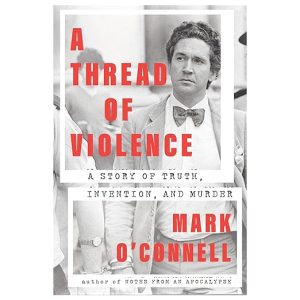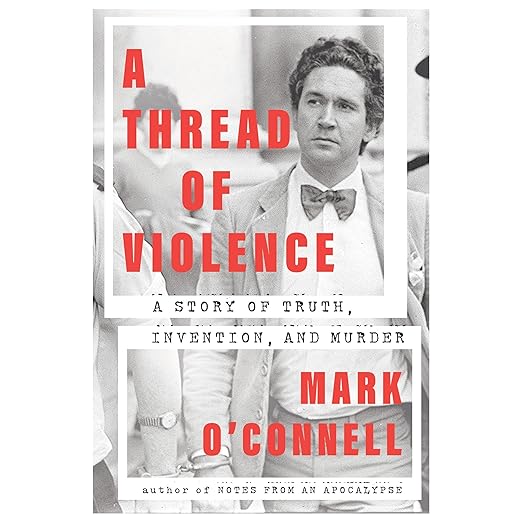
How does a Dublin socialite who spent his days reading philosophy and mingling with artists end up committing two murders over a botched bank robbery plan? That is the question Mark O'Connell spends this audiobook chasing, and the case at its center, Malcolm Macarthur's 1982 killings and the political scandal that followed, remains, per the synopsis, one of the most infamous in modern Irish history, contributing directly to the collapse of a sitting government.
Found Hiding in the Attorney General's Home
Macarthur's arrest itself became almost as notorious as the crimes: police found him hiding in the Dublin home of Ireland's own attorney general, Patrick Connolly, a coincidence so absurd it helped tip the entire episode into the kind of political scandal Irish commentators still reach for a single word to describe decades later. O'Connell, an award-winning author whose earlier work has ranged across cultural criticism and memoir-adjacent nonfiction, spent what the synopsis describes as countless hours interviewing Macarthur directly, conversations that 'veered from confession to evasion' rather than settling into a tidy narrative.
What makes this more than a standard true crime account is the second narrative running underneath the first: O'Connell's own reckoning with how a life gets 'rendered into story' at all, the damage that process can do, and the hazy line between what actually happened and what gets constructed afterward, by Macarthur, by the press, and by O'Connell himself in writing the book. That self-aware layer is what earned comparisons from critics like Colm Toibin and John Banville, both quoted directly in the synopsis, one calling the book 'disturbing' and 'compelling', the other calling it 'a masterly work'.
The scandal surrounding Macarthur's arrest earned its own lasting shorthand in Irish political memory: GUBU, an acronym drawn from then-Taoiseach Charles Haughey's own description of the situation as grotesque, unbelievable, bizarre, and unprecedented, coined by a journalist and still used decades later as a byword for a political crisis too strange to categorize any other way. That the case still carries its own acronym in Irish public life says something about how deeply this single episode embedded itself in the national memory.
Emmanuel Carrère's blurb calling the book 'fascinating' carries particular weight given his own background: Carrère wrote The Adversary, one of the defining works of literary true crime about a real murderer, Jean-Claude Romand, and his endorsement here reads less like a generic celebrity quote than one genre practitioner recognizing a peer working the same difficult territory, an author examining a real killer's psychology without pretending to fully resolve it.
O'Connell's Own Uncertainty, Heard in Real Time
O'Connell narrates his own material, and self-narration suits this particular book better than a hired narrator likely would, given how much of its power depends on hearing the author's own uncertainty and self-interrogation directly rather than through a performer's interpretation of it. A book this concerned with the ethics of storytelling benefits from the storyteller's actual voice carrying that doubt in real time.
The prize record backing this one is substantial: winner of both the Wellcome and Rooney Prizes, named a best book of the year by both the New York Times and The Economist. Reviewer Ian D. Griffin, writing from the United States, admits total unfamiliarity with Macarthur's notoriety going in, which is a useful data point for American listeners specifically, this is a genuinely major story in Irish public memory that never traveled widely abroad, and the audiobook does the work of making its stakes legible to outsiders.
The book sits comfortably alongside the tradition Truman Capote established with In Cold Blood, true crime narrated with real literary ambition rather than procedural distance, where the author's own presence and moral uncertainty become part of the story rather than something scrubbed out for objectivity's sake. O'Connell pushes that tradition further than Capote did, making his own doubts about the entire project audible rather than implied.
The synopsis calls this 'an act of literary subversion' as much as a true crime account, and that framing is worth taking seriously: rather than building toward the genre's usual satisfying resolution, arrest, trial, understanding, O'Connell deliberately withholds the clean closure true crime listeners typically expect, using Macarthur's own evasiveness in interview as the book's structural principle rather than an obstacle to write around.
Four Stars Sit Lower Than the Praise
Reviewer L. Rodgers, while calling the book well written overall, flags that O'Connell's own internal dialogue runs 'somewhat less interesting, and often redundant' at points, specifically his repeated wondering how many readers will find him naive for engaging with Macarthur at all. That self-questioning is central to the book's whole project, but Rodgers' three star review is a fair warning that the introspective layer will not land equally well for every listener expecting a more conventional true crime pace throughout.
The rating here, four stars from five hundred twelve ratings, sits lower than the wall of critical praise quoted in the synopsis might lead you to expect, worth flagging honestly rather than smoothed over, since prize juries and everyday listeners don't always weigh the same things when a book leans this literary in its ambitions. Reviewer Brian Lewis's account of Macarthur's 'expensive tastes' outrunning his actual means is a good entry point for listeners wondering whether the story itself, stripped of the literary framing, still holds up as compelling on its own terms. It does.
Fintan O'Toole's blurb calling the book 'morally complex and mesmerizing' points at something specific: neither Macarthur nor the narrative around him resolves into a simple villain, and O'Connell resists giving listeners the easy satisfaction of a clean moral verdict. Listeners who want true crime to deliver clear condemnation by the final chapter should know this book is deliberately more uncomfortable and unresolved than that.
Reviewer L. Rodgers specifically notes that the book handles the first victim's life with real respect and detail, a point worth flagging for listeners concerned that literary true crime can sometimes center the killer's psychology at the expense of the people he actually harmed. That balance, taking Macarthur's interior life seriously without losing sight of who he hurt, is part of what separates this from lesser entries in the genre.
Introspective Pacing Won't Suit Every Fan
Recommend this to true crime listeners who want genuine literary ambition alongside the crime itself, to readers of writers like Toibin or Rooney curious what nonfiction from inside that same Irish literary scene sounds like, and to anyone interested in how a single scandal can genuinely destabilize a national government.
Skip it if you want a fast-paced, plot-forward true crime account without authorial self-reflection slowing the momentum, since O'Connell's own uncertainty about the ethics of the project is baked into the book's structure rather than an occasional aside, and that introspective pacing will not suit every true crime listener equally.