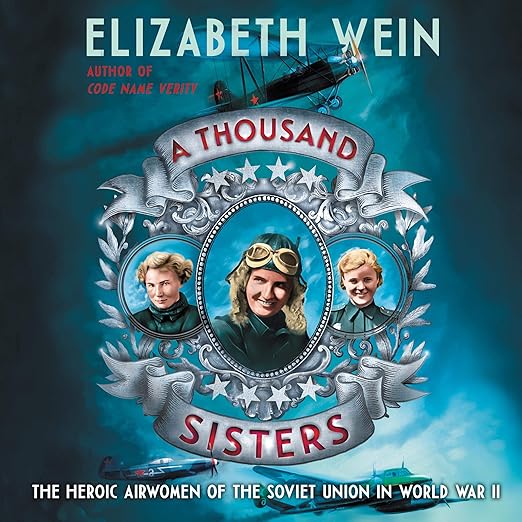
Somewhere over the Eastern Front in the early years of World War II, young Soviet women were flying bombing missions in the dark, in aircraft so outdated that the engines had to be turned off on approach to avoid detection, gliding silently toward enemy positions, dropping their bombs, and pulling away before the searchlights could catch them. The Germans called them the Night Witches. Elizabeth Wein's audiobook A Thousand Sisters tells their story in full, and it is a story that most Western listeners will be encountering for the first time. I came to it having read Wein's fiction, Code Name Verity in particular, and I was not surprised to find the same quality of research and the same moral seriousness in her nonfiction work. What surprised me was the sheer scale of what had been overlooked.
Josef Stalin issued the order in the early years of the war that made the Soviet Union the first country in the world to allow women to fly in combat. Marina Raskova, a celebrated aviator and navigator, organized three regiments, the 586th Fighter Aviation Regiment, the 587th Bomber Aviation Regiment, and the 588th Night Bomber Regiment. Some of the women who enlisted were teenagers. Some of them did not survive the war. All of them flew.
Is A Thousand Sisters Worth Your Time?
Wein is an award-winning author of historical fiction for young adults, and that background shows in how she structures this nonfiction account. The book does not read like a dry military history; it reads like a carefully researched story about specific people caught inside enormous events. The regiment members emerge as individuals rather than symbols, their relationships with each other, their fears and ambitions, their complicated experience of being celebrated for doing something their country simultaneously refused to fully acknowledge.
Amy Landon's narration serves this approach well. The material includes a significant amount of military and technical detail about aircraft types, combat formations, and the specific geography of the Eastern Front, and Landon handles this with the same confidence she brings to the personal stories. She does not treat the technical passages as obstacles to get through; she gives them the same weight as the human material, which is exactly right for a book that argues the tactical and the personal cannot be separated.
The book has been recognized as a finalist for the Excellence in Nonfiction for Young Adults award, which reflects the dual quality that distinguishes it: accessible and engaging for younger listeners, serious and thorough enough to hold adult attention.
The audiobook format is particularly effective for narrative nonfiction of this kind, where the pacing of the story matters as much as the facts it contains. Wein manages the chronology of the war and the progression of the three regiments with real skill, building a sense of accumulation, the reader understands not just individual missions but the arc of years of combat and the cumulative losses they produced.
One reviewer, a licensed pilot herself, described discovering a story she had never encountered despite extensive knowledge of women pilots in history. That gap, the near-total absence of the Soviet women combat pilots from Western WWII histories, is both a critique of what gets remembered and a measure of how much this audiobook restores. Wein's extensive historical research, combined with black-and-white photographs and detailed sidebars described in the text, makes the audio version a faithful representation of the book's informational depth.
The sisterhood theme that Wein foregrounds throughout gives the book an emotional through-line that transcends the military history. The relationships formed under extreme pressure, the loyalty of women who trained and fought and died together, constitute a distinct subject alongside the tactical history, and Wein gives it the attention it deserves.
Where Elizabeth Wein Loses Some Ground
The book's YA framing shapes some of its presentational choices in ways that adult listeners should anticipate. Wein writes with great clarity about difficult material, death, failure, institutional betrayal, but she exercises a certain restraint in how she approaches the darkest aspects of the Eastern Front. Readers wanting the full historical horror of the conflict will need to supplement this account with other sources.
The three regiments receive uneven coverage, which reflects the available historical record more than editorial choice. The 588th Night Bomber Regiment, the Night Witches, receive the most detailed treatment; the other two regiments appear with less narrative depth. Listeners who arrive specifically for the Night Witches story will be richly served; those hoping for equal coverage of all three units may find the imbalance notable.
Some of the archival complexity, the multiple accounts, the propaganda dimension of Soviet wartime storytelling, the difficulty of separating myth from record, is handled in a way that is accessible for young adult readers but may feel simplified for specialist listeners.
Should You Listen to A Thousand Sisters?
This audiobook works for young adult listeners and adults in equal measure. History enthusiasts interested in WWII and particularly in the Eastern Front, an area Western accounts tend to undercover, will find the research substantial and the narrative approach compelling. Listeners drawn to stories of women's achievement under systemic resistance will find the material resonant far beyond its historical setting.
Skip it if you need extensive military-tactical detail or want a comprehensive account of all three regiments with equal depth. For a clear-eyed, deeply researched, and genuinely moving account of a chapter of history most listeners do not know at all, A Thousand Sisters delivers what it promises.
Key Details
- Narrator: Amy Landon brings energy and clarity to Wein's research-dense narrative, keeping the material accessible without simplifying the history.
- Subjects: Women in combat, Soviet WWII history, sisterhood under extreme pressure
- Tone: Urgent and moving, with the weight of forgotten history being restored
- Bottom line: Elizabeth Wein's A Thousand Sisters audiobook is a remarkable work of narrative nonfiction that recovers a chapter of World War II history almost entirely absent from Western accounts.
Questions Listeners Ask
Does the audiobook cover all three Soviet women's aviation regiments equally?
The 588th Night Bomber Regiment, known as the Night Witches, receives the most detailed narrative treatment. The other two regiments appear throughout but with less depth, reflecting the distribution of available historical records.
Do I need background knowledge of World War II to follow this audiobook?
Basic familiarity with WWII helps, but Wein provides enough context for the Eastern Front and the Soviet war effort that listeners without specialist knowledge can follow the narrative clearly.
How does Amy Landon handle the technical aviation and military content in the audiobook?
Landon handles the technical material with the same confidence she brings to the personal stories, giving aircraft types, combat formations, and tactical detail the same weight as the human narrative rather than treating them as interruptions.