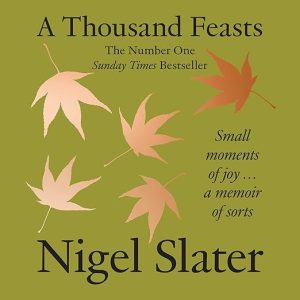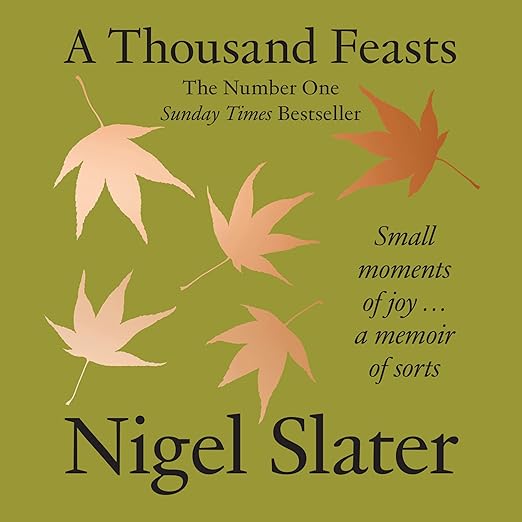
I read kitchen prose the way some people read poetry, slowly, with the text earning attention sentence by sentence rather than carrying me forward by plot or argument. Nigel Slater writes in that register, and A Thousand Feasts, his Number One Sunday Times bestseller, is the purest expression of it he has produced. This is a book assembled from notebooks kept over many years: at his kitchen table in London, in a fisherman's hut in Reykjavik, in a moss garden in Japan, sheltering from a blizzard in a Viennese Konditorei. It is not a cookbook or a memoir in any conventional sense, though it contains elements of both. It is something closer to a secular book of hours, to borrow Edmund de Waal's description from his endorsement, which is the most accurate framing I have encountered for what Slater has made here.
The book's premise is simple and its execution exquisite. Slater has spent years noticing, the specific quality of morning light through a particular window, the smell of fresh sweet peas just picked from the garden, the sound of water breathing at night somewhere in Japan, the taste of a mango eaten standing in monsoon rain, the precise comfort of a bowl of restorative macaroni cheese on the right kind of difficult day. A Thousand Feasts gathers those noticings and presents them with a precision and a tenderness that transforms the act of reading into something very like the act of attention itself. You finish a section and find yourself wanting to put the book down and go look at something carefully before continuing.
Food Becomes Memory Instead of Recipe
Slater is best known for Kitchen Diaries and Toast, both of which operate in the memoir-with-recipes space, and readers coming from those books will find A Thousand Feasts both immediately recognizable and distinctly different from what came before. There are no recipes here. The food, that bowl of macaroni cheese, miso soup for breakfast, a Japanese meal described with the precision of a still life painter, appears as experience and memory and sensation rather than as instruction. Slater is interested exclusively in what food feels like, and this shift frees him to write about eating with a range and a freedom he cannot quite achieve when recipes must eventually be delivered to justify the narrative.
Olivia Laing's endorsement, that Slater has a magical capacity to find beauty in the smallest moments, is the most accurate single-sentence description of what the book consistently does. Nigella Lawson's characterization of it as a prose-poem for eaters and a spiritual companion for thoughtful cooks captures the register correctly, and both endorsements suggest that this is prose that operates on you the way good poetry does: not by argument or forward narrative momentum but by accumulated attention and precise image.
Exquisite Yet Effortless, Concealing Real Labor
The book's fragmentary structure is both its principal challenge and its deepest source of power. There is no conventional narrative arc to follow, no journey to complete, no crisis to resolve, no redemptive transformation to arrive at. What there is instead is accumulation: the gradual sense, page by page and fragment by fragment, of a life lived with genuine and sustained care for the quality of experience. Elizabeth Day's description of the prose as exquisite yet effortless, filled with heart, tenderness, yearning and humour captures the central paradox of Slater's particular achievement, the feeling that this writing cost nothing to produce, which carefully conceals the extraordinary labor of observation and selection that precedes every sentence.
Reviewers who have responded most intensely to the book consistently note something similar: that Slater's words bring back their own long-forgotten memories and sensations. This is not coincidental and not merely sentimental. When he notices something precisely enough, his observation triggers recognition in the reader rather than simply delivering information. That is rare in any prose, and it is the reason the book has attracted the sustained attention of some of the most discerning writers currently working in English.
Verify the Narrator Before You Buy This One
The metadata for this Audible edition does not list a narrator, which is worth knowing before downloading. Slater has narrated some of his own audio work in the past, and his voice, warm, unhurried, with its distinctive Midlands cadences, would suit this material precisely. Whoever reads A Thousand Feasts needs to match the prose's quality of attention with an equivalent quality of reading. A narrator who rushes the fragments, or who imposes emotional emphasis where Slater deliberately allows ambiguity to stand, would diminish the experience in ways that would be difficult to recover from. Fourth Estate, the publisher, produced the audiobook in September 2024 alongside the instant bestseller print edition, so the production quality should be appropriate. Verify the narrator on the Audible listing before committing.
Short, Deliberate Sessions Suit This Best
A Thousand Feasts is for readers who want something that nourishes rather than stimulates, prose that slows you down and asks you to be present rather than prose that accelerates you toward a resolution. It is for anyone who has ever eaten something alone and been surprised by the fullness of pleasure they felt, or noticed a quality of light and wished the moment could extend. At 8 hours and 24 minutes, it is a book best absorbed in short, deliberate sessions rather than consumed end to end, which suits audio listening particularly well. For the right listener in the right frame of mind, this is the closest thing to a genuine literary gift that food writing can currently offer.
- Performance: No narrator is listed in the available metadata, verify on the Audible listing before downloading, as the identity of the reader will significantly shape this experience.
- What it covers: The aesthetics of small pleasures, food as emotional memory, the daily practice of paying genuine attention
- Feel: Languorous and deeply pleasurable, best absorbed in small, deliberate portions
- Our call: Slater's most distilled work to date, a collection of notebook fragments that argues, convincingly, that the good life is built from moments most of us are too busy to register.