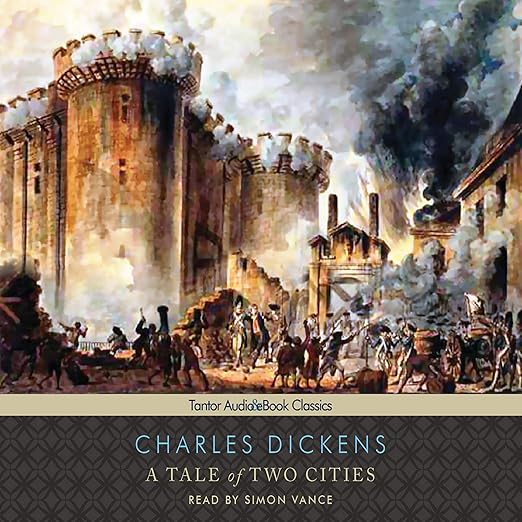
Doctor Manette spent eighteen years in the Bastille without a trial, and the man who came out was not the man who went in. That is where Dickens starts, and it is worth remembering before you press play on a novel this long. Tantor Audio's edition, with Simon Vance credited as reader, has been on the shelf since 2009, which makes it one of the older recordings of this book still in circulation. An audiobook of A Tale of Two Cities is a particular proposition, because the thing most people actually remember about this novel is how it sounds.
A Closer Look at A Tale of Two Cities [Tantor]
Among Dickens novels this one is the anomaly: structurally tight, historical rather than social, and almost entirely free of the comic grotesques he usually cannot resist. What it has instead is architecture. One five-star response described the book standing on three solid pillars surrounded by a host of decorative posts, naming the first as historical detail accurate down to the last aristocratically cruel glare over a laced collar, and the second as a strong, ever-moving plot that stitches London and Paris history into one finely woven story. That is a fair account of the method. Dickens is not reconstructing the Revolution so much as staging it, and the accuracy sits in the texture rather than in the chronology. The third pillar, as it happens, never arrives: that response breaks off mid-sentence just as it reaches for it.
What holds those pillars up is a family that keeps crossing the channel at exactly the wrong moment. Lucie Manette is raised English despite French ancestry. Charles Darnay walks away from a French title and a French fortune on principle, then walks back into France to help an old family servant and is arrested for crimes his relations committed rather than any of his own. Lucie, their young daughter, and her aged father follow him into a city that has stopped distinguishing between a name and a person. Every private decision turns out to carry a public bill, which is precisely the collision the description promises between private experience and public history.
What Makes A Tale of Two Cities [Tantor] Worth Hearing
Dickens wrote for the ear, and the prose carries the evidence: clauses that build, repetitions landing on a beat, sentences engineered to be spoken rather than scanned. The opening paragraph that half the reading public can approximate from memory is memorable for its rhythm, not for its information. A novel constructed that way has a natural claim on this format, and A Tale of Two Cities is one of the rare cases where hearing a book may be closer to how it was built to work than reading it silently.
One counterargument comes from inside the response pool, and it deserves to be taken seriously. One reader made an impassioned case against shortcuts: do not settle for the film, do not let a screen do the work, read the book, because a great deal is lost when Dickens is visualized instead of read. That argument is aimed at adaptation rather than at audio, but it lands nearby. Is a recording a shortcut? For this novel, probably the opposite. Nothing is cut, nothing is dramatized, nothing is compressed into two hours of costume. A full-length reading is, if anything, the least shortened way to take in a book most people meet through a screen.
The Tantor edition credits Simon Vance, and for this particular novel the demand is range rather than warmth. The book moves between a London household and a Paris tribunal, between Doctor Manette's ruined quiet and Madame Defarge's patient fury, and it asks a single voice to hold both registers all the way to the end. That is a real technical ask, and it is why recordings of this novel differ from one another far more than the fixed text would suggest.
Things to Know Before Starting A Tale of Two Cities [Tantor]
Difficulty is the honest warning, and one four-star entry put it plainly: the language can be a bit difficult, though the message and the ending are very powerful. That is exactly right, and it changes character in audio. A hard sentence on a page is a sentence you read again. A hard sentence in a recording is one you either let go or hunt back for with a scrub bar, and Dickens builds paragraphs where the subject arrives four clauses after you needed it. That same entry, oddly, closes with the words "Used, like new," a condition grade for a secondhand physical copy that cannot describe a recording at all. It is a small sign of where the column's attention really sits.
The title needs decoding too. It displays as A Tale of Two Cities with Tantor in square brackets, which is not part of the book's name but a catalog tag distinguishing this production from the many other versions of a novel long out of copyright. That bracket does real work. A listener searching by title alone will surface a dozen productions at wildly different lengths and standards, sharing an author and sharing nothing else, so the publisher tag is the only thing on the page identifying which recording is in the cart.
Note also that two of the five responses were filed outside the United States, one from Brazil and one from Canada, and that second one opens by signing itself as a review by its own author, in the manner of something written for publication elsewhere and reposted here. Its subject is the novel: the French poor turned by injustice into an unrelenting mob, the innocents carried to Madame Guillotine day after day, Madame Defarge and her hatred. That is a fair summary of what the book does, and a useful reminder that this column is discussing Dickens rather than any particular edition of him.
Who Charles Dickens Is Writing For
Two groups should stay away. Anyone who wants Dickens at his funniest should start almost anywhere else in the catalog, because this novel spends its comic budget early and never restocks. And anyone who finds long periodic sentences hard going on the page will find them harder without a page to steady them. Everyone else is well served. The novel rewards listeners who like history kept at eye level, readers of the Revolution who want the mob's logic rather than the textbook's, and anyone who has only ever met this story through a screen and suspects, correctly, that something went missing. It is a book about what people will give up for other people, and it earns its ending by making you wait for it.
Before You Listen
How does this audiobook edition differ from other recordings of A Tale of Two Cities?
The distinguishing details on this listing are the publisher, Tantor Audio, the credited reader, Simon Vance, a March 3, 2009 release, and a running time of thirteen hours and thirty-nine minutes. The novel is long out of copyright, so length and reader are the practical ways to tell productions apart.
Is A Tale of Two Cities a good first Dickens?
Arguably the best one, for the reasons that make it least typical: it is his tightest plot and the one least crowded with subplots, which means fewer threads to hold. What it does not offer is the comedy people associate with him. Start here for structure, elsewhere for the caricatures.
Does the audiobook require knowing French Revolution history?
No. The novel supplies what it needs as it goes, and the description frames the Revolution as backdrop to a family under threat rather than as a subject to be studied. Knowing roughly when the Bastille fell will help. Everything past that the book explains through the people it endangers.
Which characters should I keep track of in this audiobook?
Four carry the plot: Doctor Manette, imprisoned eighteen years without trial; his daughter Lucie, raised in London despite French ancestry; Charles Darnay, who renounced a French title and returns to France anyway; and Madame Defarge, whose hatred drives the Paris half. Names arrive fast early on, so concentrate there.