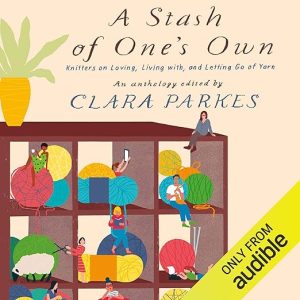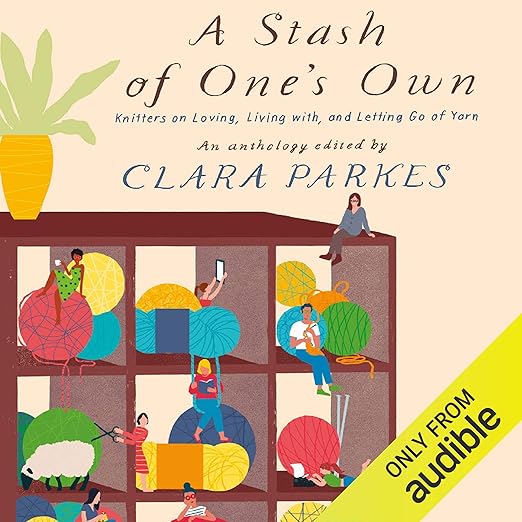
Clara Parkes built a career as one of knitting's most articulate voices, and A Stash of One's Own extends that authority into the territory of literary anthology. Narrated by Kevin T. Collins and running 5 hours and 1 minute, this collection of 21 essays from knitters, designers, dyers, and fiber artists carries a 4.6 rating from 439 listeners. Publishers Weekly named it among the top 10 lifestyle books of fall 2017. The premise is the yarn stash, that accumulation of fiber that knitters maintain for reasons that are rarely entirely rational and almost always emotionally significant. It turns out to be remarkably rich territory for literary inquiry, as Parkes demonstrates across five disciplined and generous hours of audio.
From KonMari Minimalists to Industrial Dyers
The smartest thing Parkes did in assembling this collection is resist the temptation to make it only about knitting. The contributors represent a range of relationships to fiber and stash that runs from the KonMari minimalist to the joyous collector, from the industrial dyer to the academic scholar, from the working designer to the sheep farmer. What connects them is the question the anthology actually wants to answer: why do we keep things, what do the things we keep tell us about who we are, and how do we decide when the keeping has become something other than care?
The contributors include New York Times bestselling authors Stephanie Pearl-McPhee and Debbie Stoller alongside less publicly prominent figures from the knitting and fiber arts world. That range matters. Pearl-McPhee's writing on the experience of knitting has always had a precision about the psychology of craft that distinguishes her work from general crafting content, and she brings that precision to her essay here. The designers talk about stash as creative research. The dyers talk about it as inventory and investment. The social worker in the collection talks about yarn as a therapeutic tool. The sheep farmer brings a perspective that is entirely outside the consumer relationship with fiber, which sharpens the contrast with the essays written from inside it. The convergence of these different relationships to the same material is what gives the anthology its breadth beyond the knitting community.
Collins Reads as a Conduit for 21 Voices
Collins narrating an essentially feminine crafts anthology is an interesting production choice, and it mostly works. His delivery is attentive rather than demonstrative, which suits the reflective quality of the essays. He does not impose an interpretive layer on the contributors' voices but rather reads as a conduit for them, which is the right approach for anthology narration where the goal is individual voice rather than collective performance. Some listeners would have preferred a female narrator for the cultural register of the material, and that preference is understandable and noted in a few reviews. But Collins never condescends to the content or treats the subject as exotic, which is the primary risk with male narrators handling feminine craft culture.
The 5-hour runtime is genuinely appropriate for an anthology designed to be consumed in chapters. The essay form means listeners can pause and return between contributors without losing narrative thread, and the audiobook rewards longer listening sessions that allow the accumulation of perspectives to build the reflective mood the collection aims for. One reviewer noted this was the kind of book to take along on a trip and read a chapter at a time; in audio form, the same structure applies naturally. Another kept returning to specific essays on culling, which prompted a reassessment of her own stash practices. That functional impact is the measure of craft writing that achieves genuine literary reach.
Culling a Stash as an Act of Identity
Pay particular attention to the essays addressing the act of letting go, culling or curating a stash that has grown beyond management. This dimension of the stash relationship is where the anthology's deeper argument about attachment, identity, and change becomes most acute. The question of what it means to release materials you have loved, and what the difficulty of that release reveals about your relationship to your creative identity, is handled with more psychological care in several of these essays than the genre typically permits. One reviewer specifically noted that the sections on culling prompted a reassessment of her own stash practices, which is the functional definition of craft writing that achieves literary reach.
Parkes' own framing essays that introduce and contextualize the collection are also worth attending to carefully. Her wry, witty voice, well-established through her own books and her long-running work at Knitter's Review, carries the anthology's editorial logic and gives the listener the structuring intelligence behind the contributor selection. She is not merely a curator here but an argument-maker, and the argument is worth following through to the final essay. The collection is organized to build toward a conclusion about why keeping things matters, and Parkes' editorial hand is what makes that trajectory coherent across 21 very different voices.
No Connection to Knitting Required for This Anthology
This audiobook is ideal for knitters and fiber arts enthusiasts who want to see their practice examined with genuine literary intelligence. Listeners who have no connection to knitting or fiber arts will still find the anthology's broader argument about collecting, identity, and attachment worth their time. The yarn is the specific vehicle but the psychology it illuminates is universal. Readers who already know Stephanie Pearl-McPhee, Debbie Stoller, or Meg Swansen's work will find the familiar voices enhanced by Collins' narration, and the less prominent contributors are a genuine discovery. Those expecting a how-to guide or pattern reference should know that this is an essay anthology about the experience of fiber culture, not a practical crafting resource.