The Short Version
- Voice: Wolfgang Milliken is credited alone, covering a human lead, a skull-faced Duskwalker, and the demons around them across a 17-hour indie production.
- Big ideas: Sacrificial bride, monster romance, village superstition, loneliness on both sides
- Atmosphere: Dark and slow-burning, tender in the middle of genuine menace
- Worth it?: A strong entry point for monster romance readers who want the monster to stay monstrous.
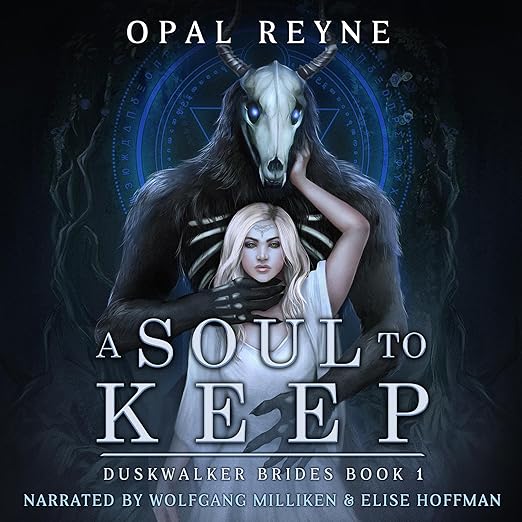
Duskwalker Brides opens with a bargain that monster romance has been circling for years, and Opal Reyne plays it straight. Reia's village has decided she is a harbinger of bad omens, blames her for the Demons that ate her family, and when the next offering comes due it hands her a choice between the prison cells and the altar. The monstrous Duskwalker heading their way collects one human every decade in exchange for a ward that keeps the Demons out. What Reia finds waiting for her is a skull face, glowing eyes, and a creature who wants company more than he wants a corpse.
Wolfgang Milliken narrates, and the credit is worth a pause: one voice carries Reia, a faceless Duskwalker, and the Demons that terrorize the world beyond the Veil across 17 hours and 43 minutes of audiobook. Thirty ratings sit behind the 4.4 currently on display, and the release is dated October 30, 2023. The publisher field carries Opal Reyne's own name, so this is an independent production rather than a house release, which matters mainly because it explains the runtime: nobody was cutting this for length.
Reia and Orpheus are both alone before they meet, and that symmetry is the engine of the book. She has spent her life being treated as contagious by people who share her walls. He has been taking a companion to the Veil every ten years, and the synopsis is blunt about how those arrangements have ended: their lives were always, unfortunately, cut short. So the pairing is not enemies-to-lovers, whatever the sacrificial setup implies. It is two lonely parties discovering that the other one is not going to flinch, and the tension comes from whether Reia will choose to stay rather than from whether Orpheus will hurt her.
Opal Reyne also resists the shortcut of making the village cartoonishly cruel. The people who hand Reia over are frightened, superstitious, and entirely convinced they are buying safety for everyone else, which is a more uncomfortable arrangement than plain villainy. Chrissy.ok, one of the five responses on the page, called the worldbuilding great and said the demons and duskwalkers were woven through the story rather than shoved in the reader's face, and that is the right description of the balance. The Veil is treated as a location with rules, not as a spooky backdrop, and the rules get established early enough that the back half can spend its time on the relationship. The economics get attention too. A ward costs one person per decade, the village has always been willing to pay it, and the book keeps returning to the fact that this arrangement predates Reia and will outlast her, which gives the romance a political edge the cover copy does not advertise.
The Strengths
The heat level is real and the book does not treat it as an afterthought. Shelby Di Martino praised what the review calls a fabulous balance between spice and plot and singled out the character designs for the demons and duskwalkers as refreshing for a monster fiction reader. Pegasus, reviewing from Mexico, summed the appeal up as heat, heart, and intrigue, which is about as economical as this subgenre gets. If you have already worked through the more famous monster romance series and want one where the non-human lead stays non-human rather than turning conveniently pretty, this is aimed at you.
Seventeen hours and forty-three minutes is a serious runtime for a series opener, and the length buys a specific thing: room. Reia's adjustment to the Veil is not compressed into a montage, the supporting cast gets development rather than a single identifying trait, and Darkling.Books, whose response comes from the United Kingdom, described finishing this one and immediately making the remainder of the series a goal for the year. Long books convert better in audio than in print for exactly this reason, since a commute-sized chunk of a leisurely chapter is far easier to absorb than forty pages of it at midnight.
Weak Spots in A Soul to Keep
Madison K awarded four stars and put the two main caveats directly in the review title: interesting but long, and written in third person, the second half in capital letters. That capitalization tells you something about the genre's expectations, since a lot of monster romance readers arrive expecting first-person intimacy and get a slightly wider camera instead. Both objections are amplified by audio. Third person keeps you marginally further from Reia's head than the subgenre usually allows, and the runtime that reads as generous on the page becomes a genuine commitment when you are metering it out in listening sessions.
Chrissy.ok also flagged the content honestly: gore, violence, and creatures that eat and kill humans, though noted as woven into the story rather than staged for shock. Shelby Di Martino's response opens by warning readers about trigger warnings around violence before recommending the book anyway. Take both at face value. This is not a cozy fantasy romance with a monster-shaped love interest, it is a book where the demons do what demons do, and the sweetness between Reia and Orpheus is built in contrast to that rather than in isolation from it.
Recommended For
Monster romance readers who want the fantasy element treated seriously are the obvious audience, particularly anyone tired of love interests whose monstrousness is decorative. Listeners who like a slow-burn structure will get one, since the relationship develops across a runtime long enough to make the gradual thaw plausible instead of asserted. Fantasy readers who care about systems will find the decade cycle, the protection ward, and the geography of the Veil worked out with more rigor than the sacrificial-bride premise promises. And anyone starting a long series in audio should note the practical advantage here: this is book one of Duskwalker Brides, the entry point is clean, and no prior reading is assumed.
Not for you if you need the first-person voice that dominates the subgenre, because Madison K is right that the third-person choice changes the temperature. Not for you either if graphic violence is a hard limit, since the Demons are written as genuine predators and two separate reviewers went out of their way to say so. Listeners who prefer their romance under ten hours should also think twice before committing a credit. Reia's bargain rewards patience, but a seventeen-hour first date with a series that clearly intends to keep going is a real ask.
Questions Listeners Ask
How explicit is the A Soul to Keep audiobook?
Spicy, and unhurried about getting there. Shelby Di Martino described a fabulous balance between spice and plot, and Pegasus summarized the book as heat, heart, and intrigue. The physical relationship arrives after the emotional one is established, so listeners expecting immediate content will wait, and those wanting plot alongside it are well served.
Does one narrator handle both leads in this audiobook?
Wolfgang Milliken is the only credit on the listing, which means a single voice carries Reia, Orpheus, the villagers who cast her out, and the Demons beyond the Veil. That is a normal arrangement for indie romance, and it does mean the contrast between a human lead and a skull-faced Duskwalker rests entirely on one performer.