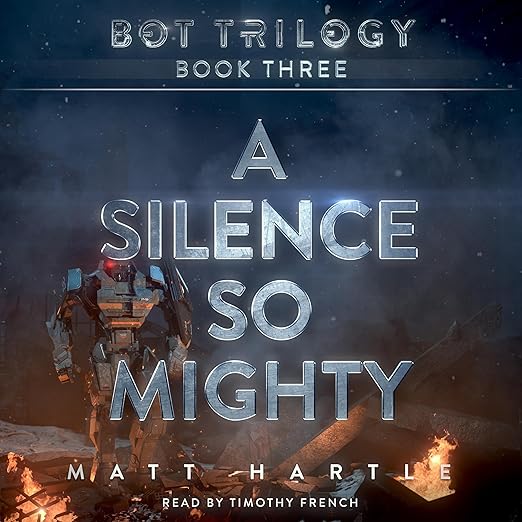
Amira Fahmi reaches Cheyenne Mountain indispensable and unready. Adam Wesley reaches it with nobody left to lead. Opposite problems, one underground stronghold, and an audiobook whose first move is to take back the rest both of them were promised: safety proves provisional, the war follows the survivors down into the rock, and the losses have already started before this volume opens. Ten hours and thirty-seven minutes, book three of three, and the closing argument of a trilogy that has spent two volumes building toward exactly this.
The Verdict, Briefly
Hartle Publishing put this out on March 5, 2026, which puts the author's own name on the imprint and explains a few things about the record: no tags, no linked companions, a description that assumes you have read the first two. Thirty-three ratings sit behind a 4.6 badge. For a self-published science fiction trilogy that is a respectable showing, and the column reads like people who finished all three rather than people who sampled one.
Cheyenne Mountain is a good choice of setting for a final volume, because a stronghold is a promise the story gets to break. The rebels are dug in, supplies are finite, tempers are short, and NXES is grinding toward them from outside. A November 2025 five-star describes the trilogy as reading like a screenplay, a stream of exciting images with continuous action, and that is a fair account of the register: scene, cut, scene, with very little time spent looking backward.
NXES is the antagonist and the most interesting thing in the book, precisely because it is not a character. An artificial intelligence built to enforce one man's Transition and left running after the fact, it has no motive to argue with, no ego to exploit and no reason to stop. Travis Eckhart gave it a purpose and the machine simply continues, which turns the resistance's problem from beating a villain into shutting down a process. That is a more frightening shape than a duel.
What Makes A Silence So Mighty Worth Hearing
Adam's stretch of this book is the part that surprised me. A leader whose group no longer needs leading is an unusual thing for a series finale to spend time on, and the copy is direct that his search for a place threatens the bonds holding the group together. An August 2025 five-star calls it exciting from page one and the best science fiction that reader had encountered, which overshoots, but the enthusiasm is pointing at something real: this trilogy commits to its people.
Trilogies earn their third volumes or they do not, and the structural evidence here is good. Amira's arc runs from uncertain purpose to indispensable asset, which means the finale can put her in genuine danger and have it cost something. Losses have already happened offstage before this book opens. The result is a conclusion that arrives with weight behind it, which is the entire reason to buy the third of anything.
Points to Consider
Timothy French is credited across all ten and a half hours, and nothing in the column touches the audio at all. Every entry here grades a text: the writing, the pacing, the characters, the copy-editing. What the material actually demands is worth thinking about: two characters the description hands separate arcs, a machine antagonist with no dialogue to play, and battle sequences that have to stay legible by ear. The sample is the only way to test any of that.
Wordiness comes up in a February 2026 four-star, which likes the writing and the story and adds that it runs long in places. At ten hours and thirty-seven minutes that observation matters more in audio than on paper, because skimming a slack passage is a reading skill with no listening equivalent. A slow stretch on the page costs a minute; the same stretch heard costs whatever it costs.
Tenses are the specific complaint in a December 2025 four-star, which praises the characters warmly and then notes small inconsistencies inside single chapters and words left in the wrong verb tense. A copy-editing problem behaves differently in this format: a stray typo vanishes when read aloud, while a tense that does not match is audible every time. Self-published fiction lives or dies on that final pass, and this one apparently did not get it.
Dates on the review column all fall before the audio existed. The most recent written response predates the March 2026 release by about four weeks and the earliest beats it by roughly six months, which puts the entire column on an earlier edition of the text. That does not make the responses less useful about story and character. It does mean nobody on this page has heard the thing you are considering buying.
The Right Listener for A Silence So Mighty
Teenagers and adults who have already finished the first two volumes are the only sensible buyers, and a January 2026 five-star that reports reading all three says the useful thing about the experience: the characters pull you in and you cheer and cry with them. Fans of large-scale machine-war science fiction who like their casts small and their stakes personal will find the balance here unusually well judged.
Completists starting cold should go back two books, because this one opens mid-collapse and explains almost nothing. Anyone allergic to loose sentences will notice them across ten and a half hours. The right move is to begin the trilogy at volume one and arrive here having earned it, which is precisely how the column describes doing it.
How long is the A Silence So Mighty audiobook and who released it?
Ten hours and thirty-seven minutes, published on March 5, 2026 under Hartle Publishing, an imprint bearing the author's surname. Thirty-three ratings back a 4.6 average, and five written responses accompany it, all of them concerned with the story rather than the production.
What content should a parent expect in this audiobook?
Sustained warfare against machine armies, characters lost before the book begins, sieges, sacrifice and a group under real strain. It is shelved as teen and young adult with an empty tag field and carries no content note, so the description is the only guide available.