Yorick's Passport Trouble Opens the Journey
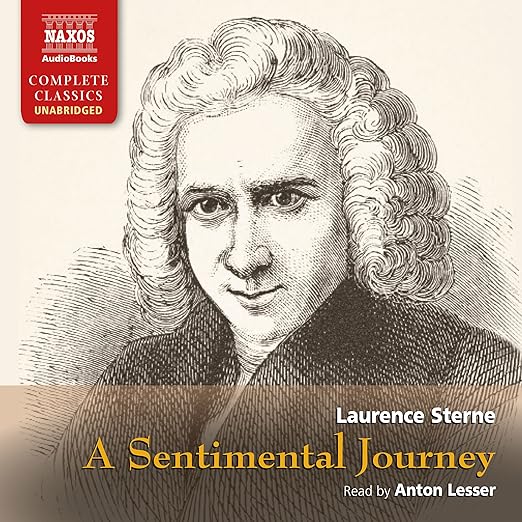
Parson Yorick reaches Calais and immediately gets into trouble over a passport he does not have, and A Sentimental Journey is off and running as an audiobook. Laurence Sterne published this lightly fictionalised account of his own European travels just months before his death in 1768, and the combination of terminal illness and comic genius gives the book a particular quality: the digressions feel genuinely pleasurable rather than self-indulgent because Sterne knows he does not have time to waste on false seriousness. Yorick, the narrator who also appears in Sterne's masterwork Tristram Shandy, travels through France with a cheerful incapacity for staying on topic. The title's promise of sentimentality is kept and also constantly subverted, often in the same paragraph.
Anton Lesser's narration is the critical asset here. Sterne's prose is intricate in ways that can read as impenetrable on the page but reward a skilled reader enormously. Lesser, familiar to many listeners from his work on classical and historical texts, brings exactly the kind of intelligence the material requires: he understands which phrases are meant to be funny, which are meant to be touching, and which are deliberately confounding in ways that serve the comedy. A reviewer who heard this recording described Lesser as 'a voice genius who makes Sterne's challenging prose and unique mind accessible to the bewildered masses,' and that is not an overstatement. The audiobook is, in meaningful ways, easier to absorb than the print version.
One important note for prospective buyers: at least one reviewer reports that this specific edition appears to be abridged in ways that are not clearly labeled, with content missing between disc sections. If you plan to listen while following along with the printed text, check the edition carefully before purchasing. The listening experience as audio alone remains valuable, but completists and scholars should verify the edition's integrity against a full-text version before committing. The abridgement, if confirmed, does not render the listening experience incoherent, but it would explain some of the jarring transitions that the same reviewer noted.
Sterne's achievement in this book is the creation of an entire philosophy of travel out of what are essentially missed connections, misread situations, and comedy of errors. Yorick does not get where he is going, does not accomplish what he sets out to accomplish, and does not understand half of what happens to him. And yet the book is one of the most companionable in the English tradition, because Yorick's failure to navigate the world correctly is accompanied by genuine warmth for the people he encounters along the way.
Anton Lesser Restores Sterne's Spoken Rhythm
Sterne is one of the English language's great comic writers, and A Sentimental Journey is his most immediately accessible work, far more so than Tristram Shandy's labyrinthine architecture. The book covers Yorick's journey from Calais through France, but calling it a travel narrative misrepresents what it actually does. The places Sterne visits are largely incidental. What he is cataloguing is a particular quality of attention: the way a man of feeling responds to the world around him, the small encounters with strangers that accumulate into something like a philosophy of human sympathy.
The audiobook format suits this material because Sterne wrote with a spoken-word rhythm in mind. His sentences have a conversational energy that is sometimes lost in silent reading, where the eye can skip ahead of the voice. Lesser's pacing restores the timing that Sterne built into the prose, including the comic pauses, the mock-portentous build-ups to conclusions that then swerve away from where they seemed to be going. For a first encounter with Sterne, this audio version is a genuinely hospitable entry point into an author who can seem forbidding on the page.
Genuine Feeling and Comedy, Never Resolved
Sterne's comedy is rooted in the 18th-century culture of sensibility, the widespread belief that the capacity for feeling was a moral virtue and that a person's emotional responses to beauty, suffering, and human connection were evidence of their character. Sterne both celebrates this culture and satirizes it, often in the same sentence. When Yorick has a long, tender encounter with a caged starling, the emotion is genuine and the comedy is also genuine. The two coexist without resolving into irony or sincerity alone. Listeners who want clear tonal signals will need to calibrate to the ambiguity that Sterne treats as the only honest position.
The book is very short by modern standards, running just over four hours in this recording. The brevity is not a limitation but a formal achievement. Sterne understood that digression sustains interest only when the underlying momentum is real, and every apparent tangent in A Sentimental Journey is doing work. The ending, which is famously abrupt and deliberately inconclusive, is Sterne making a philosophical point rather than running out of material.
An Easier Front Door Than Tristram Shandy
This audiobook is well suited for listeners with an interest in 18th-century British literature who have found Tristram Shandy's length and complexity daunting. A Sentimental Journey covers similar intellectual territory in a form that is far more immediately approachable. It is also a natural companion to 18th-century travel writing more broadly, and listeners who have enjoyed Boswell's journals or the travel writings of Smollett will find Sterne's approach usefully different: more inward, more comic, less interested in objective description.
For anyone who has never encountered Sterne, this is the place to start. Anton Lesser's performance makes the case that Sterne's prose is pleasurable rather than merely important, and that is the argument that matters most for a new reader. Literary fiction listeners, particularly those who appreciate formal experimentation and comic intelligence, will find this four-hour listen considerably more rewarding than its brief runtime might suggest. Lesser is one of the few narrators who could make this argument convincingly.
Do I need to have read Tristram Shandy before listening to this audiobook?
No. A Sentimental Journey stands completely on its own. Parson Yorick also appears in Tristram Shandy, but no prior knowledge of that novel is needed to follow or enjoy this one.
Is this audiobook abridged?
At least one listener review reports missing content between disc sections, suggesting this edition may be abridged without clear labeling. If you plan to follow along with a printed text, verify the edition against a complete version first. As audio alone, the experience is coherent.
Is this audiobook a good choice for someone new to 18th-century British literature?
Yes, particularly with this narration. A Sentimental Journey is shorter and more playful than most canonical 18th-century novels, and Lesser's performance makes the period language feel natural rather than archaic.