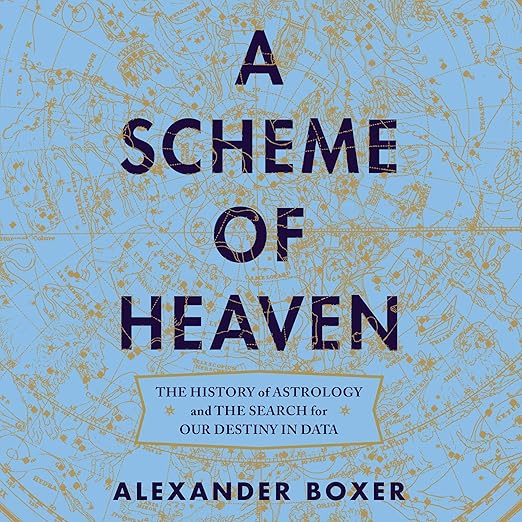
Alexander Boxer opens A Scheme of Heaven - the audiobook narrated by Peter Noble - with a premise that requires the listener to set aside whatever they think astrology is: not a set of personality types derived from birth months, not a mystical system competing with science, but the first sustained human attempt to extract meaningful patterns from numerical data about the natural world. Boxer is a data scientist, and his argument is that astrologers were the original data scientists - people who developed increasingly sophisticated tools to correlate planetary positions with human events, and whose methods prefigure what modern analysts do with spreadsheets and statistical models.
At 9 hours and 38 minutes, this audiobook covers considerable historical ground. Boxer teaches the reader to read horoscopes - not to believe them, but to understand the complex astronomical calculations required to generate one accurately in the ancient world. He uses specific historical horoscopes as case studies, diagramming what the heavens looked like at important moments in astrology's history, and then applies modern statistical methods to those same configurations to test the claims astrologers made about them. The results are, predictably, not supportive of astrological prediction. What Boxer finds instead is more interesting: a record of intelligent people developing rigorous methods to answer an unanswerable question, and the specific ways those methods fail. Noble's narration introduces this program clearly and maintains that clarity across the full runtime.
One reviewer who was thoroughly skeptical of astrology before picking up the book described it as astounding to learn how astrology was essentially a hard science for thousands of years. That transformation - from dismissiveness to genuine respect for the intellectual history, without any change in belief about whether the predictions work - is what Boxer is aiming for, and the audiobook largely achieves it. Noble's narration is central to this success: he reads the material with the tone of someone explaining something genuinely interesting rather than defending a controversial premise, and the effect is disarming.
A second reviewer with significant astrological expertise praised the treatment as rare in the genre of skeptical astrology criticism - specifically that it treats the subject with respect and handles its history well. The critique that reviewer offered, about the quality of the statistical analysis applied to modern data sets, is worth noting: Boxer is more impressive as a historian than as a statistician, and his use of contemporary data to test astrological claims is acknowledged by multiple reviewers as the book's weaker section. Noble's narration presents those arguments with enough clarity that listeners can assess them independently rather than simply accepting or rejecting Boxer's conclusions.
What Makes A Scheme of Heaven Worth Hearing
The book's central analogy - between ancient astrologers and modern data scientists - is not purely rhetorical. Boxer builds it carefully across the audiobook's nine hours, showing how both practices involve selecting which variables to track, deciding what counts as a meaningful correlation, and constructing narratives around the resulting numbers that feel inevitable in retrospect. The critique of modern data science that emerges from this parallel is implicit but sharp: we are still doing what astrologers did, still finding patterns in data sets that may be no more predictive than a horoscope, still building confidence on the authority of methodology rather than the quality of outcomes.
Noble handles the mathematical and astronomical sections without simplifying them into vagueness. Listeners who are not quantitatively trained will find some passages require more attention than others - the sections on the specific geometry of planetary configurations are the most demanding - but the overall argument remains accessible because Boxer has structured it so that the historical narrative carries the book even when the statistical analysis asks more of the listener. The writing has been praised for brevity and epigrammatic clarity, and Noble's measured pacing through the more compressed passages allows the ideas to register before the book moves on.
Things to Know Before Starting A Scheme of Heaven
The book's relationship to its subject is genuinely unusual. Boxer is neither a believer nor a simple debunker - he is something closer to an archaeologist of a discarded science, interested in recovering the logic of a system that was coherent in its own terms before being disqualified by subsequent developments in astronomy, physics, and statistics. That archaeological stance means the book is more valuable as history and intellectual critique than as either a defense or an attack on contemporary astrology. Listeners expecting a final verdict on whether astrology works will find the book more interested in how it worked for the people who practiced it, and in what that history reveals about how all pattern-matching systems - ancient and modern - generate confidence that their outputs reflect reality rather than their own assumptions.
The 9-hour runtime reflects genuine content density rather than expanded anecdote. Boxer does not pad. The historical case studies accumulate toward the data science critique rather than serving as entertainment breaks between arguments. Noble's pacing honors this structure - he does not speed through the historical material to get to the analysis, treating each case study as the evidence it is meant to be.
Who Alexander Boxer Is Writing For
This audiobook works for listeners interested in the history of science and the philosophy of knowledge - particularly those curious about how intellectual systems that we now dismiss as superstition were understood by the sophisticated, mathematically literate people who practiced them. Data science professionals and statisticians will find the parallel Boxer draws both flattering and worth interrogating. Astrology believers will find a respectful treatment that does not confirm the predictive claims of the system. Skeptics will find a history that complicates easy dismissal. Noble's narration makes the 9-hour investment accessible, and the intellectual payoff is proportionate.
In Brief
- Performance: Peter Noble brings a measured, scholarly presence to Alexander Boxer's history-meets-data-science argument - his voice suits the book's combination of historical depth and analytical precision.
- What it covers: Pattern recognition and its pitfalls, the history of science and pseudoscience, data interpretation across centuries
- Feel: Intellectually generous and surprising
- Our call: Boxer's approach to astrology as a data science problem rather than a belief system is one of the more original intellectual frames in recent popular history - and Noble's narration makes the statistical sections considerably less daunting than they might otherwise be.
Questions Listeners Ask
Does this audiobook try to convince listeners that astrology has predictive validity?
No - Boxer's position is that astrology is pseudoscience as currently practiced, but his historical argument is that it was a sophisticated and coherent system of data analysis for thousands of years before modern astronomy and statistics disqualified its core claims. The book aims at understanding, not belief.
How does Peter Noble's narration handle the technical and mathematical passages in this audiobook?
Noble maintains clarity without over-explaining. He reads the technical material as continuous exposition rather than separating it into a different register, which keeps the book's argument unified and prevents the astronomical sections from feeling like interruptions to the main narrative.