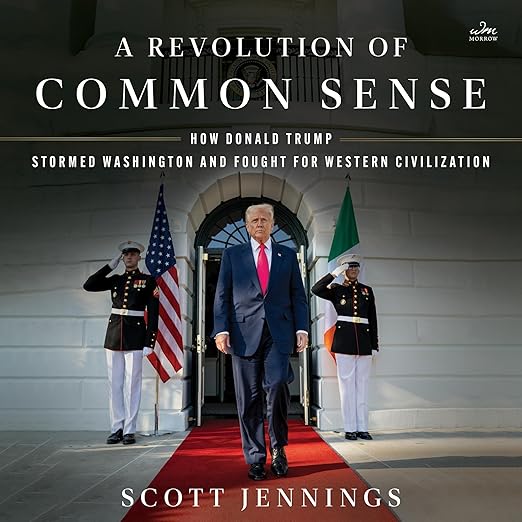
Before You Press Play
- Voice: Scott Jennings reading his own work gives the audiobook the immediacy of a journalist speaking directly to his audience, confident, opinionated, and unambiguous about where he stands.
- Big ideas: Trump's second term, institutional disruption, Republican political strategy
- Atmosphere: Partisan and propulsive
- Worth it?: A New York Times bestseller that functions as an insider's political chronicle of Trump's return to power, best suited to listeners who share Jennings's sympathetic perspective on that project.
Political audiobooks narrated by their authors carry a particular energy, and A Revolution of Common Sense demonstrates exactly why. When Scott Jennings reads this book, you are not getting a neutral recitation of events. You are getting the voice of someone who has spent his career in Republican politics and who, from his perch as a CNN commentator, genuinely believes he is watching a historic moment unfold. That conviction is audible on every page. Whether it translates to compelling listening depends substantially on where you stand politically, but as a production this audiobook is unquestionably more alive than it would be with a professional narrator who did not live this story from the inside.
The book arrives with a foreword from Donald Trump himself, who describes Jennings as someone who totally gets it and positions the book as a correction to what he calls Fake News accounts of his administration. That framing is revealing: this is not a book written for undecided readers. It is a book written by a true believer for true believers, and Jennings does not pretend otherwise. His access to the principals, including Secretary of State Marco Rubio, Treasury Secretary Scott Bessent, Defense Secretary Pete Hegseth, Elon Musk, and campaign manager Chris LaCivita, gives the text specific scenes and details that distinguish it from mere punditry. He is reporting as much as he is opining, which creates a hybrid form that is more interesting than pure advocacy.
Jennings Talks to You With His Own Words
Jennings opens with Thomas Paine, invoking Common Sense as both precedent and aspiration. Paine wrote that a long habit of not thinking a thing wrong gives it a superficial appearance of being right, and Jennings applies this to Washington dysfunction, bureaucratic bloat, and what he frames as elite consensus that had calcified into unquestioned assumption. Whether you find this framing resonant or overwrought, it organizes the audiobook around a single coherent argument rather than a sequence of disconnected political episodes, and that structure gives the listening experience more momentum than most political chronicles manage to sustain.
The scenes from the Oval Office and Air Force One are the audiobook's strongest material. Behind-the-curtain moments with the key players of Trump's second term are documented with the specificity of someone who was actually in the room, or close enough to reconstruct conversations with genuine authority. Reviewer Big Daddy Joe captured this quality: Scott is a very good writer that talks to you with his words. That observation cuts to the heart of what makes the self-narrated version particularly effective. Jennings has a conversational authority that pulls you through even the sections where his political analysis feels more partisan than analytical, because the delivery is consistently that of someone who has thought carefully about what he wants to say.
A Reader Removed From Mainland Politics Found It Illuminating
The nine-and-a-half-hour runtime is proportionate to the scope. Jennings covers the full arc of Trump's return, from the campaign through the early executive actions, the media battles, and the policy agenda, without padding the narrative or retreating into abstraction. He moves between reportage and commentary with the ease of someone who has spent years doing both simultaneously on television. Reviewer Michael Tymn, describing himself as removed from mainland American politics, found the audiobook illuminating as a way of getting perspective on a genuinely disorienting political period. That reaction from a listener who came without strong prior investment in the Trump project is telling: the access and specificity make the audiobook more useful than the partisan framing alone would suggest.
The audiobook is framed explicitly as a tribute to Trump's second-term mission, which Jennings describes as a revolt against elite dogmas and a restoration of sanity in public life. Reviewer Young Middle Class Guy described it as a factually rich chronicle worth keeping for future generations, which reflects the historical documentation impulse the book activates in its core audience alongside its immediate political appeal.
A Deliberate Choice to Skip the Harms
The book does not engage seriously with critics of the second Trump term or with arguments that the revolution Jennings celebrates has generated genuine harms alongside its disruptions. That is a deliberate authorial choice rather than an oversight. Jennings is writing a sympathetic chronicle, and he is transparent about that stance throughout. But listeners who want a complete accounting of Trump's second term will need supplementary sources to fill in the perspectives this audiobook deliberately omits.
The New York Times Bestseller status tells you something about the book's reach across the American political landscape. The Trump foreword tells you something about the book's posture and its intended relationship with its audience. Both pieces of context are useful for calibrating expectations before you invest nine and a half hours in the listening experience.
Advocacy Journalism From a Committed Participant
Republican voters and Trump supporters who want an insider's account of the second term, complete with behind-the-scenes access to the key figures shaping the administration's agenda, will find this audiobook exactly what it promises. Political observers curious about Jennings's access and what his proximity to the Trump circle reveals about how decisions were made and communicated will also find value here. Listeners hoping for balanced political analysis or for a critical examination of the second term from multiple perspectives should look elsewhere. This audiobook is advocacy journalism from a committed participant, not a dispassionate political history.
Does Scott Jennings narrate A Revolution of Common Sense himself, and does that affect the listening experience?
Yes, Jennings reads his own work, and it meaningfully improves the audiobook. His background as a commentator who speaks confidently in public settings translates well to narration. The delivery is authoritative and engaged rather than performed, which suits the chronicle style of the book.
Is A Revolution of Common Sense an audiobook that requires sympathy with Trump and Republican politics to find valuable?
Largely yes. Jennings writes as an enthusiastic participant in and advocate for the Trump political project, and the book's framing, sourcing, and editorial judgments all reflect that alignment. Readers from across the political spectrum can engage with it as a document of a particular perspective, but they should know that critical distance is not part of the text.
What distinguishes this audiobook from other books about Trump's second term in terms of the access Jennings had?
Jennings had access to key members of the Trump inner circle, including Marco Rubio, Scott Bessent, Pete Hegseth, Elon Musk, and campaign manager Chris LaCivita. He includes behind-the-scenes scenes from the Oval Office and Air Force One that go beyond what a commentator without direct access could reconstruct.
At nine and a half hours, does A Revolution of Common Sense cover the full arc of Trump's second term, or is it focused on a particular period?
The audiobook covers the full return to power, from the campaign through early executive actions and the broader policy agenda of the second term. Jennings is writing a chronicle of a political movement rather than a narrow policy analysis, so the scope is deliberately broad.