Key Details
- Narrator: Williamson narrates her own work, and the intimacy of her voice is central to the experience; this is a book that sounds like a conversation rather than a lecture.
- Subjects: love as a spiritual practice, fear versus love as organizing principles, A Course in Miracles applied to daily life
- Tone: Warm and deliberate, like sitting with someone who has thought carefully about how to live
- Bottom line: If you are open to its spiritual framework, this is one of the more practically grounded self-help audiobooks of the past thirty years; if you are not, the ACIM references will be a significant barrier.
I came to A Return to Love during a period when I was reading widely in the self-help and spirituality space, trying to understand what distinguished the books that actually changed people from the ones that simply felt like they had. What struck me about Marianne Williamson's work, reading it for the first time, is how seriously she takes the practical question. She is not interested in giving you feelings. She is interested in giving you a framework for making decisions.
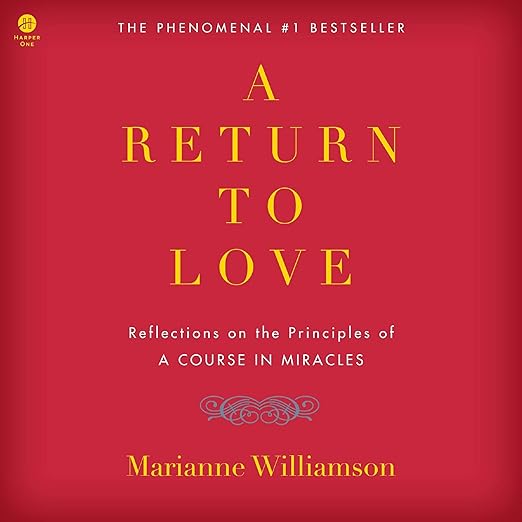
Published originally in 1992 and updated by the author, A Return to Love is Williamson's extended meditation on A Course in Miracles, a channeled text from the 1970s that has generated its own substantial following. You do not need to know ACIM going in, but understanding that the book is grounded in a specific spiritual tradition helps contextualize Williamson's language. The central organizing principle is simple: fear and love are the two fundamental orientations available to us, and most suffering comes from choosing fear. Love, in her framework, is not primarily an emotion but a practice, a decision made repeatedly in relationships, in work, in the way we speak to ourselves.
What Williamson does in this book that most ACIM-adjacent writing does not is stay resolutely practical. She applies the framework to specific domains: romantic relationships, career, health, the experience of loss. One reviewer described the book as a toolbox, noting that you do not necessarily need every tool in every section but the organization allows you to return to specific chapters when particular areas of life need attention. That structural quality holds up across re-readings. Multiple reviewers note returning to the book during difficult periods: one described reading it first while giving up alcohol, where it helped with self-compassion, and later rereading it when she needed to extend that compassion outward to others.
Williamson writes with a distinctly personal voice, one that acknowledges her own failures and confusions alongside her insights. A reader who described her ideas as like velvet captured something real about the prose quality: it is smooth without being empty, assured without being arrogant.
What Works
At two hours and forty minutes, this is among the shorter audiobooks in the spirituality and self-help space, which suits the material well. Williamson narrating her own work is not an afterthought: her voice carries a warmth and a cadence that fit the conversational texture of the writing. The book sounds like someone explaining something they believe deeply but without evangelical pressure. The absence of that pressure is part of why readers with secular orientations or different religious backgrounds report finding it accessible despite its explicitly spiritual content.
Weak Spots in A Return to Love
Listeners who approach this book expecting a secular psychology text will find the ACIM references significant. Williamson does not hide her spiritual frame, and for readers who find channeled texts or explicitly Christian-adjacent language off-putting, that context will be present throughout. The book also reflects its original early-1990s cultural moment in a few places, though the updated edition has addressed some of the more dated framing. The core argument, that love is a discipline rather than a feeling, translates across cultural and historical contexts in ways that much self-help writing does not.
Who It's For
Listeners who are spiritually open but not necessarily committed to any particular tradition will find this accessible and often practical. People navigating major life transitions, whether in relationships, career, or health, will find specific chapters directly relevant. Those who are firmly secular or hostile to spiritual framing will likely find the ACIM grounding a persistent obstacle. Readers who have already encountered Williamson's podcast appearances or political interviews and respond to her voice will find the audiobook format particularly satisfying, since her narration is essentially the extended version of how she speaks in conversation.
Do you need to have read A Course in Miracles to understand A Return to Love?
No. Williamson introduces the relevant ACIM concepts as she goes and the book functions as a standalone guide. Prior familiarity with ACIM deepens the reading but is not required.
How does Williamson handle the religious dimension for listeners who are not Christian?
Several reviewers who do not identify with Christianity or who follow other traditions report finding the book accessible regardless. Williamson uses language from A Course in Miracles, which draws on Christian vocabulary but applies it in a non-denominational context. The book is explicitly spiritual but not sectarian.
Is A Return to Love appropriate for someone recovering from addiction or mental health challenges?
Multiple reviewers describe finding the book meaningful during recovery from alcohol or during periods of mental health difficulty. It is not a clinical resource, but its focus on self-compassion and reframing fear-based thinking has clear therapeutic resonance for some readers.