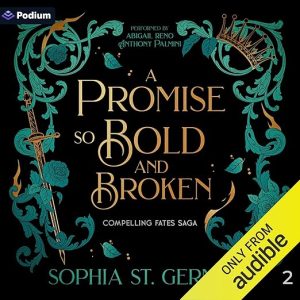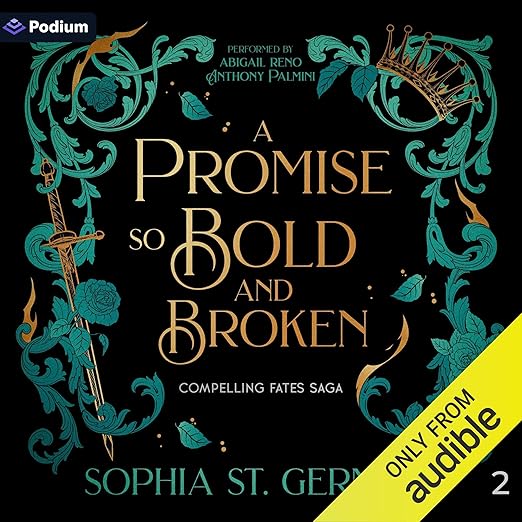
I went into A Promise So Bold and Broken already invested in Elessia from the first Compelling Fates Saga book, which is the only context in which I would recommend approaching it, this is emphatically not a starting point for new readers. The sequel picks up with the immediacy of someone who has not checked whether you are ready. Elessia is on the run, carrying guilt she cannot quite name, and within the first chapters she is already processing the fallout of choices that end of Book 1 set in motion. Sophia St. Germain writes the sequel's opening with real narrative confidence: there is no recap scaffolding here, no courtesy summary of what you might have missed. This is written for readers who remember exactly where they left off.
That confidence is both the book's greatest virtue and its most significant practical limitation. For listeners who have held the first book in their memory, it is a genuine pleasure, the emotional continuity feels earned and the stakes feel real because the world has been built to support them. For anyone coming in cold, it will be impenetrable, and the reviews suggesting it delivers everything the first book promised only make sense in that context.
A Closer Look at A Promise So Bold and Broken
The book's central emotional architecture is a triangle that the author handles with unusual specificity. Elessia's guilt over Loche, a man she describes as someone she foolishly believed could mend her broken soul, is not simply jealousy or complication. It is the more difficult thing: genuine complicity in a betrayal she had reasons for and cannot stop reliving. That texture prevents the Loche thread from becoming a narrative obstacle between reader and the Merrick romance, which is the inevitable destination. Reviewers are unanimously fond of Merrick, and the praise for him as the kind of dark, brooding, deeply heroic character who earns his moment makes complete sense once he is on the page. St. Germain does not rush the payoff. The loyalty thread, what it means to trust someone when every institution around you has proved unreliable, runs underneath the romance and gives it actual weight.
What Makes A Promise So Bold and Broken Worth Hearing
Abigail Reno's narration is a significant asset. The performance manages something technically demanding: Elessia is processing two emotional states simultaneously throughout most of the book, the weight of her past choices and the pull of something new, and Reno keeps those registers distinct without making the performance feel calculated. The secondary ensemble is also well-served. The banter among Merrick's band of unwilling warriors, praised in multiple reviews for genuine humor, lands in the audio format in a way that benefits from Reno's timing. The broader world of Havlands, with its warring factions, Fae politics, and looming existential threat, requires a narrative voice that can carry both exposition and emotional subtext without sounding like it is doing both at once, and Reno largely manages it.
Things to Know Before Starting A Promise So Bold and Broken
Second books in fantasy romance series carry a particular structural pressure: they need to advance the world's threat stakes while also deepening the personal story, and they need to do both without the benefit of the first book's discovery energy. St. Germain handles the world-building escalation more confidently than the threat itself, the looming peril that could shatter the foundations of Havlands is present throughout but feels somewhat abstract relative to the intimate emotional stakes of Elessia's immediate situation. Listeners who came primarily for the romance will find this a satisfying listen. Those who came primarily for the fantasy world's political complexity may find the large threat somewhat underserved relative to its apparent importance. The mature content is present throughout, the content warnings on St. Germain's website are worth consulting beforehand.
Who Sophia St. Germain Is Writing For
Listeners who completed The Compelling Fates Saga Book 1 and found themselves invested in Elessia, Merrick, and the political world of Havlands. This is not for new readers, and it is not for readers who prefer their fantasy without explicit romantic content. For its intended audience, returning fans of the series, it delivers genuine forward momentum and a Merrick arc that the early reviews suggest was entirely worth the wait.