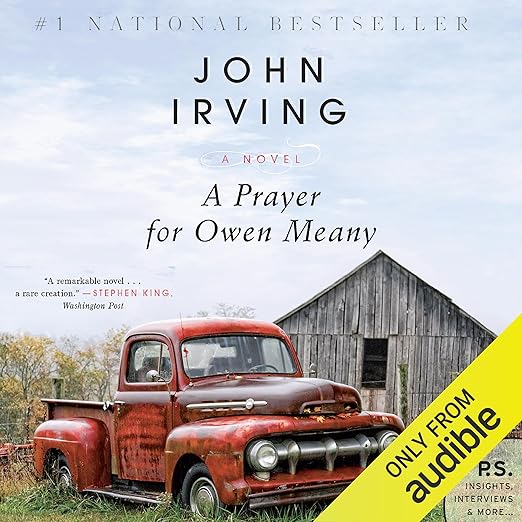
I spent two weeks with A Prayer for Owen Meany during a period when I was traveling, which meant I experienced large sections of it in airports, on planes, and in hotel rooms in various states of alertness. That turned out to be exactly right for a book about memory and the way certain events color everything that comes after them. John Irving's narrator John Wheelwright is looking backward across decades, and that retrospective quality, the knowledge that you are hearing a story from someone who already knows how it ends, settles into you differently when you are already displaced from your ordinary context.
Joe Barrett's performance is the first thing worth discussing, because Irving made an unusual choice in selecting him and the rationale explains something important about the novel. In print, Owen Meany's dialogue appears in capital letters, his voice is presented as a typographical fact, a thing that exists differently on the page than anything around it. In audio, that visual distinction has to become acoustic, and Barrett delivers Owen's high, strange, seemingly damaged voice with a consistency that is remarkable across twenty-seven hours. It never becomes comic, which it easily could. It remains exactly as unsettling and as beloved as the text requires.
What John Irving Delivers
Irving's novel is about a boy who believes he is God's instrument, and about the friend who watches that belief shape everything, including events that seem to confirm it. The foul ball that kills John's mother in the summer of 1953 is the book's central trauma, the event from which everything else radiates, including Owen's certainty that his life has a specific purpose. What Irving does with that certainty, how he tests it against the randomness and violence of American history in the 1960s, is the novel's real argument.
One reviewer quoted the opening sentence: "I am doomed to remember a boy with a wrecked voice." That sentence does what great opening sentences do, it tells you the emotional key of the entire book in a single line. The novel is an act of remembrance, and it asks what it means to carry someone with you across a lifetime, especially someone whose presence was always, even while living, slightly outside the ordinary.
What John Irving Gets Right
The Earphones Award from AudioFile Magazine is not given frivolously, and this production earned it. Beyond Barrett's performance as Owen, the narration handles Irving's particular blend of the comic and the devastating without losing tonal footing. The New Hampshire setting, the boarding school milieu, the Christmas pageant that functions as a recurring set piece, these elements require a voice that can carry comedy without sacrificing gravity, and Barrett manages it consistently.
The bonus interview with Jim Atlas, which Audible includes at the end of the production, is a genuine addition rather than filler. Irving is an engaging speaker about his own work, and the interview adds context without over-explaining the novel's meanings.
Where John Irving Loses Some Ground
The novel operates on two timelines, the central narrative of John and Owen's friendship in the 1950s and 60s, and John's present-day perspective as an adult living in Canada, looking back. The present-day sections include his disillusionment with American politics, particularly around the Vietnam War era, which Irving uses to frame the retrospective. Pay attention to how these sections shift in tone relative to the past, there is a bitterness in the present-day narrator that is absent from the boy remembering his friend.
Irving also embeds the Christmas pageant sequences as a kind of comic counterweight to the heavier material. These sections play beautifully in audio because the timing of the physical comedy is built into the prose itself.
Who Should Pick Up A Prayer for Owen Meany
Listeners who have read Irving's other work, The World According to Garp, The Cider House Rules, will find this a natural and rewarding companion. Those new to Irving could start here without prior knowledge; the novel is self-contained. Given the twenty-seven-hour runtime, patience is necessary, but the investment returns compound interest. Listeners who want a short, plot-driven listen should look elsewhere. Those willing to spend weeks with a novel's ideas, characters, and voice will find this one of the richest audio experiences available.
The Short Version
- Voice: Joe Barrett was personally selected by Irving to deliver Owen Meany's distinctive voice, and the result is a performance that earns the Earphones Award the production received.
- Big ideas: Faith and predestination, friendship and grief, the Vietnam War era's effect on American moral life
- Atmosphere: Rich and deeply funny, with a sorrow that accumulates across the full twenty-seven hours
- Worth it?: The rare audiobook where the narration is so precisely calibrated to the text that listening becomes the preferred way to encounter this novel.